Showing posts with label toys. Show all posts

Monday, 10 January 2022

MICROGORIA 106 - The Terror of Tank Command


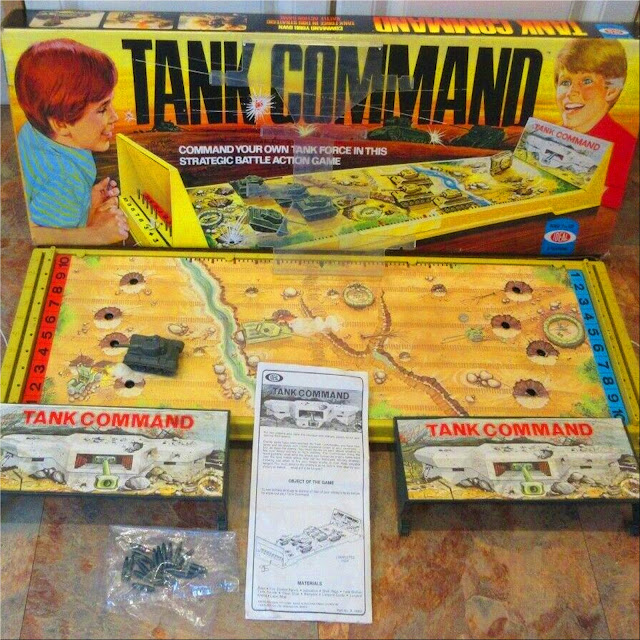
In an unscheduled excursion down the dodgier end of Memory Lane, we pay a visit to the 'Orrible 'Ouse of Terrible Old Tat and unearth one of the most disappointing board games of the 1970s - the infamous Tank Command from Ideal!

DIRECT DOWNLOAD MICROGORIA 106 - The Terror of Tank Command

 
Find all the podcasts in the HYPNOGORIA family here -

HYPNOGORIA HOME DOMAIN - Full archive, RSS feed and other useful links


HYPNOGORIA on TUNE IN

HYPNOGORIA ON GOOGLE PLAY PODCASTS


Sunday, 20 June 2021

MICROGORA 096 - To The Cursed Earth


We continue to trace the various science fiction vehicles inspired by Roger Zelazny's Damnation Alley.  We learn how both Zelazny's story and the Adventure 2000 toys turned up in a classic Judge Dredd tale in 2000 AD, plus look at some futuristic toys from the same ear - the Xploratrons from Corgi - who also had connections to the galaxy's greatest comic too! 

DIRECT DOWNLOAD MICROGORA 096 - To The Cursed Earth


Find all the podcasts in the HYPNOGORIA family here -

HYPNOGORIA HOME DOMAIN - Full archive, RSS feed and other useful links


HYPNOGORIA on TUNE IN

HYPNOGORIA ON GOOGLE PLAY PODCASTS


Sunday, 13 June 2021

MICROGORIA - From Damnation Alley...


In the first of a two part trip to the 'Orrible 'Ouse of Terrible Old Tat we trace a strange family tree spawned by Hell Tanner's ride in Roger Zelazny's Damnation Alley, and see how the movie version's Land Master influenced a successful line of sci-fi toy vehicles from Matchbox - the Adventure 2000 range. 

DIRECT DOWNLOAD - MICROGORIA 095 - From Damnation Alley...


Find all the podcasts in the HYPNOGORIA family here -

HYPNOGORIA HOME DOMAIN - Full archive, RSS feed and other useful links


HYPNOGORIA on TUNE IN

HYPNOGORIA ON GOOGLE PLAY PODCASTS


Sunday, 21 February 2021

HYPNOGORIA 170 - Tardis Tuners & Zone Boxes


In this episode we pay a visit to the 'Orrible 'Ouse of Terrible Old Tat to investigate some very rare and rather weird items of science fiction merchandise! First we ask what exactly was a TARDIS Tuner? And why had it never actually appeared in Doctor Who? Then we investigate the  Zone Box, a piece of tie-in tat for The Twilight Zone that is as bizarre as it is obscure! 


Find all the podcasts in the HYPNOGORIA family here -

HYPNOGORIA HOME DOMAIN - Full archive, RSS feed and other useful links


HYPNOGORIA on TUNE IN

HYPNOGORIA ON GOOGLE PLAY PODCASTS


Sunday, 28 June 2020

MICROGORIA 77 - Which Witch is Haunting Ghost Castle


In this podcast we take a trip down the more disreputable end of Memory Lane, to the ramshackle edifice that lurks just behind the Great Library of Dreams... The 'Orrible 'Ouse of Terrible Old Tat! Inside we uncover the twisted history of a classic board game featuring ghosts, ghouls and witches, known variously over the years as Which Witch, Haunted House and Ghost Castle.


Find all the podcasts in the HYPNOGORIA family here -

HYPNOGORIA HOME DOMAIN - Full archive, RSS feed and other useful links


HYPNOGORIA on TUNE IN

HYPNOGORIA ON GOOGLE PLAY PODCASTS


Wednesday, 20 February 2019

THE 'ORRIBLE 'OUSE OF TERRIBLE OLD TAT - Who Trumped?


Welcome back dear fiends to the 'Orrible 'Ouse of Terrible Old Tat! A few weeks ago we were rummaging in the games cupboard and unearthed a fondly remembered deck of cards that was essentially a set of Marvel superhero Top Trumps. They were made by the toy company Jotastar, who held a great many licenses to produce spin-off and tie-in tat for a variety of kid-friendly franchises and properties. However this Marvel card game was not their only foray in the twilight world of exactly-like-Top-Trumps-except-in-name-only card games. For in 1978 they produced another suspiciously Trump-like card game but tied to another legendary fictional universe - Doctor Who.

Back in 1978, Doctor Who was enjoying one of its many golden ages, for this was the era of the Fourth Doctor. And not only was Tom Baker's incarnation of the Time Lord that delighting the kids with his own brand of anarchy, humour and jelly babies. He was teamed up with popular companion (and in particular very popular with the Dads watching), Leela, she of the handy dagger and tribal garb, plus at that time was just coming to the end of a run of particularly scarifying stories, which had greatly expanded the Who canon of iconic monsters and villains. 

Now the card game produced by Jotastar was assembled by using pretty much the same template as their Marvel game, with the same rules being were used with minor tweaks here and there. Aside from the rules text being rewritten to include references to the long running  SF show, there was a slight change to the stats on the cards - while we still had the attributes Special Powers and Weapons, just like the Marvel deck, instead of Physical Strength we now had Mental Ability - a fitting change as the Doctor tends to outthink his enemies rather than throw buses at them.


Just like the Marvel game, you could divide the pack into to halves and play the good guys vs the baddies. However it is here that this game goes a little weird. For over the years the Doctor has had a long line of companions and assistants, plus he has met a host of good characters who have helped him out, such as the Brigadier, assorted Time Lords, Thals, and so forth. However somewhat weirdly, in the Heroes list the only familiar faces we have are the Doctor himself (obviously) and the TARDIS.  And instead of other characters from the show's history, we have the following - 

HEROES
Alexander the Great
Annie Oakley
Boadicea
Chaka King of the Zulus
Colonel James Bowie
Davy Crockett
Doctor Who
Geronimo
Hercules
King Arthur
Lord Nelson
Parthian Warrior
Robin Hood
Samson
Sherlock Holmes
Shiao Chi Samurai Warrior
Spartacus
The TARDIS
Thor
Wyatt Earp

Yes for some reason it was decided that famous historical characters should be the good guys. The rules refer to this disparate group as "the Legendary Legion". Now firstly it is only right and proper to question why we have mythological characters (such as Thor) and fictional folks (Sherlock Holmes) rubbing shoulders with actual historical personages. But to kids back in the 1970s the more important question was "Why the hell are this lot in here? They were never in the show!". Well alright, Wyatt Earp had appeared in an First Doctor Story The Gunslingers, back when the show still did purely historical stories without any alien monsters in. But even so, that was back in 1966, well before most of the target audience would have been able to remember, or even been born. So then, here was a Doctor Who game in which nearly the half the cards had bugger all to do with Doctor Who.


On the whole, looking at the selection of characters in the deck, I rather suspect the deck was devised by someone who had never seen the show properly - which would explain the good guys being pulled from history books. And as for the Aliens selection, it looks like they just went through the seminal Target tie-in tome The Doctor Who Monster Book which was first published back in November 1975 (and you can read about it here). And hence, there are no monsters more recent that Tom Baker's first season (Davros and the Zygons). However while it was suspicious there were no newer monsters and villains, in all fairness  it is a rather good list of famous foes! 

ALIENS
Davros
Gellguards
Omega
Sea Devils
The Autons
The Axons
The Cybermen
The Daemons
The Draconians
The Giant Robot
The Ice Warriors
The Mechanoids
The Ogrons
The Sensorites
The Silurians
The Sontarans
The Spiders of Metebelis
The Wirrn
The Yeti
The Zygons

However there is an obvious anomaly - for although we do have their creator, Davros, their hired muscle, the Ogrons, and two races they fought bloody and bitter wars with, the Mechanoids and the Draconians, the Doctor's most famous enemies, the Daleks do not appear,  Possibly this was down to the fact that Terry Nation, who originally created the intergalactic terrors, still owned the copyright to the Daleks, and indeed around this time he was considering various plans featuring the pepperpots from Skaro such as having them appear in Blake's 7 and developing a separate Dalek series.

However judging from some of the attributes given on the cards, it is equally plausible that the Daleks being missing was just a blunder. For it seems clear that not only had whoever devised the set never seen Doctor Who, they were also wildly oblivious to both history and even what was on the cards. For example, Boadicea has a Weapons score of 0 despite being shown waving a dirty great sword and riding in her famous chariot with spiky wheels!


Sadly also the artwork on the cards isn't quite as good as the Marvel pack. Some cards do like rather nice, and it's fun to see familiar faces for Whoniverse rendered in a pseudo comic-book style. On teh downside though, many are clearly copied from very familiar photos (hello again Target's Doctor Who Monster Book) and some look distinctly wobbly. Also as many of photos used as reference were in black and white (spookily enough just as they all were in Target's Doctor Who Monster Book), you can see where the artist has just been guessing what was in the dark, smudgy areas. The Ogron is a great example of this, with clear guesswork filling in many areas of shadowed detail, and the whole picture looking like a ripply funfair mirror reflection. See also the background face on the Spiders from Metebelis card, whose features have been clearly surmised from a blurry photo.

On the whole then, while it seemed like a brilliant concept, sadly this Doctor Who Trump Card Game didn't deliver on its promise. Nor did it live up to its Marvel cousin - while that card game had felt authentic and official, to the extent it was like a little loose leaf encyclopedia or guidebook for the Marvel Universe, the flawed execution of the Doctor Who game clearly marked it out as cash-in tat. Much like the Doctor Who Annuals of the same era (more on which another day) or the previously discussed TARDIS TUNER, while we were happy to have them - there wasn't a lot of merch about back then remember -  at the same time you knew they weren't exactly right; they weren't proper Doctor Who like the Target Books or the Palitoy Talking Dalek. In fact in many ways they were a pale shadow of Doctor Who cards given away free with Weetabix around the time which featured not only better art but an innate understanding of the series (and again, more on those another day)

However despite all that, the set now goes for a hefty price, with many sellers flogging off individual cards for a couple of quid a go. And while my inner collecting geek naturally baulks at breaking up sets and selling off cards one by one in this manner, at the same time I can understand why you might really want, for example, the Sea Devil or Mechanoid cards but be more than happy to pass on the wobbly Ogron... 


If you want to see the set without paying an arm or a leg you can download a copy here - DISCLAIMER - I have no idea about the legality of this

Wednesday, 23 January 2019

THE 'ORRIBLE 'OUSE OF TERRIBLE OLD TAT - Top Marvels! Part II


Last week we learned how in the mid '70s, there were two hot crazes gripping the playgrounds of the UK - Top Trumps cards and Marvel comics. And it was perhaps inevitable that these two titans would not only meet, but be fused together by colossal cosmic forces in a Stan Lee style plot twist!  Well, that was almost the case... For back then Top Trumps were still mainly concentrating on vehicles and military hardware and it would be several years before the brand began to produce packs that were tie-ins to fictional properties such as movies, TV shows or comics. Clearly they were missing a trick here, but in the shadows, other eyes were looking to seal a canny and timely toy licensing deal. 

Those eyes, presumably glowing with the uncanny light of comic-book radiation, or at least the prospect of big money to be made, belonged to Jotastar, a toy maker who would produce a great many tie-in toys for a variety of different kid-friendly properties, from the Mister Men and Hollie Hobby to The Real Ghostbusters and M.A.S.K. Now when it comes to games, rules mechanics are very hard to copyright, mainly because so many share commons ones i.e. roll a die and move that number of spaces, or play a card on your turn etc. Now in the case of Top Trumps, things were even murkier, as that game itself had evolved from earlier card games such as Quartets. Hence you could, quite legitimately produce a game with identical rules, and provided the magic words "Top Trumps" never appeared in the instructions, packaging or marketing there was very little to stop you.

Now while cars and motorbikes undoubtedly had an appeal for kids, Jotastar couldn't help but notice that superhero comics were greatly outselling motoring magazines down the newsagents. And so, in 1977, the Marvel Superheroes Card Game was launched, and news soon spread that there was now a marvel Top Trumps. Of course, that last two words in that sentence very carefully did not appear anywhere in the rulesor marketing, but kids everywhere instantly knew who to play this game - indeed the rules included could have been written in ancient runes of Latvaria and the game would still have sold shed-loads.


The pack itself consisted of forty cards, two a card detailing the rules and another listing all the character in the deck. The pack was divided into two halves, twenty heroes, and twenty villains -  

SUPER-HEROES
Black Bolt
Captain America
Captain Britain
Daredevil
Ghost Rider
Goliath

Invisible Girl
Iron Man

Mr Fantastic
Spider-Man

The Black Panther
The Hulk
The Human Torch
The Mighty Thor
The Silver Surfer
The Sub-Mariner
The Thing
The Vision

The Wasp

VILLAINS
Absorbing Man
Dr Doom
Dr Octopus
Dr Strange
Galactus
Hammerhead
Loki
Mephisto
Morbius
Tarantula
The Abomination
The Dread Dormammu
The Green Goblin
The Gremlin
The Grizzly
The Human Top
The Jackal
The Red Skull
The Rhino
The Vulture
Tiger Shark


The rules of the game suggest dividing the pack into heroes and villains and for two players to have at it. An alternative is also suggested under the banner of GAME TWO - basically a brief couple of lines saying just shuffle the pack and divide it among the players and use the rules for GAME ONE.
However of course many kids came up with their own variant, such as pitting a small team of heroes, like for example all the Fantastic Four and seeing how they fared against an army of villains, or if they could take down their fellow heroes.

Indeed using the stats given on these cards - Physical Strength, Special Powers and Weapons - many a geek argument was settled. And fact-fans, in case you wondering how Civil War would play out in this deck, well it was no contest really - with Iron Man out-gunning Cap in all categories: Physical Strength - 8 vs 7, Special Powers - 5 vs 3, and Weapons 6 vs 5. Yep, Shell-Head wins every time! Now you may argue that these stats were just pulled from the air by some desk jockey at Jotastar, but these cards were OFFICIAL Marvel merch right? They even advertised in the pages of Marvel's flagship comics in the UK, The Mighty World of Marvel as seen below (which even cheekily included the word "Trump" just to ensure everyone knew what they were getting). And what's more you could even send off from a pack from the advert too in case your local toy emporium didn't stock it. 


And hence as they were not only advertised but sold in the pages of Marvel UK comics, this game felt like pretty definitive. Indeed even the rules sound like Stan the Man himself, complete with unnecessary capitals - "a game for challenge for two players in which those Mighty Marvel Super Heroes battle the most awesome array of Vicious Villains ever assembled!". Of course now we may question the actual selection of characters - Grizzly and the Gremlin but no X-persons - but it is a fascinating snapshot of the Marvel Universe as it was back then, an era before the likes of Wolverine, the Punisher and Venom became mega-favourites with the fans.

Back in the 1970s however, in an age before Wikipedia, and lavish coffee-table books on comics lore and history, this card game was more than just a fun pastime - it was a secret encyclopaedia of the Marvel universe. Remember that cheesy old song about how a soldier gets out of trouble for having a deck of cards by spinning an elaborate explanation of how the cards all remind him of something in the Bible? Well, that was close to how we felt about the Marvel Super Heroes Card Game, except we really sincere (unlike that soldier in the song who I suspect if he were a Top Trumps card would have stats such as BARE-FACED CHEEK 8 and BULLSHITTING SUPERIORS 9). And this was even more true I think for UK kids, who had only recently discovered this universe thanks to Marvel UK opening as few years earlier. Of course, even back then we knew there omissions - what no Nick Fury or Man-Thing? However this was a close to a guide book to the comics as you were going to get back in the mid-'70s. And hence that what it was to many of us - an encyclopedia with shufflable pages! 

Interesting around the same time, Jotastar would produce a very similar Doctor Who themed deck... But that's a story for another day...


Wednesday, 16 January 2019

THE 'ORRIBLE 'OUSE OF TERRIBLE OLD TAT - Top Marvels! Part I


Welcome back dear fiends to the 'Orrible 'Ouse of Terrible Old Tat! While a new year may well be beckoning, rest assured that all of the crew here at the 'Orrible Old'Ouse have our eyes firmly looking to the past, where things may not have been better but certainly on many occasions were more amusing! Now on this blog, several years ago, we ran a lengthy series on the infamous Horror Top Trumps sets (which may well be resurrected in a new form at some point this year), however they weren't the only cultish decks available. And today we're going to have a look at another must-have pack! 

Now in case you don't know, Top Trumps is an enduringly popular species of card game, and the basics are as follows. Every deck has a theme, such as cars, tanks, animals, and each card features an particular item complete with a picture, sometimes a bit of text, but always with a list of statistics. To play the game, players pick one of these stats from the top card in their hand and compares it with the other players' card. Whoever has the highest or best stat wins that round, with the winner collecting the vanquished cards and adding them to his hand. The game ends when one player has got all the cards (or some one has a massive strop). It's a very easy game to learn, quick to play, and the game has been adapted to many themes over the years, ensuring that no matter what floats your boat, at some point there's been a Top Trumps deck to suit your interests. And yes, there have been adults only naughty decks produced over the years! 

However while the leading brand and game generally goes under the name of Top Trumps, thanks to the way the game evolved - namely being spawned by earlier card games such as Quartets and Ace Trumps (a history which is explained here) - no one company or individual own the copyright. Hence many different companies have produced Top Trumps-a-like games. In fact, even in 1977, the year Dubrec launched Top Trumps in the UK, within months rival companies had started producing their own Trumps-a-like games. And as it happens, one of the coolest decks to own back in the first flowering of Top Trumps mania, and one of the most fondly remembered, wasn't an official Top Trumps deck. 


But to set the scene, we first have to step out of the toy shop, carefully step over that hazardous pile of white dog poo, and pop in the newsagent next door. Just as in America, Britain had a flourishing comics industry entertaining the nation's kids, and just as the market in the US was dominated by two titans, Marvel and DC, weirdly enough,  it was the same state of affairs in the UK, with another DC - DC Thomson, publishers of venerable heavyweight titles such as The Dandy and The Beano, fighting it out with arch rivals IPC for dominance of the British comics market.  However in the 1972 the titanic twosome's fortunes were threatened by the sense-shattering arrival of a bold new outfit. Can you guess who that was true believers? 

Now American comic books had been finding their way to this septic isle for many decades beforehand. Famously in the war-years, US comic books were packed into the crates as padding. However thanks to the vagaries of shipping and having no proper national distribution network, while you could find copies of US comics featuring the likes of Batman and Spider-man in UK shops, it was somewhat a haphazard affair, and the mighty superheroes of Marvel and DC were better known through reprints by UK publishers such as Odhams Press or Alan Class Comics. However these reprint deals had petered out at the end of the 1960s, and hence in the early 1970s, Stan Lee decided it was high time to bring Marvel back to British shores. 

He realised that aside from the expense of shipping comic books to the UK, and lacking a proper means of distribution in Blighty, there was another tricky problem. And that was that UK comics were very different to their US cousins. Rather than been published monthly, British comics appeared weekly. They were twice the size, and rather than featuring the adventures of one character each issue, British comics were anthologies running several strips in every week. With characteristic insight, Stan realised that for Marvel to break the British market, they needed to radically rethink their comics. Like the Skrulls they would have to shapeshift to infiltrate the UK comics scene. And so, Marvel UK was born, an outfit based in that London, but taking orders from the Big Apple, with a remit to publish classic tales from the House of Ideas, but in a format that blended in with the home-grown British titles. Hence in early 1972, a new weekly comic appeared in newsagents up and down the land, The Mighty World of Marvel, which served up adventures featuring The Hulk, Spider-man and The Fantastic Four. 

It was soon joined by Spider-man Comics Weekly later in 1972, with more titles being added to the roster over the next few years. Pete Parker got a second title all to himself, The Amazing Spider-Man, The Superheroes featured tales of the X-Men and the Silver Surfer while The Titans brough British kids the adventures of Captain America, the Sub-mariner, Captain Marvel and the Inhumans. Outside the land of the spandex brigade, Marvel UK also thrilled kids with a Planet of the Apes tie-in comic and more exciting still, delivered spooky action with Dracula Lives that featured a selection from theer horror lines. In 1975 a young chap called Neil Tennant was put in charge - yes, the same Neil Tennant who is now half of the Pet Shop Boys - and his two year reign saw Marvel UK begin to produce their own UK-grown material for the Marvel Universe with the debut of Captain Britain in 1976. 

So then by 1977, the year Top Trumps was released, nay, unleashed upon the nation's kiddiewinks, Marvel UK had a thriving stable of titles and were giving IPC and DC Thomson a run for their money. Plus they had given Britain its very own Marvel superhero to boot! Marvel was no more an exotic import, but was now well and truly part of British pop culture. Now the initial decks in the Top Trumps range were very much vehicle obsessed, with packs themed around cars, motorbikes, tanks and planes. However some bright spark in a rival company noted how these card games were selling like hot cakes and had the smart idea of producing a game that might appeal to something other than the petrolhead market... 


NEXT TIME! Discover how kids in the '70s could play their own version of Civil War decades before Marvel had come up with that epic storyline! 


Thursday, 13 December 2018

THE FIRST PHANTOM - MR James, Ghosts and Punch and Judy


It is almost Christmas once again, and for some of us one of the delights of the festive season is indulging in the old tradition of telling ghost stories. Now the practise of spinning chilling tales of spectres and apparitions round the fire at Yuletide is indeed a very old one (and for an in-depth history of the ghost story at Christmas, do have a listen to my Christmas show from last year), and of course, one of the great stories of the season is A Christmas Carol. However aside from Marley's shade and all the other festive spirits conjured up by Dickens, when we think of ghost stories and Christmas, there is another name to springs to mind - MR James. 

James was a brilliant scholar and writer, who lectured at Kings College Cambridge and was Provost of Eton. However while his academic work on old texts alone may have earned him a place in the history books, he is better known for the ghost stories he penned in his spare time, which were collected into several volumes throughout his life. And while his chilling tales were written merely for the amusement of his friends, and indeed often as a little entertainment for a Christmas night, since their publication, they have had a huge influence upon the weird tale in literature, inspiring a host of other masters of the macabre such as HP Lovecraft, Ramsey Campbell, Thomas Ligotti and Adam Nevill. 


However what influenced James himself? Well, if we are looking for a literary model, the tales of Sheridan le Fanu are an obvious reference point - for James considered the ghost stories of this Irish Gothic writer to be the finest ever written. However many inspirations for James' own tales are found in his personal history and interests. Many stories were suggested by places he visited or situations in his own life - indeed one of the oft-leveled criticisms of James' works is that they too often feature scholars or antiquarians. However while this has been a recurring motif with his critics, it is also one of the laziest criticisms possible, for is not one of the golden rules for any author to "write what you know". 

However as regarding the horrors that haunt his stories, James himself has supplied an ancestor for them all. In the spring of 1931, on the 17th of April, he published a short article entitled “Ghosts Treat Them Gently” in the pages of the Evening News. This short essay detailed his own thoughts on the writing of eerie tales, and begins with detailing what first drew him to them - 
What first interested me in ghosts? This I can tell you quite definitely. In my childhood I chanced to see a toy Punch and Judy set, with figures cut out in cardboard. One of these was The Ghost. I was a tall figure habited in white with an unnaturally long and narrow head, also surrounded with white, and a dismal visage. Upon this my conceptions of a ghost were based, and for years it permeated my dreams.
And indeed one can find many traces of this first phantom in his stories - for there are disconcerting whites shapes several of this stories - for example, in Casting the Runes, An Evening's Entertainment and Oh Whistle and I'll Come To You My Lad.  And then, of course, there is the only tale he wrote that was set over Christmas time - The Story of a Disappearance and An Appearance, which features a sinister spectral Punch and Judy show as its centre piece. 

Now it recently occurred to me that it would be most interesting to discover if the toy theatre whose Ghost so impressed itself upon the imagination of the young Monty James was still in existence. MR James was born in Goodnestone, Dover, on 1st August 1862, and hence I reasoned that we were looking for a Punch and Judy set dating from around 1860 to 1880. Now given that we have no name or maker's details given, and in addition to the ephemeral nature of toys in particular those constructed of cardboard, it seemed like this may well be an impossible task. However on the positive side of things, toys, puppets and Punch and Judy sets have long been very collectible items, so there was a chance we could locate a possible candidate or two.


Now the toy theatres, with puppets constructed of paper or card, have been a popular item for many, many years. And it was not too much trouble to discover that histories of this particular toy have been written (and for further detail see this site). Hence it was quickly discovered that the toy theatre began in the early 1800s. Now prior to the 19th century, prints of characters from plays and dramas had been very popular, and in 1808 a printer's apprentice named John Kilby Green had the idea of taking such prints featuring a cast of characters and making them smaller so they could be cut out and made into figures. A penny got you a sheet in black and white which you had to colour in yourself, or tuppence a printed colour one. 

These "Juvenile Drama" sheets were very popular, and other printers soon got in on the act. Furthermore the production of these sheets of characters were soon accompanied by cut-outs that could be assembled into a miniature theatre for the figures to perform in. And by 1812 toy theatres were all the rage, and indeed have remained popular ever since. In the early days, a child had to glue the carefully trimmed out pieces onto card themselves, but later toy theatres came already created in cardboard with only some minor assembly to be done before a first performance was possible.


So then, by the time MR James was a boy, these paper and card theatres were a long established staple of the toybox. And much like today, they came in a variety of forms, from expensive ones with wooden theatres and real curtains, to cheap kits of just printed paper or card. Now I soon discovered that the traditional Punch and Judy show had been a popular subject for Victorian and Edwardian toy theatres, partly down to this particular species of puppet drama enjoying its heyday then, but also because a paper Punch and Judy show required only a small tent rather than a complicated theatre and featured a small cast of characters. And hence a whole show could be cheaply produced on one sheet of paper or cardboard. The downside of this for our investigation was that as Punch and Judy toy theatres were usually of the cheaper variety, and so there are fewer of them surviving from the late 1800s to hunt through for James' Ghost.


Now while James does not supply us with many details of his cardboard theatre, his description of the Ghost itself certainly helped to narrow the field. And indeed many surviving examples of card Punch and Judy shows were eliminated straight away as they didn't contain the Ghost character at all. And the remaining examples did not feature a phantom with an unusually thin head. Even allowing for later sets, on the grounds that prints were often reused many times down the years and even pirated by rival printers, finding a thin headed ghost proved difficult. Indeed I feared that the set that had made such an impression upon James was now lost to us. 


But then I chanced upon an item in the Victorian and Albert Museum. It was a relatively new piece, but it was a reproduction of an earlier toy theatre. Published in 1977 by Mike Bartley and now part of the George Speaight Punch & Judy collection at the V&A, this was a reprint of one-sheet theatre set entitled PUNCH'S SHOW, which was published by originally by J. Murray and is believed to date from circa 1875. And as you can see below, the Ghost does indeed sport "an unnaturally long and narrow head, also surrounded with white, and a dismal visage"


Of course in 1875, MR James would have been 13 years old, and perhaps therefore a little too old for this paper ghoul to have made a huge impression on his imagination. However given that toy theatres had been popular since 1812, it is not unreasonable to theorise that this design by John Murray had been printed before at an earlier date. Plus considering that in the world of Victorian printing, piracy was rife - for example, Dickens was famously a frequent victim of such copyright breaking - it is very possible too that Murray's Punch's Show is a knock-off of an earlier work. 

Given that according to the historians of such miniature theatres, by 1870 the popularity of the toy was waning it seems likely that this obviously inexpensive one-sheet set could indeed date from an earlier time. And so, as I have so far found no other possible candidates to fit the description given by James, we could well have here that seminal first phantom that sparked the great writer's imagination, and from whom a celebrated line of formidable visitants descended! 

Wednesday, 31 January 2018

THE 'ORRIBLE 'OUSE OF TERRIBLE OLD TAT - The Magic of Merlin


After a somewhat longer than intended Christmas break, welcome dear fiends once again to the crumbling edifice packed with shite that is the 'Orrible 'Ouse of Terrible of Tat! Now then we were last rummaging through this curious collection of pop culture empherea, we had been looking into the ancestry of modern video gaming, specifically the assorted handheld devices that called themselves "electronic games". Now these weren't pocket-sized versions of popular arcade classics - for those would come a little late - but rather in the late '70s there were gadgets using circuits and microchips to make games that could play themselves with you. 

The first superstar of this genre, so popular that it's still around today, was Simon, whose history we charted last time. However Simon wasn't the only kid on the newly built electronic block, for venerable game makers Parker Brothers also had seen the toy potential at the dawning of silicon age. And so in the run-up to Christmas 1978, Simon was locking horns with another bunch of microchips and flashing lights in a plastic case - Merlin

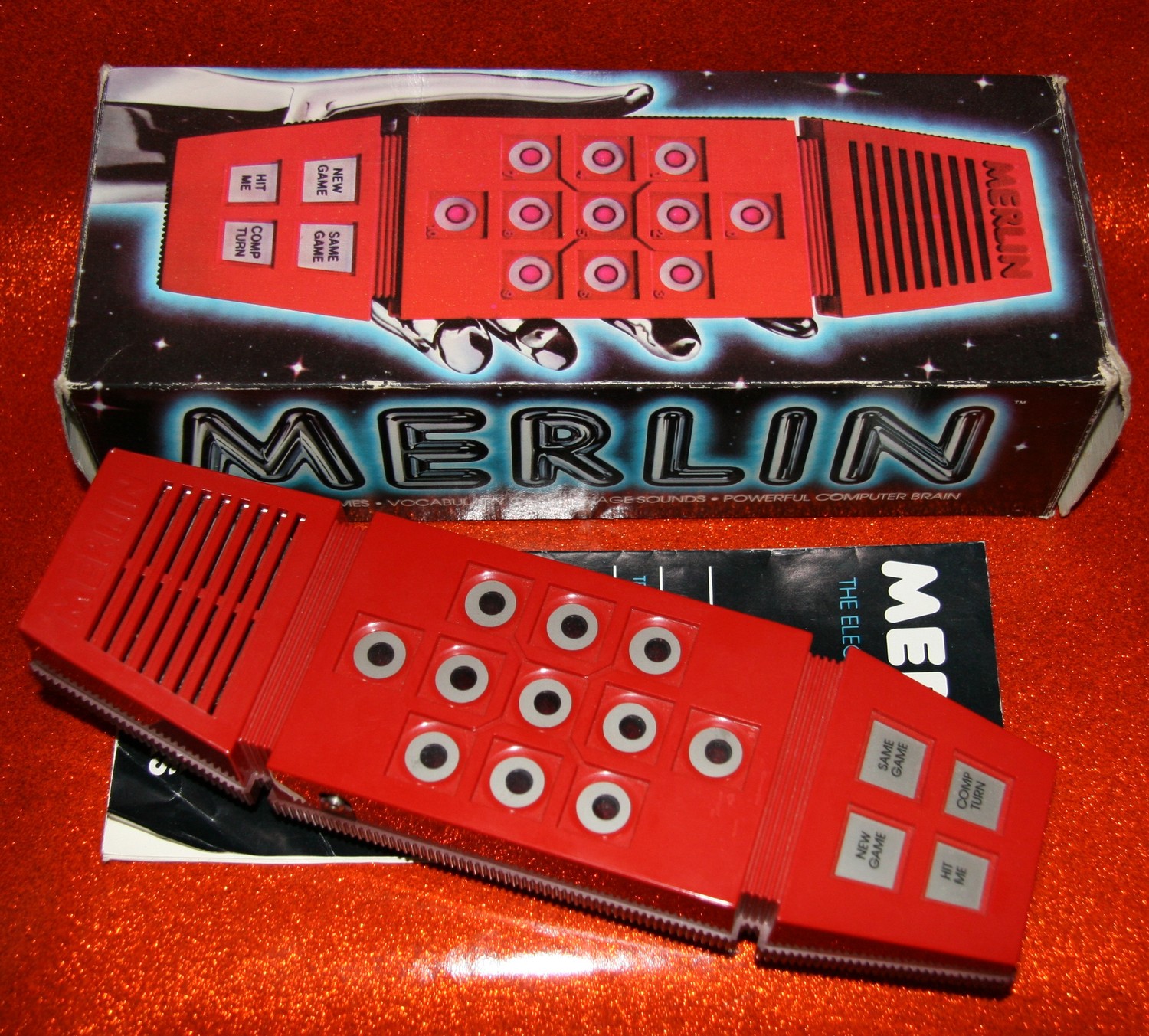
Now despite its name Merlin was not born of the Round Table or cooked up in Camelot, but rather was the brainchild of Bob Doyle, a former NASA engineer, which gives this space-age toy a truly space-age pedigree. Assisted by his wife Holly and his brother-in-law Wendl Thomas, Doyle came up with a device that looked like an over-sized red phone handset studded with eleven buttons that lit up when pressed thanks to inset LEDs. However despite not looking quite as colorful as Simon, Merlin had more than a few tricks up his electronic sleeve, and could in all fairness, quite rightly claim to be a magical marvel of microchippery. Milton Bradley's circular smart-arse might have been heavily marketed as an electronic brain that could think for itself and play against you, but despite looking like a relative of R2D2 who had been flattened in the Trash Compactor, Simon was pretty much a one trick pony. Oh yes, he might have been a clever little bastard, but when you came down to it, he only knew one game.

But Merlin could offer kids not one, not two, not even three, but a whopping SIX different games. And they really were six different games, and not just variant modes of a basic either. Indeed Merlin could convincingly claim to be a whole toybox in electronic form. And the full line-up of electronic delights conjured up by Merlin goes like this... 

1) Tic-Tac-Toe - or Noughts and Crosses as we in this septic isle more commonly call it. Yes, it is as old as the hills, but it is still a classic, and now you could play it against a computer! OK, that doesn't sound terribly thrilling now, but back at the end of the '70s playing a game against a machine was something previously only seen in the realms of SF.

2) Music Machine - Now technically speaking with wasn't a game as such, but more an activity. In this function, Merlin became a primitive synthesizer, with each key on its pad playing a different note. You could program a tune of up to 48 notes and rests - not huge scope there admittedly, but all the same pretty impressive for a toy back then. Certainly there was memory space enough for Merlin to be used as an early sequencer!  The instruction manual also came with some well-known tunes, including tunes as diverse as Beethoven's 9th and Auld Lang Syne, transcribed into ready to program number sequences.


3) Echo - Basically Merlin plays a tune that you had to replicate on the keypad. Yes, very like Simon, but accounting for the development timelines of both toys, I suspect that Doyle and co. had also seen  Atari's Touch Me and, like Simon's creators thought, they could do better.

4) Blackjack 13 - fairly self-explanatory, Merlin plays the dealer for an electronic version of  the famous card game. No gambling involved of course!

5) Magic Square - In this Merlin devised a pattern that the player must deduce from which lights come on or go off when certain keys are pressed.

6) Mindbender - In this game, Merlin ask you to decide deduce a random number - essentially it is an electronic version of the old game Cows & Bulls which earlier had inspired the creation of another best-selling 1970s game we've chatted about before, Mastermind (see here for more details). However the neat thing here, is that you had the option of setting the size of the number, choosing between 2 and 9 digits.

And for more details on all of these games, you can read the original manual online here.

Unsurprisingly "the Electronic Wizard" (as the marketing dubbed him) more than held his own against Simon and would go on to become the best selling toy in America in 1980, notching up sales of over 2 million Merlins in that year alone. Like his rotund rival, Merlin remained popular throughout the '80s, and saw  re-releases periodically over the years. Also like his electronic chum, there were some spin-off versions too, in the shape of Split Second in 1980, Master Merlin in 1981, and Merlin the 10th Quest in 1996.

Now Merlin is just a piece of gaming history, but being a very robust bit of kit, there are still plenty of working units out there. Of course, these days you can play all these games, and hundreds more, on your phone. But considering the unique and eye-catching telephonic design of Merlin, this computerised gadget wasn't just a pioneer of the computerised play, but in a weird way he was a prophecy of the future of gaming! Truly an Electronic Wizard! 


Wednesday, 29 November 2017

THE 'ORRIBLE 'OUSE OF TERRIBLE OLD TAT - Simon Says


Hello dear fiends, and welcome once again to the 'Orrible 'Ouse of Terrible Old Tat! Well then, we are in the toy cupboard once again and continuing our explorations into the strange twilight world of what were known as "electronic games". Now last time we saw how the ancestors of modern handheld video game platforms were a couple of gizmos produced at the end of the '70s.  Mattel Auto Race and Mattel Electronic Football were the first of what would become a huge wave of toys in the '80s, little plastic consoles that delivered a single video game. Yes, they were primitive but they had brought the games arcade into the home, and indeed, into the pockets of kids.

Now we will look at a few more examples of this early form of video gaming in future trips to the 'Orrible Old 'Ouse, but this week I want to look at another particular branch of this toy family. Now the Mattel duo and their descendants sought to recreate an arcade video game experience with chips and some LEDS instead of a real screen. However, around the same time, the first of a new breed of electronic game appeared that wasn't aiming to create a video game in a home or handheld format. Instead these were toys that boasted about microchip brains, games that could play themselves with you!

Our story begins at the Music Operators of America trade show in 1976, where two chaps, Ralph H Baer and Howard J Morrison saw an Atari arcade machine called Touch Me. Now this machine had already been around for a few years, first appearing in 1974, but unlike the games we normally associate with Atari, there were no spaceships, fast cars, things to gobble up or shoot. Instead Touch Me had four big black buttons and a small screen. Basically the machine flashed a sequence of lights at you while making primitive electronic rasping noises, and the player had to press the buttons to replicate the sequence. Baer and Morrison were rather unimpressed - the machine was ugly, the interface dull (all black buttons?!), and the electro-fart sound effects were less than appealing.


And these two chaps weren't just any old passing punters either. Morrison was  - even by the mid '70s - a leading light in the toy industry, working for the legendary Marvin Glass and Associates (click the link to find out why they were so legendary), while Baer had invented a primitive electronic tennis game on a computer which was the forefather of Pong. What's more, Baer had also created the world's first video game console in the shape of the Magnavox Odyssey in 1972, and hence not for nothing he is now known as the father of video games. Now while these learned gents agreed that Touch Me was rather bad, both also thought that the actual game concept - essentially an electronic variant of old playground and kids party perennial Simon Says - definitely had potential.

Hence our two heroes returned to their secret volcano base... (That's not right - Ed) Ok, returned to their workshop at the North Pole (Neither is that, try again - Ed) ... Oh right, returned to wherever it is that toy-makers do their magic, and emerged blinking in the sunlight, to the cheers of elves (Stop that! - Ed) with a round black disc, with brightly coloured panels. And thus Simon was born! Well, at least as soon as they found some batteries to go in it. They thought they had some in drawer but in accordance with one of the fundamental laws of the universe, any toy you buy will require exactly one extra battery of a type that currently you don't have... Even though you'd swear blind you bought a packet of those just the other week. And you put them in that drawer! Who's been in that drawer. eh? C'mon, own up!

Anyhow, once the necessary batteries had been fitted, they were ready to demonstrate this new electronic game. Now much like Touch Me, new boy Simon would light up his coloured panels in a sequence , while making merry beeps, and the player had to replicate them. Now you may say that perhaps this was just stealing Atari's idea, but in fairness as Atari had taken Baer's tennis game and created Pong,  and then later copied his Magnovox to create their own best-selling console, I think it's fair to say that they owed him one. However Baer and Morrison had made some significant advances of their own...


To begin with, the looks and feel of Simon was light years ahead of Touch Me. The round disc design, and brightly coloured lights looked both futuristic and pleasing echoed disco lights and illuminated jukeboxes. Hence it was both space-age and classically retro at the same time. Come to think of it, the curves, beeps and lights also chimed rather well with a certain droid who hit the big screen in 1977 too. However real innovation was perhaps more subtle - for Touch Me was an arcade machine, whereas Simon was designed for the home, and to be played in a group rather than a lone player with an excess of loose change to get rid of. That round disc design was not only visually appealing but perfect for a table or bedroom floor.

Now the marketing of Simon really played up the electronic nature of the game - this was a game you really could play with - a game that played back as it were. And while during its development this new game had been called Follow Me, the name change to Simon was another stroke of genius. Firstly the new name tipped its hat to the game's inspiration, the daddy of all follow and copy game, Simon Says, and in making that connection, people instinctively grasped what this new toy did. Secondly though, giving the toy a "proper" name gave it a personality - something the marketing played up no end. And while the actual electronic gubbins inside Simon were fairly basic, the ads really sold on the idea that this brightly coloured disc was an electronic brain. And that was another winning concept too - where most board games fall down is the fact they you need to get some other humans to play with you. But now you had a game that would happily play with you itself! Naturally a generation who had just fallen in love with R2D2 embraced Simon with open arms.

Simon released in 1978 by Milton Bradley and became the top selling toy that Christmas. Very soon there were several rivals and outright clones on the market. Even Touch Me was resurrected as what were now referred to as a handheld too, although keeping the black and yellow design and the electro farting did little to challenge the dominance of Simon. In the kingdom of the electronic games, the four colour disc was king. And while it's easy to see Simon as relic of those heady days, an iconic of late '70s/early '80s pop culture, our little round pal has continued to sell over the years, in a variety of different formats. There's even a new VR headset version of the old classic! For that design has proved to be iconic and timeless, but more importantly, the gameplay is still there. It's still a whole lot of fun for all the family, or just to play yourself against Simon himself.


Wednesday, 15 November 2017

The 'Orribe 'Ouse of Terrible Old Tat - The Mysteries of Mastermind


Welcome once again dear fiends to the 'Orrible 'Ouse of Terrible Old Tat! Now then, last time you popped over we were rummaging in the Old Board Games cupboard, and had uncovered the history of the international bestseller Mastermind - namely that this well-known game was actually an adaptation of an old pen and paper pastime called Bulls and Cows. However we didn't quite reveal all the secrets of this code-breaking game...

Bulls and Cows was a game which involve guessing a sequence of numbers, or in a popular variant, words. Now obviously any game involving numbers raises the spectre of mathematics, which for many folks is the polar opposite of fun. And therefore a key factor in Mastermind becoming a global hit was the simple but genius decision to replace the numbers with colours. To begin with this gives the game a visual appeal, but also the placing of multi-coloured pegs gives the game a pleasing tactile quality too. And it should be noted too that having a choice of six colours to create a sequence to be guessed by the other player actually cuts down the odds of guessing it correctly, hence making the game a little bit easier and more accessible for younger players. Now at this point I would to the maths to show the reduction in possibilites but you'd all stop reading. Such is the dread power of maths! 

Anyhow, instead of scoring "Bulls or "Cows", the board game used a system of black and white pegs. A correct colour in the right place gets a black peg, whereas a correct colour in the wrong spot gets a white peg. Now the board in Mastermind has a number of rows for the player to make his guesses, and each row of peg-holes has an additional quartet of slots for marking the guesses. Dr John Billingsley, who played a key role in developing the game, cunningly decided that the marking holes should be placed in a square to disrupt the tendency for players to mark each peg in sequence, thus making the game a little too easy. 


Now it was also Dr Billingsley that gave the game its name. And here lies one of the great mysteries of Mastermind. For around the same time as the board game hit the shelves, there was a hit TV show on the BBC in England which was also called MastermindDevised by a chap called Bill Wright, the inspiration for this quiz show was actually Wright's experiences in World War II being interrogated by the Gestapo! The show's format is both iconic and brilliantly simply - basically each episode sees four contestants face two rounds of questions. Each in  turn takes their place in a black leather chair lit only by a spotlight and faces two minutes of questions. The first round is on their chosen specialised subject, with the second round comprising of general knowledge questions. Winners of each show then go on to compete with each other until at each series's finale an overall winner is decided and awarded an ornamental glass bowl. And no, I'm not making that up! You really did only win a bowl.  

Now the TV show Mastermind has something on an interesting history in itself. It first aired in 1972 on a Sunday evening in a late night slot. Given its cerebral nature, it was thought that the show would only ever have a niche audience - for there were no flashy prizes or big cash giveaways, and the questions were of a high level of difficulty. Not your usual quiz show in other words. However in 1973, the BBC found itself in a bit of a bind. A raunchy sitcom Casanova '73 which starred Leslie "Ding Dong!" Phillips had proved to be a bit too lecherous and had drawn a flood of complaints. After three episodes, a full scale public outcry was taking place and the Beeb decided to swiftly move the sexy show to a later time slot. However this snap decision to appease shrill self-appointed voices of the probably mythical Silent Majority such as Mary Whitehouse left a gap in the schedules. And so, as a stop-gap Mastermind was given the troubled sitcom's old slot. This was of course only meant to be a temporary move, but to everyone's surprise became a huge hit. 

Now while competing to win a glass bowl by answering questions on subjects nobody at home knew a thing about might sound like the dullest thing ever, Mastermind was actually riveting television. To begin with we had that brilliantly atmospheric theme tune - a piece called "Approaching Menace" by British composer Neil Richardson - usual playing over a very simple title sequence that just showed the famous black leather chair lurking in its single spotlight. Whereas most quiz and game shows are wheeling out bright colours and the kind upbeat music produced by a surfeit of sugar and e-numbers, Mastermind could be mistaken for the opening of a dark thriller or even a horror movie! And while the original run of the show was hosted by the charismatic Magnus Magnusson, who managed to be both a genial and a somewhat sinister quiz master, the real star was always that infamous chair lurking in the dark. 


And what really made Mastermind such tense viewing was a very simple device employed by the show from the very beginning. And that was that as each contestant took their place in the ominous black chair and began their round of questions, the camera very slowly and oh-so-steadily zoomed in, so that by the time the buzzer sounded to mark the end of the round, the camera was squarely on the contestant's face. Filming the rounds in this way proved to be a stroke of genius, for it allowed to viewer to taste the rising tension of answering a barrage of relentless questions against the clock. 

The show ran every year until 1997, when it was decided that perhaps old Mastermind was a bit long in the tooth. But you can't keep a classic off the air long, and while TV execs might have thought the show old and boring, audiences still loved it. After all, there was a very good reason the show had ran for a quarter of century with the only changes to the format being tweaks to the title sequence. Hence it was revived almost immediately on radio, then on the Discovery Channel with Clive Anderson hosting. And then in 2003, it returned to its rightful place on BBC 1 with John Humphreys as the host, where it is still running to this very day. 

Now then, to get back to our original specialised subject of old tat, what has all of the above got to do with the board game? Well, that is in fact the very question that bedevilled generations of TV viewers and game players. Was there some connection between the game and the TV show? They had the same name, and given that the box showed a distinguished man in a darkened room, looking ominous, the game seemed like it was somehow related to the TV show. But that wasn't Magnus Magnusson sat in a stylish modern armchair chair! And he never had a beautiful assistant like the suave chap on the game box. Plus if the game was a tie-in to the TV show, why wasn't it effectively Trivial Pursuit a decade or so early? 

Well now, at last we can reveal the truth! And what is more, once again it is down the Dr John Billingsley. As Mastermind the TV show was just becoming a huge hit, the good doctor provisionally entitled the new board game with the same name, never thinking that it would hit the shelves with that monicker. Our genial boffin assumed that there would be all manner of legal difficulties and another name would be chosen for the game's release. However the makers of the new game Invicta loved the name and went with it, and somehow the BBC never challenged them over the use of the same title. Possibly if the game had featured questions and a quiz the BBC might have had something to say about it, but I suspect the prevailing thinking at the time was that "mastermind" was simply a term in common usage and no one, neither Invicta nor the Beeb, could lay claim to it.


However, who was that chap in the chair? Well, there's an interesting tale too. Given the name 'mastermind' and the brief that this was a code-breaking game, the marketing folks thought they'd invoke a James Bond/spy vibe, and so started looking for a suave-looking gent, a beautiful girl, and also hired a cat. The original model they had booked didn't turn up, so a local man who ran a string of hairdressing salons, Bill Woodward was suggested at short notice to fill the chair. And with his neatly trimmed beard and sharp suits, Bill certainly fit the bill. Likewise his glamorous companion was also a bit of chance casting. The mysterious lovely lady was Cecilia Fung, who at the time was studying computer science at Leicester University - a rather nice coincidence that chimed with the game's origins in a computer version called Moo! Cecilia was literally stopped in the street by folks from the modelling agency and offered the job on the spot, and being a struggling student she jumped at the chance.

And thus history was made! The iconic cover photo looked intriguing, glamorous, and stylish - with the aura of sophistication and mystery it generated, it undoubted it helped the game become the global smash it was. Bill Woodward did many promotional tours for the game, so much so that at one stage he had "Mr Mastermind" on his passport! However more than a few players over the years were perplexed to discover the game rules made no mention of this suave fellow and were left wondering who he was and what was his deal? Was he an M type of guy, giving the orders for secret missions? Or a Blofeld, plotting some nefarious scheme? In fact, they were going for a Bondian supervillain look, hence the hiring of the cat. Bill later recalled that several shots were taken of him holding the kitty in full Blofeld mode, but in the end it was decided to ditch the moggy. However unfortunately that wasn't before the cat itself had registered its own unique protest against the concept by pissing all over Bill's trousers. 

Sadly now, although you can still buy Mastermind, made by Hasbro these days, the iconic packing featuring Bill and Cecilia has now gone. And I can't help feeling that the game has lost some of its mystique and magic with this departure. However I am willing bet that if they were reinstated on the box, there would be a sharp spike in sales, for I am sure that that mysterious air of style and sophistication would once again have prospective buyers picking up the game just to find out who they were. Rumours that the cat is now lurking in a secret volcano base of its own and plotting world domination are entirely made up by me just now.