Showing posts with label tom baker. Show all posts

Wednesday, 10 March 2021

COMMENTARY CLUB - Minisode 025 - Blackadder II - Potato


In this episode Blackadder attempts to out-do Sir Walter Really, I mean, Raleigh, with a sea voyage of his own.  Unfortunately Captain Redbeard Rum (the legendary Tom Baker in fully barking mad mode) turns out to be both legless and clueless!

DIRECT DOWNLOAD - COMMENTARY CLUB - Minisode 025 - Blackadder II - Potato


COMMENTARY CLUB HOME DOMAIN 

If you enjoyed the show, we have a little campaign to raise money for Alzheimer's Disease research! Any donations gratefully received!


Wednesday, 20 February 2019

THE 'ORRIBLE 'OUSE OF TERRIBLE OLD TAT - Who Trumped?


Welcome back dear fiends to the 'Orrible 'Ouse of Terrible Old Tat! A few weeks ago we were rummaging in the games cupboard and unearthed a fondly remembered deck of cards that was essentially a set of Marvel superhero Top Trumps. They were made by the toy company Jotastar, who held a great many licenses to produce spin-off and tie-in tat for a variety of kid-friendly franchises and properties. However this Marvel card game was not their only foray in the twilight world of exactly-like-Top-Trumps-except-in-name-only card games. For in 1978 they produced another suspiciously Trump-like card game but tied to another legendary fictional universe - Doctor Who.

Back in 1978, Doctor Who was enjoying one of its many golden ages, for this was the era of the Fourth Doctor. And not only was Tom Baker's incarnation of the Time Lord that delighting the kids with his own brand of anarchy, humour and jelly babies. He was teamed up with popular companion (and in particular very popular with the Dads watching), Leela, she of the handy dagger and tribal garb, plus at that time was just coming to the end of a run of particularly scarifying stories, which had greatly expanded the Who canon of iconic monsters and villains. 

Now the card game produced by Jotastar was assembled by using pretty much the same template as their Marvel game, with the same rules being were used with minor tweaks here and there. Aside from the rules text being rewritten to include references to the long running  SF show, there was a slight change to the stats on the cards - while we still had the attributes Special Powers and Weapons, just like the Marvel deck, instead of Physical Strength we now had Mental Ability - a fitting change as the Doctor tends to outthink his enemies rather than throw buses at them.


Just like the Marvel game, you could divide the pack into to halves and play the good guys vs the baddies. However it is here that this game goes a little weird. For over the years the Doctor has had a long line of companions and assistants, plus he has met a host of good characters who have helped him out, such as the Brigadier, assorted Time Lords, Thals, and so forth. However somewhat weirdly, in the Heroes list the only familiar faces we have are the Doctor himself (obviously) and the TARDIS.  And instead of other characters from the show's history, we have the following - 

HEROES
Alexander the Great
Annie Oakley
Boadicea
Chaka King of the Zulus
Colonel James Bowie
Davy Crockett
Doctor Who
Geronimo
Hercules
King Arthur
Lord Nelson
Parthian Warrior
Robin Hood
Samson
Sherlock Holmes
Shiao Chi Samurai Warrior
Spartacus
The TARDIS
Thor
Wyatt Earp

Yes for some reason it was decided that famous historical characters should be the good guys. The rules refer to this disparate group as "the Legendary Legion". Now firstly it is only right and proper to question why we have mythological characters (such as Thor) and fictional folks (Sherlock Holmes) rubbing shoulders with actual historical personages. But to kids back in the 1970s the more important question was "Why the hell are this lot in here? They were never in the show!". Well alright, Wyatt Earp had appeared in an First Doctor Story The Gunslingers, back when the show still did purely historical stories without any alien monsters in. But even so, that was back in 1966, well before most of the target audience would have been able to remember, or even been born. So then, here was a Doctor Who game in which nearly the half the cards had bugger all to do with Doctor Who.


On the whole, looking at the selection of characters in the deck, I rather suspect the deck was devised by someone who had never seen the show properly - which would explain the good guys being pulled from history books. And as for the Aliens selection, it looks like they just went through the seminal Target tie-in tome The Doctor Who Monster Book which was first published back in November 1975 (and you can read about it here). And hence, there are no monsters more recent that Tom Baker's first season (Davros and the Zygons). However while it was suspicious there were no newer monsters and villains, in all fairness  it is a rather good list of famous foes! 

ALIENS
Davros
Gellguards
Omega
Sea Devils
The Autons
The Axons
The Cybermen
The Daemons
The Draconians
The Giant Robot
The Ice Warriors
The Mechanoids
The Ogrons
The Sensorites
The Silurians
The Sontarans
The Spiders of Metebelis
The Wirrn
The Yeti
The Zygons

However there is an obvious anomaly - for although we do have their creator, Davros, their hired muscle, the Ogrons, and two races they fought bloody and bitter wars with, the Mechanoids and the Draconians, the Doctor's most famous enemies, the Daleks do not appear,  Possibly this was down to the fact that Terry Nation, who originally created the intergalactic terrors, still owned the copyright to the Daleks, and indeed around this time he was considering various plans featuring the pepperpots from Skaro such as having them appear in Blake's 7 and developing a separate Dalek series.

However judging from some of the attributes given on the cards, it is equally plausible that the Daleks being missing was just a blunder. For it seems clear that not only had whoever devised the set never seen Doctor Who, they were also wildly oblivious to both history and even what was on the cards. For example, Boadicea has a Weapons score of 0 despite being shown waving a dirty great sword and riding in her famous chariot with spiky wheels!


Sadly also the artwork on the cards isn't quite as good as the Marvel pack. Some cards do like rather nice, and it's fun to see familiar faces for Whoniverse rendered in a pseudo comic-book style. On teh downside though, many are clearly copied from very familiar photos (hello again Target's Doctor Who Monster Book) and some look distinctly wobbly. Also as many of photos used as reference were in black and white (spookily enough just as they all were in Target's Doctor Who Monster Book), you can see where the artist has just been guessing what was in the dark, smudgy areas. The Ogron is a great example of this, with clear guesswork filling in many areas of shadowed detail, and the whole picture looking like a ripply funfair mirror reflection. See also the background face on the Spiders from Metebelis card, whose features have been clearly surmised from a blurry photo.

On the whole then, while it seemed like a brilliant concept, sadly this Doctor Who Trump Card Game didn't deliver on its promise. Nor did it live up to its Marvel cousin - while that card game had felt authentic and official, to the extent it was like a little loose leaf encyclopedia or guidebook for the Marvel Universe, the flawed execution of the Doctor Who game clearly marked it out as cash-in tat. Much like the Doctor Who Annuals of the same era (more on which another day) or the previously discussed TARDIS TUNER, while we were happy to have them - there wasn't a lot of merch about back then remember -  at the same time you knew they weren't exactly right; they weren't proper Doctor Who like the Target Books or the Palitoy Talking Dalek. In fact in many ways they were a pale shadow of Doctor Who cards given away free with Weetabix around the time which featured not only better art but an innate understanding of the series (and again, more on those another day)

However despite all that, the set now goes for a hefty price, with many sellers flogging off individual cards for a couple of quid a go. And while my inner collecting geek naturally baulks at breaking up sets and selling off cards one by one in this manner, at the same time I can understand why you might really want, for example, the Sea Devil or Mechanoid cards but be more than happy to pass on the wobbly Ogron... 


If you want to see the set without paying an arm or a leg you can download a copy here - DISCLAIMER - I have no idea about the legality of this

Wednesday, 25 October 2017

THE 'ORRIBLE 'OUSE OF TERRIBLE OLD TAT #29 - A Tune In For All Time Lords


Welcome once again dear fiends to the 'Orrible 'Ouse of Terrible Old Tat! That's it, step inside... But don't touch that! Anywho dear friends, last time we were talking of when the catalogue was king, that now almost forgotten age of non-digital home shopping, a time when with nothing more advanced than a big glossy book, a pen and a stamp or two, you could order all manner of goods to be delivered to your door. However in this pre-internet age, there were actually some items that you could only get through mail order, something their manufacturers proudly trumpeted in the marketing - "Not available in any shop!". And were these rare and difficult to obtain items any cop? Well, therein lies a tale or two... Some were very good, some very bad, and indeed, a few were ugly. However sometimes these mail-order-only goodies went beyond the parameters set by Sergio Leone, and some were just downright weird!

These days, if a show or a movie is successful, it's instantly merchandised to the proverbial hilt, with the brand being instantly licenced for everything from comics to clothes to cruet sets. And in some cases even actual hilts, well, replica swords at any rate. However in ages past, the availability of tie-in items were often sporadic, and often what was up for sale was rather eccentric. Now then, at the close of the 1970s, the most popular SF show, was one of the most popular TV shows  in Britain full stop. With Tom Baker helming the TARDIS, Doctor Who was enjoying a huge wave of popularity. And hence, somewhat surprisingly, it was only in the time of the Fourth Doctor, some ten years into the life of the hit series, that we got much in the way of proper merch. As previously discussed, it was in this jelly baby era that the first proper Doctor Who action figures appeared. Also this was the period when the Target novelisations began to fly off the shelves, and more exciting still, a weekly comic - Doctor Who Weekly - first appeared.  

Back in those pre-web days, specialised publications served a unique role. For aside from serving up content dedicated to their chosen area of interest, such magazines provided a valuable micro market for advertisers and mail order shops. Now then, around the same time, an electronics firm called Shortman Manufacturing wangled a license to produce tat for the Doctor Who brand. But the question was what? Despite its popularity, Doctor Who was always somewhat tricky to merchandise for - there weren't a host of exciting space-age vehicles like the Gerry Anderson shows, the Doctor didn't carry anything in the way of weapons that could be turned into toy guns, and he didn't wear a special outfit or costume either. In those days, even the now very toyetic sonic screwdriver wasn't used that much in the old series. Hence Shortman came up with a novel idea - how about an item that had never and would never feature in the series, but you could stick a Who logo on! Perfect!


And so the TARDIS Tuner was born! Pimped frequently in the pages of Dr Who Weekly and comics such as 2000 AD from 1978 onwards, with a full page comic strip ad, thousands of kids wondered what the hell a TARDIS TUNER was! The adverts proclaimed it was a "A TUNE IN FOR ALL TIME LORDS", but a little careful reading of the blurb revealed it was in effect a jazzed up medium wave transistor radio. Priced initially at £14.25, but later climbing up to £19.91, this seemed a bit steep for a novelty tranny even it if was a rather chunky one -  approximately 20 cm x 15 cm x 8 cm (that's approx 8" x 6" x 3" in old money). 

However powered up by 4 AA batteries (or HP7s as they were back in the day), admittedly it did do other things too! The full, if somewhat cryptic, list of features was as follows -  
  • Mind blowing volume control
  • Built in radio receiver, 
  • picks up radio 1, 2 & 3
  • ‘Laser light control switch’
  • Constant flashing laser lights
  • Radio tuner for crystal clear reception
  • Time warp bleeper control switch
  • Tough moulded matt-black casing stands up to the heaviest landings
  • Sliding door for battery supplies
Wait a minute! This had lasers?!? Take my money now!

Of course it didn't really have lasers, just some bog standard flashing lights. Now I'm not sure whether Shortman were hoping that no one would be daft enough to think the TARDIS Tuner really had lasers, or were actually daft enough to believe the blurb but conveniently also be too stupid to start legal proceedings. Either way though, to a child of the 1970s, flashing lights were very cool in themselves. Yes, I know, simpler times!  *Insert favourite old git rant of your choice here*

So what did this space-age gadget actually do? Well after literally years of idly wondering what a "Time warp bleeper control switch" did, at last the truth can be revealed! Switch 1 toggled the TARDIS Tuner  between  "Radio" or "Lights" mode. In "Radio", obviously you could listen to the radio. No Radio 4 though as this didn't pick up FM, but I'm sure that wasn't a huge deal for the nation's kids. However its in "Lights" mode where things get interesting. In this second mode, you could no longer use the radio, but instead the TARDIS Tuner can be made to emit a range of electronic noises. Well, a range of two electronic noise -  the second switch - "Switch 2" natch - allows you to chose between "Morse Warp" or "Laser Bleep". However by using the volume control you could modulate the pitch of both of these to create eerie space age oscillating tones... or just a racket to annoy everyone else in the house with at any rate! 


The TARDIS Tuner in action!

However one does wonder whether the advertisers had much faith in it as the faux strip hawking it was entitled "Doctor Who and the Turgids". Methinks someone was having a laugh there. But despite soundly horribly low tech to modern ears, and to be honest even potentially disappointing back then, quite clearly the TARDIS Tuner sold well enough, for it was advertised in the pages of Doctor Who Weekly and other comics for several years. And now this totally non-canonical item has become popular with Who cosplayers, with a working model going for a 100 quid recently! 


Saturday, 19 June 2010

THE REGENERATION GAME (Round 3) - Bohemian Cricket!


Nice to see Who, to see Who nice!

This round of the Regeneration Game is going to split into two parts – mainly due to the fact that the Tom Baker era covers a lot of ground. Fans of the Fifth Doctor don’t despair! Part II will be along in the next couple of days…

THE FOURTH DOCTOR


In December 1974, the public were introduced to a brand new Doctor, Tom Baker. And Baker would stay the role until 1980; by far the longest serving Time Lord in the TARDIS, and for many the Fourth Doctor is the incarnation that first springs to mind when Doctor Who is mentioned. The Fourth Doctor has proved to be enduringly popular, with the Baker Man still regularly topping fan polls for favourite Doctor, and it is only recently he had any serious competition thanks to the immense appeal of David Tennant.

However, back in ’74, the general reaction wasn’t one of instant love. As I recalled in my review of The Eleventh Hour, a common response to the new Doctor was that he was too young. And additionally, initially many felt that his behaviour was far too silly and the costume, in particular the long scarf and floppy hat, that are now so iconic, made our Time Lord hero look a berk.

Now to contextualise this reaction, you have to remember that in the previous year, The Three Doctors had been broadcast and for many younger viewers this was their first exposure to the fact that there had been other Doctors before the white haired chap in the smoking jacket we enjoyed so much on a Saturday tea-time between Basil Brush and The Generation Game.

And we were hungry to learn more. Fortunately for us, a few months later the Radio Times published a Doctor Who special to celebrate tenth anniversary of the show. This magazine format tome was the first fandom bible, containing interviews with key cast and crew members from down the years, a Terry Nation short story, and even blueprints for building your very own Dalek. But the bulk of the page count was an episode guide, detailing every serial of all ten seasons to date. Now we had the full history of our hero’s adventures and very quickly playgrounds across the land were full of self-styled experts.

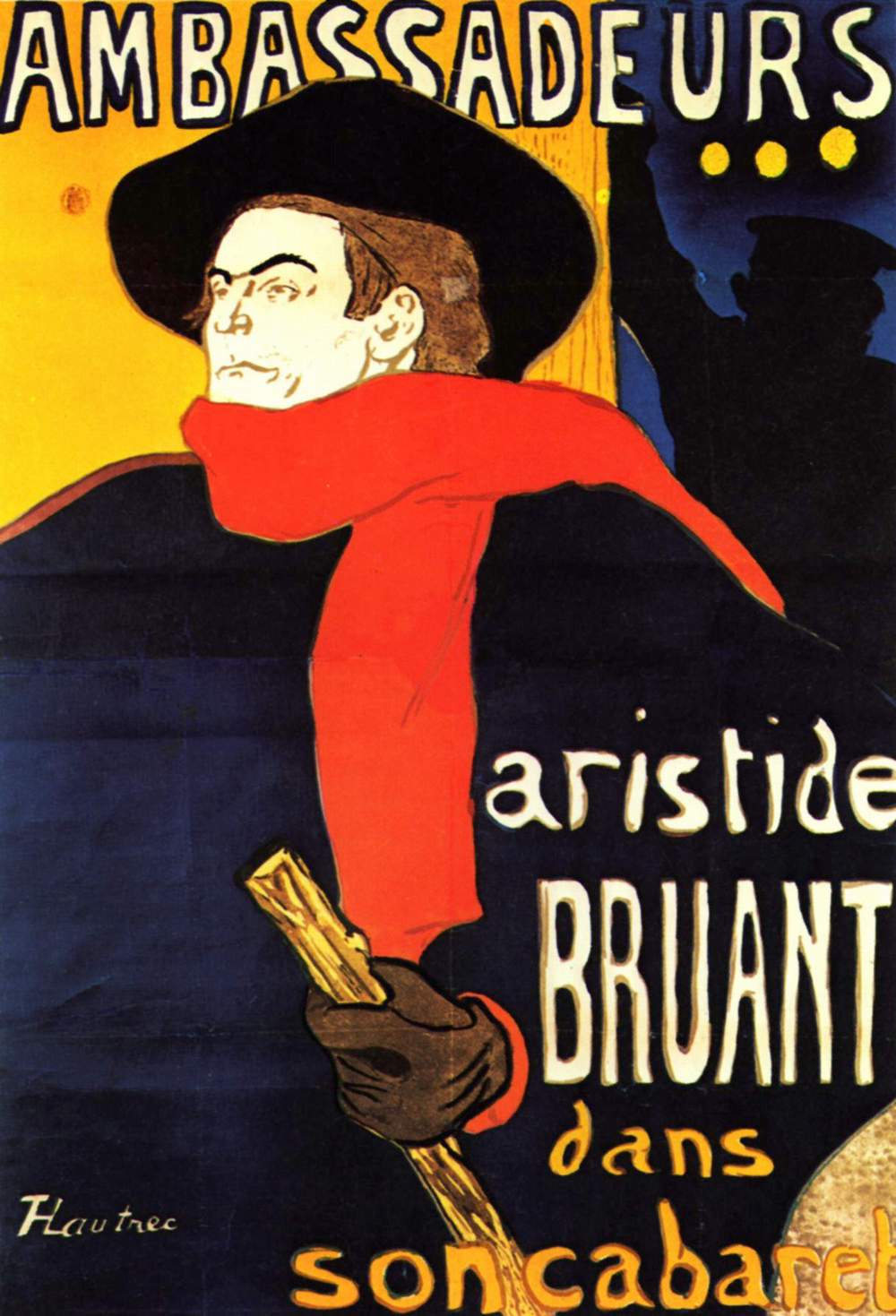
Now if we look at the marvellous stills from the Three Doctors and this hallowed volume which show all three incarnations together (here's one), you can begin to understand the mixed reception the Fourth Doctor received. Hartnell, Troughton and Pertwee are all of a comparable age and share a similarly Edwardian look; Hartnell may appear staid and stolid in his dress sense, Troughton scruffy and Pertwee dandified but their wardrobe is rooted in the same basic style. Hence Baker’s age and his outfit, inspired by a Toulouse Lautrec poster incidentally, seemed a very radical break with tradition at the time. Equally after the dashing but patriarchal scientist of Pertwee, Baker’s anarchic antics and clowning was something of a shock to the system.

However his first season saw the return of the Daleks, the Cybermen and the Sontarans, introduced an iconic new villain Davros, and delved into proto Alien sci-fi body horror territory with the Wirrn in The Ark in Space; a feast of horrors to test the mettle of any Doctor, and Baker quickly proved his worth. With Phillip Hinchcliffe in the producer’s chair and Robert Holmes in charge of scripts, this new series of Doctor Who was almost another soft reboot. In the wake of the energy crisis, British government teetering close to collapse, and Watergate and Vietnam across the pond, it no longer seemed appropriate for a television hero to be in the pocket of the powers that be and working for the military. And so the cosy UNIT set up was quickly phased out. After Baker's debut story Robot, the show returned to travelling in time and among the stars; no more would England be invaded by any passing intergalactic chancers every other month; the days of tea and biscuits with the Brig and Benton were over.

With Hinchcliffe and Holmes at the reins, the new stories were pitched at an older audience. Although the Pertwee days had delivered many frightening moments and memorable monsters, the Holmes/Hinchcliffe union brought harder story lines, packed with darkness and violence. In contrast the pop art psychedelic action sci-fi backdrop of the Third Doctor’s adventures, the first three seasons of Baker’s run saw the Fourth Doctor roaming a gothic universe, with stories like The Brain of Morbius and The Pyramids of Mars riffing on horror classics. And in this milieu, the anarchic quips and general Tom-foolery fitted in perfectly; the monsters and villains may have had us behind the sofa but you knew the Fourth Doctor would be offering them jelly babies in the next scene.

But there was more to Tom Baker’s Doctor than just tripping over his own scarf; the Fourth incarnation of our favourite Time Lord also showed himself to possess the same scientific brilliance and moral vigour of his predecessors. He may have used his wit to prick the pomposity of his adversaries (sample quote - “That’s the empty rhetoric of a defeated dictator… And I don’t like your face either!”), but he was also given to fiercely debating with the villains, poetically musing aloud and delivering stirring speeches.

Looking at the Doctor’s various regenerations, it is tempting to speculate that the transformative process does not just randomly assemble a new personality and physique but at some level, possibly only subconsciously, each new incarnation is shaped by the circumstance of the previous one. Hence when the First morphed into the Second, Troughton was younger and better suited to the adventuring life, with a greater capacity for enjoying his travels. When the Time Lords forcible regenerate him at the close of The War Games, they choose the look of his new incarnation – and being a staid and steady ancient race they naturally pick a distinguished elder statesman appearance with a matching conservative attitude for his exile to earth. However when the Doctor has earned his freedom and regenerates into the Fourth, it is almost as if the metamorphosis has deliberately gone for a younger model complete with a bohemian attitude that borders on the Byronic. This Doctor loves his freedom to travel, loves liberty, and espouses a Romantic philosophy of experiencing knowledge rather dusty book learning.

However he is also the most alien of the Doctors so far: unpredictable in his reactions and showing a far greater range of emotions, moods, and responses than his preceding incarnations. And while he may have jettisoned the slightly patronising airs of the Third, he retains the same openly Time Lord attitude, capable of being as very bit the stern authoritarian as Pertwee when the circumstances dictate. It is very telling that his major competitor for the title of most beloved Doctor, Tennant’s Tenth, has a similar personality spectrum – shifting quickly and easily from joviality and playful humour to portentous rhetoric and righteous ire. And that’s not the only parallel with the Tenth Doctor as we shall see later on.

While the return to wandering the cosmos is the show returning to its original set-up, the Doctor himself is significantly different. Now we know he is a Time Lord, and he acts accordingly. Although Pertwee pioneered the portrayal of the Doctor as a Time Lord rather than a mysterious old chap, it was Tom Baker’s performance that defined him as an alien, with his quirks and eccentricities being part of his otherness. And from now on, strange personality traits will be de rigueur for every following Doctor.

It was also in the Tom Baker era that the format of the Doctor travelling with a female companion became firmly cemented in the public consciousness. While it is true that this trope first appeared in the days of the Third Doctor with Jo Grant, there was usually the Brigadier, Sgt. Benton, Captain Yates and all the soldier boys from Pippin Fort, sorry UNIT HQ, were part of the regular supporting cast. Indeed in the Fourth Doctor’s first series, he has Harry Sullivan (played by Ian Marter) in tow as well as Sarah Jane.

Now the role of Harry was created before they had cast the Fourth Doctor; the reasoning being that the series might need a young actor like Ian Marter for the physical action scenes if an older thespian inherited the TARDIS. However at the same time, having multiple and mixed sex companions was just as much a return to the show’s original format as travelling all space and time. The first Doctor regularly had three assistants with him, and by the time Patrick Troughton took control of the TARDIS, the production team had found that having a dashing chap and a pretty girl was the optimum number of characters for scripts.

But with the casting of a younger Doctor, sadly Harry was deemed surplus to requirements as Baker was more than capable of wrestling Dalek embryos and the occasional bit of fisticuffs. Hence we have a string of single white females in the TARDIS – Sarah Jane, Leela and two Romanas. And no, K9 doesn’t count – he was essentially talking prop rather than a dramatic foil and often left behind in the TARDIS due to the behind the scenes nightmares getting him to work properly caused (particularly in stories heavy on location shooting, far away from smooth studio floors). As for Adric who turns up in Tom Baker’s final season, we will carp about, sorry, explore in more detail when we get to the Fifth Doctor.

But back to the tin dog. The inclusion of K9 is a fitting symbol of the changing taking place in the production office at the time. Although the Holmes and Hinchcliffe era is now regarded as a run of classic stories, and the show saw record audience figures, the darker material did cause problems for the mandarins at Broadcasting House. BBC bosses came under increasing fire from self appointed TV watchdog Mary Whitehouse, who frequently had cause to complain over the levels of violence, gore and general horrific tone of serials such as Genesis of the Daleks and The Seeds of Doom.

Now Mrs Whitehouse was something of a constant thorn in the side of the BBC; frequently complaining about sex, violence and swearing on the small screen (and I’d recommend interested readers to Filth: The Mary Whitehouse Story, a quality drama starring Julie Walters which documents her tussles with Auntie Beeb). However while often the BBC respectfully shrugged off most of her criticisms, her complaints over the cliff-hanger of Episode 3 of The Deadly Assassin were picked up by several national newspapers and the question of whether Doctor Who was now going too far for a Saturday evening show could not be ignored.

And so despite receiving massive ratings not seen since the early days of the show when Dalekmania was in full swing and not seen again until the modern reincarnation, Hinchcliffe was quietly moved on. Graham Williams stepped in as producer and Robert Holmes was replaced as script editor soon after. And Williams came to the wheel with strict orders from on high to lighten the show. And although the fourth series in the reign of the Baker Man saw Image of the Fendahl and The Horror of Fang Rock still playing with the classic horror styles – stories developed under Hinchcliffe – the series was moving a new direction.

William’s second serial The Invisible Enemy which introduces K9, encapsulates this shift. This adventure begins with astronauts in the far future becoming infected and possessed by a mysterious alien force, but the Nigel Kneale style Quatermass sci-fi horror the story starts out with soon gives way to outright science fantasy. Hence in teh second half, we have a robot dog and miniaturised clones of the Doctor and Leela beginning injected into the infected Doctor’s brain Fantastic Voyage style.

And perhaps it was a timely change; switching the emphasis to space ships and alien planets, adding more mythological touches to the stories, and including a robot character that the little ‘uns loved all proved very fortuitous. As Williams was taking over in 1977 – the year of Star Wars; Lucas’ space opera changed the way the public perceived sci-fi and the retooled Doctor Who almost by accident had moved in sync with the change in trends. And the Doctor was changing too.

After Bob Holmes has stepped down, Anthony Read took over as script editor for the second half of that series. However the other two Williams produced seasons saw Douglas Adams taking over the role. And naturally with the man who would later bring us The Hitchhikers Guide To The Galaxy” in charge of scripts, as well as more fantasy-orientated adventures, we got a Doctor who was a lot more given to pithy quips and comedy asides.

However as well an increased propensity for witty banter and a tendency to talk to himself that verges on breaking the fourth wall (“Not even the sonic screwdriver can get me out of this one!” in The Invasion of Time), the Fourth Doctor under Williams and Adams becomes much more of superman than previous incarnations. Like the Tennant’s Tenth, this later Fourth Doctor is prone to pulling unmentioned special abilities out of the hat, but more importantly he now knows it all. Pertwee may have been ready to patronise at the drop of a ruffled shirt, but Baker’s becomes positively arrogant after Hinchcliffe and Holmes leave.

And while the Doctor should be intellectually brilliant, he really shouldn’t become nearly all knowing, as this instantly diminishes the level of threat in any situation he finds himself in. And while it’s fun to see the Fourth Doctor blithely opposing ultra powerful beings such as the Black Guardian, the knowledge and intelligence he displays in this part of his career come dangerously close to making him as invulnerable as Superman. And this problem was compounded by the introduction of both K9 and Romana. With a Time Lady companion and a mobile super computer, we now had three geniuses in the TARDIS with enough combined intellect to easily stitch up any monsters and villains the scripts could muster. And combined with the directive not to upset Mrs Whitehouse, his adversaries don’t even provide the fright factor for the audience.

Needless to say, things had to change, and change they would when Jon Nathan-Turner took the producer’s seat for Tom Baker’s final season. And as he would hold the position until the show’s cancellation in 1989, we’ll be hearing a lot more about him and his influence on the show in the Fifth Doctor section and future instalments of these articles.

The last Fourth Doctor series felt like a huge shake-up. For a start there was a new titles sequence – a gleaming star field rather than the familiar Time Vortex tunnel – and horror of horrors, a new arrangement of the theme. The iconic Delia Derbyshire version was scrapped and replaced with a very ‘80s synth rendition from Peter Howell. And the show’s scheduling changed as well, it was moved from its traditional Saturday evening slot to weekday nights. But the stories too reflected a radical change in styles, and the first outing The Leisure Hive is a good example of things to come, showing a shift from science fantasy to a much more nuts-and-bolts hard sci-fi. New script editor Christopher Bidmead was very keen to get the science in the fiction accurate and now cutting edge physics - like the concept of tachyons in this outing - were the inspirations for the plotting.

The Doctor’s character, as ever, moves with the changing times. There’s less reliance on convenient new abilities, markedly less comedy and he is vulnerable again – seeing the previously breezy in the face of danger Doctor aged into his dotage in The Leisure Hive was something of a shock. However by this point, the Doctor is becoming more distant and something of a colder character than previously. Partly this was due to the tonal shift – stories brimming with hard science like Warriors Gate didn’t leave the character much room for either fun or moral crusading. But equally after seven series Tom Baker was growing tired and bored of the role, and the increasing friction with directors and the new producer are clearly colouring his performance. In short, it was time to go…

During the Fourth Doctor’s reign, the show’s mythos was significantly expanded in many ways. Aside from the occasional titbits about the Doctor himself, such as he scored poorly in his Time Lord exams, and that his nickname in those days was Theta Sigma, we also learn a lot more about the Time Lords. We hear of Rassilion, the founder of Time Lord society, and that despite putting the Doctor on trial for interfering in other races affairs, the Time Lords do surreptitiously meddle with the fabric of history to suit their own ends. Several times they deliberately have the Doctor intervene on their behalf, and the first shot in The Last Great Time War is the mission they give him in Genesis of the Daleks - to stop the creation of the race that eventually make exterminate the rest of creation.

We also discover in The Deadly Assassin that Time Lords may only regenerate twelve times. This means that there can be only ever be thirteen incarnations of the Doctor, and brings us conveniently to totting up how this era has affected our running totals of how many incarnations of the Doctor are there, and how many actors have essayed the role. Now the causal reader may well be thinking this is just a simple case of adding one to both scores on the doors… Oh if only it were that simple!

For a start, there is an alternative Fourth Doctor. In December 1974, two weeks before Baker donned the scarf, Seven Keys To Doomsday opened at the Adelphi Theatre in London. This stage play was originally written by veteran Who scribe Terrance Dicks for Jon Pertwee’s Third Doctor, but due to various scheduling problems the part of everybody’s favourite Time Lord went to one Trevor Martin. Hence the production’s opening shows Pertwee regenerating into Martin.

Now although other actors have portrayed the Doctor in various stage plays over the years, I’m counting Trevor Martin in our tally on the grounds that many years later Big Finish adapted the this theatre production into an audio adventure. So as he has appeared as the Doctor in officially licensed and BBC rubber stamped broadcast media, he has earned a place next to Peter Cushing in the ranks of apocryphal Doctors.

And speaking of Big Finish, in The Kingmaker the voice of the fourth Doctor appears. However the distinctive tones we are do not belong to Tom Baker! Although recently his Bakerness has relented and returned to the role in the audio medium, at the time The Kingmaker was recorded he was still rebuffing all advances from the Big Finish folk. But he did give permission for his Doctor to appear and recommended they hire impressionist John Culshaw, whose impersonations of the Fourth Doctor were a regular feature odf the Dead Ringers comedy show. Now does this count? Well, it's a BBC licensed production and Culshaw has the approval of the Baker Man himself, so clearly we have a third thespian in the role of the Fourth Doctor.

However, where things get REALLY complicated is The Brain of Morbius. In this Holmes & Hinchcliffe outing, a classic slice of their patent space gothic which riffs on both Donovan’s Brain and Frankenstein, the Doctor find himself going toe to toe with Time Lord criminal Morbius. The story culminates with our hero challenging Morbius to the Gallifreyan equivalent of a duel – the dangerous mind bending contest, a species of mental combat where the opponents try and overpower each others minds.


Now this psychic duel as we see it in Episode 4, has the Doctor and Morbius hooked up to some technological gizmo and on its view screen we see faces of their incarnations appearing. And here lies the controversy – at first the screen switches from showing Morbius to the Doctor, but the villain gains the upper hand. “How far Doctor? How long have you lived?” gloats Morbius as we see previous incarnations of the Doctor appearing; Pertwee, then Troughton and right back to Hartnell. And then … WHO THE HELL IS THAT!

Eight, repeat eight, other faces appear after what we thought was the ‘First’ Doctor…

Now this strange cavalcade of strangers (see here for pictures and details of who they actually were) surely can’t be hitherto unknown incarnations of the Doctor, can they? In The Three Doctors the Time Lords clearly state there are but three version of him running about in history at that point. So then are these odd fellows previous incarnations of Morbius?

Now this is the easy explanation that banishes the continuity demons back to the Howling Halls once more. But for some, including myself, this simply won’t do, as it just doesn’t tally with what we actually see. The Doctor is clearly losing; indeed he only wins because Morbius’ brain case overheats. More importantly, as the mystery faces are appearing, Morbius is gloating “Your puny mind is powerless against the strength of Morbius! Back…back to your beginnings!”

Another theory which has been mooted is that these faces represent future incarnations of the Doctor. However it makes no logical sense for incarnations that have yet to occurred to appear prior to Hartnell. Plus we have no indications that Time Lords know in advance what form their future regenerations will take. And again the above quotes from Morbius fairly definitely rule this theory out.

Now it is possible the Time Lords’ records aren’t perhaps as complete as they assume. In The Deadly Assassin we find that they have no records of the Master despite the fact that previously an emissary from Gallifrey had warned the Third Doctor of his escape from prison in Terror of the Autons. However it is later revealed that since then the Master had tampered with their data banks, expunging all mentions of himself in order to execute his schemes in this adventure. Therefore you could assume that their files on the Doctor have also been meddled with.

But the problem with this is that in Mawdryn Undead the current Doctor clearly states he is the fifth, and in The Five Doctors the First Doctor (Hurndall model) is very emphatic that he is “the original”. And subsequent Doctors and the show itself has referenced their number of regenerations, in Time And The Rani Sylvester McCoy proclaims himself as the seventh incarnation and both The Next Doctor and The Eleventh Hour show us a complete run of Doctors with no strange chaps with beards appearing. And most recently in The Lodger Matt Smith states he is the eleventh version of the Doctor.

So with the evidence to hand, another explanation could be that the Doctor was faking an endless stream of previous incarnations in order to fry Morbius’ brain. Now although this is an appealingly neat solution to the problem of the Morbius Doctors, producer Philip Hinchcliffe has stated for the record that the faces on the screen ARE meant to be earlier versions of the Doctor.

Additionally during Hinchcliffe's tenure as producer, the familiar white control room disappeared when the Doctor decided to use the secondary control room for a while. As well as being more suitably in tune with the gothic sensibilities of the show at the time, all wooden panels and HG Wells steampunk controls, there is also a old costume lying around that clearly didn’t belong to Hartnell, Troughton or Pertwee, which supports the idea that Hartnell wasn’t the first.

Is there an answer to all of these mysteries? Well possibly, but you’ll have to wait until we get the Seventh Doctor to find out more…

Coming very soon…
Part II - THE FIFTH DOCTOR

Monday, 14 June 2010

DOCTOR WHO 5.11 - The Lodger


Now remember what we were saying last week about putting aside prejudices… Well if anything the ability to separate an individual’s past from the episode's content seems more relevant than ever this week. James Corden has developed into a Marmite figure – you either love him with a passion or hate him with a vengeance. Certainly the early near universal goodwill he reaped from Gavin & Stacy has been somewhat tempered by a poor sketch show (Corden & Horne), a frequently reviled movie outing (Lesbian Vampire Killers), and a string of irritating personal appearances which culminated last week in a nasty spat with Sir Patrick Stewart (see here for the entire cringe inducing debacle). Hence The Lodger turns up on our doorsteps with an entire entourage of porters in tow to deliver the baggage, and a good third of the assorted trunks and cases being freshly packed additions to the freight post-Stewart.

Now personally, I have no real love for Corden. I’ve found him annoyingly hyper in his guest appearances in other shows, and been largely indifferent to the charms of Gavin & Stacy.I watched the first couple when they aired on BBC 3, thought they were ok but didn’t grab me enough to ensure further viewing. And hence I was somewhat surprised when some time later the nation seemed to take the show to its heart – in the words of the late great Bill Hicks – “Did I miss a meeting?”

However, no good deed goes unpunished in this parish, and while I personally didn’t fall in love with the show, I can appreciate the quality of the series, with Corden doing a sterling job on the writing and performing well, hitting the right notes between comedy and drama. And thankfully it was this incarnation of Corden that turned up for duty on this week’s Doctor Who, and consequently I had no problems with either his performance or ignoring my high personal bugbears with the man himself. His Craig played very well against both Matt Smith’s Doctor and Daisy Haggard’s Sophie.

Also returning to Who this week was another guaranteed fan divider, Gareth Roberts. Now Roberts writes fun Doctor Who; the likes of The Shakespeare Code and The Unicorn and the Wasp he’s not going for heavy sci-fi or child traumatising scares but just to romp around pressing the button marked fun. While he might not be serving up the most weighty adventures, his stories have been entertaining. And The Lodger is no different, but I would say it is the most polished of his episodes so far. The romance in the story line may well have been quite predictable, but the characters were handled with warmth and charm, and the way he wove together the parallel plot threads of the mystery of upstairs and the Craig/Sophie relationship showed a greater degree of sophistication than his previous outings.

So far, so good, but I did have a major niggle with this episode – the psychic head butting. Yes, it was funny and I don’t have a problem with that in itself. What bothered me was that this was another instance of a writer suddenly inventing a new power for the Doctor. Yes, the show is within its rights to add and reveal new facets of the Doctor, but really the script editors should come down hard to on a writer that produces a new ability like a rabbit from a hat to plug a hole in the plot. Especially when these abilities are going to be a one shot deal – seen once and then never used again and leaving unnecessary clutter in the character’s continuity. And often these novelty super powers, like the ability to mentally transfer information as seen in the The Lodger, makes the viewer wonder why the Doctor hasn’t used them before in his myriad previous travels.

Now the RTD era was very bad for this, inventing powers left, right and centre. And Gareth Roberts has previous form in this field; in The Unicorn and the Wasp, he informs us that Time Lords can synthesise antidotes to toxins given the ingestion of the right ingredients. Like the head butting in The Lodger the scene was written to raise a few laughs but unlike this week’s episode, having an inbuilt toxicologist as part of your digestive system isn’t an ability that comes to the fore often. However being able to explain and impart masses of information with a quick Glasgow kiss would have been very bloody usefully in many of the Doctor’s previous adventures.

Now it has previously been well established that the Time Lords do possess psychic powers that mere mortals do not. Back on Gallifrey, all Time Lords share a mental link, and the TARDIS itself possesses telepathic circuits which allow it to meld to a certain degree with its pilot and crew, allowing the handy instant translation service as well as protecting its occupants from the physical stresses of time travel as mentioned in this episode.

So my issue here is that rather than inventing a new hitherto unbelievably handy ability, one so useful as to make the viewer question its authenticity, surely some technical lash-up involving the ear piece the Doctor uses to communicate with Amy would have better served the logic of the on-going narrative of the series. You could have still had the comedy but you wouldn’t have rankled fools like myself who probably give too much of a toss about the continuity.

That said though, it wasn’t a deal breaker for this episode. And although my inner fanboy was growling, the flashes of the previous old school Doctors did help balance the internal geek scales. I must say I do like the fact that this series is acknowledging the show’s long history a lot more and far more explicitly than its predecessors. And I do wonder whether the repeated cameos of the likes of Hartnell and Troughton are something more than just a subtle way of alerting younger viewers to the show’s illustrious past.

However while still on matters of plot logic and exposition, some reviewers have been a little irritated that there wasn’t more explanation of the origins of the time ship. However personally, I thought it was a refreshing change not to have the Doctor instantly recognise it; it’s good to have a mystery now and again that isn’t just explained away in a causal ‘oh it’s a MacGuffin class warp vessel from the Basil Nebula in the Exposition galaxy’ fashion. And while this rogue time craft offers all possibilities for future stories to reveal its ancestry, I can happily live with it remaining an enigma, with the questions of why it appears so TARDIS-like in appearance hanging tantalizingly up in the air. Of course, the two part finale may shed some further light on the matter… but I wouldn’t bet on it. And if the television series never alludes to the mystery craft again, eventually some book, comic or audio will come along and explain a little more.


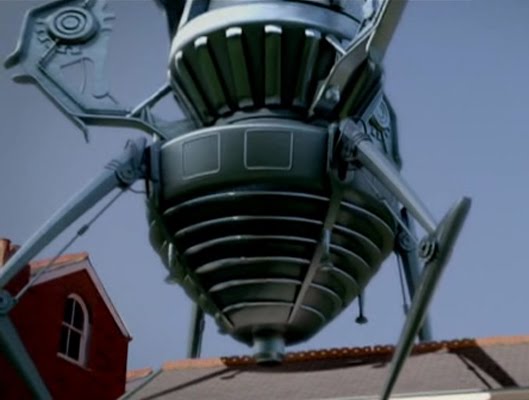
In the meantime though, many long-time Who fans have remarked on the ship’s similarity to the Jagaroth vessel seen in the Tom Baker outing City of Death. And if you have a look at the picture reproduced below, they are not a million miles away design wise, I’m sure you’ll agree. Now for those of you who haven’t seen this story, or can only remember Lalla Ward dressed up as a school girl, the relevant facts are as follows…


The Jagaroth although familiar with the concepts, were not a time travelling species. However during a civil war in the distant past when the Earth was still young, their ship (as seen above) exploded due to a warp engine failure. This resulted in the engines operator Scaroth, being thrust into the Time Vortex and splintered into twelve different sub selves that were scattered throughout Earth’s history. Now as these events took place some 4 billion years ago, it is not unlikely to assume that in later ages, that having noted the effects of this warp malfunction, the Jagaroth have come closer to mastering time travel technology. And hence the ship seen in The Lodger could be an early lost prototype.

It’s not much of an explanation and ultimately will probably proved wrong, but if you really need one it’s as good as you’re going to get for now! So back to the episode in hand…

The Lodger started life as a comic strip in Doctor Who Magazine #368. This was a one-off story centred on the Tenth Doctor staying with Mickey Smith and naturally changed a great deal when it evolved into the current episode. The basic concept, exploring the Doctor flat sharing with an ordinary bloke remained the same, but the dynamics changed considerably with a different Doctor. Now some commentators have questioned why living normally among humans was such as challenge for the Eleventh Doctor, pointing out that previous Doctors – most notably the Third who was exiled to Earth – had no such problems. But the key thing here is that different Doctors have different personalities – and some are better tuned to playing along with our social mores than others. While the Pertwee Doctor was quite assured in human company, the Fourth would struggle to play along if forced into a domestic situation; and Matt Smith’s Doctor is very much in the same eccentric alien mould as the Fourth. But also he demonstrates a Troughton-like twist of calculatedly acting the clown to mask his real activities and nature in this episode, as well as Seventh Doctor secret eye of the bigger picture – all of which suggests to me that he wasn’t struggling as much as it may first appear.

However what I would perhaps question is the placement of this story in the series. As it was such a showcase for Matt Smith to explore his Doctor’s personality maybe it would have made more sense to schedule this story earlier in the season. However you could see this story as just a palate cleanser before the big two part ending; certainly that would fit with this episode’s light tone - making it a sorbet story if you will.

But that said, we’ve not seen the finale yet. This series has had a far greater sense of continuity than previous seasons and while it may seem that The Lodger, bar its coda, is not advancing the Cracks story arc, there is still a lot of thematic threads been added to here. For example, we have perceptions filters name checked again, and the theme of how we see things featuring heavily once more. Plus we have more references to early Doctors and a story that underlines how well the Doctor really actually does understand human relationships. And this last point is perhaps more crucial than it first appears, especially considering how the episode ends with Amy discovering Rory’s ring. Hence while it may not be adding to the details of the plot arc, it would seem that The Lodger is establishing character points that will make more sense once we see the finale - which would explain why its placement here.

But sorbet or not, and niggles aside, I enjoyed this episode; its sense of delight was quite infectious and the performances from our main trio was spot on. It was nice to see Matt Smith get a chance to really revel in the role, Corden was genuinely likeable here, and Daisy Haggard (daughter of Blood On Satan’s Claw director Piers Haggard fact fans) was wonderful as ever. This comic actress has always impressed me, she has great range and it’s high time she got a star vehicle of her own.

While The Lodger may be froth, it was a romp done right. So far this series has been an incredible run of stories, and while not all have been definite classics, equally there have no real dogs either. On the whole, with Moffat at the reins standards have been raised across the board and now all we need to make it the best series so far of new Who is a satisfying finale that ties up all the threads…