Showing posts with label Touch Me. Show all posts

Wednesday, 31 January 2018

THE 'ORRIBLE 'OUSE OF TERRIBLE OLD TAT - The Magic of Merlin


After a somewhat longer than intended Christmas break, welcome dear fiends once again to the crumbling edifice packed with shite that is the 'Orrible 'Ouse of Terrible of Tat! Now then we were last rummaging through this curious collection of pop culture empherea, we had been looking into the ancestry of modern video gaming, specifically the assorted handheld devices that called themselves "electronic games". Now these weren't pocket-sized versions of popular arcade classics - for those would come a little late - but rather in the late '70s there were gadgets using circuits and microchips to make games that could play themselves with you. 

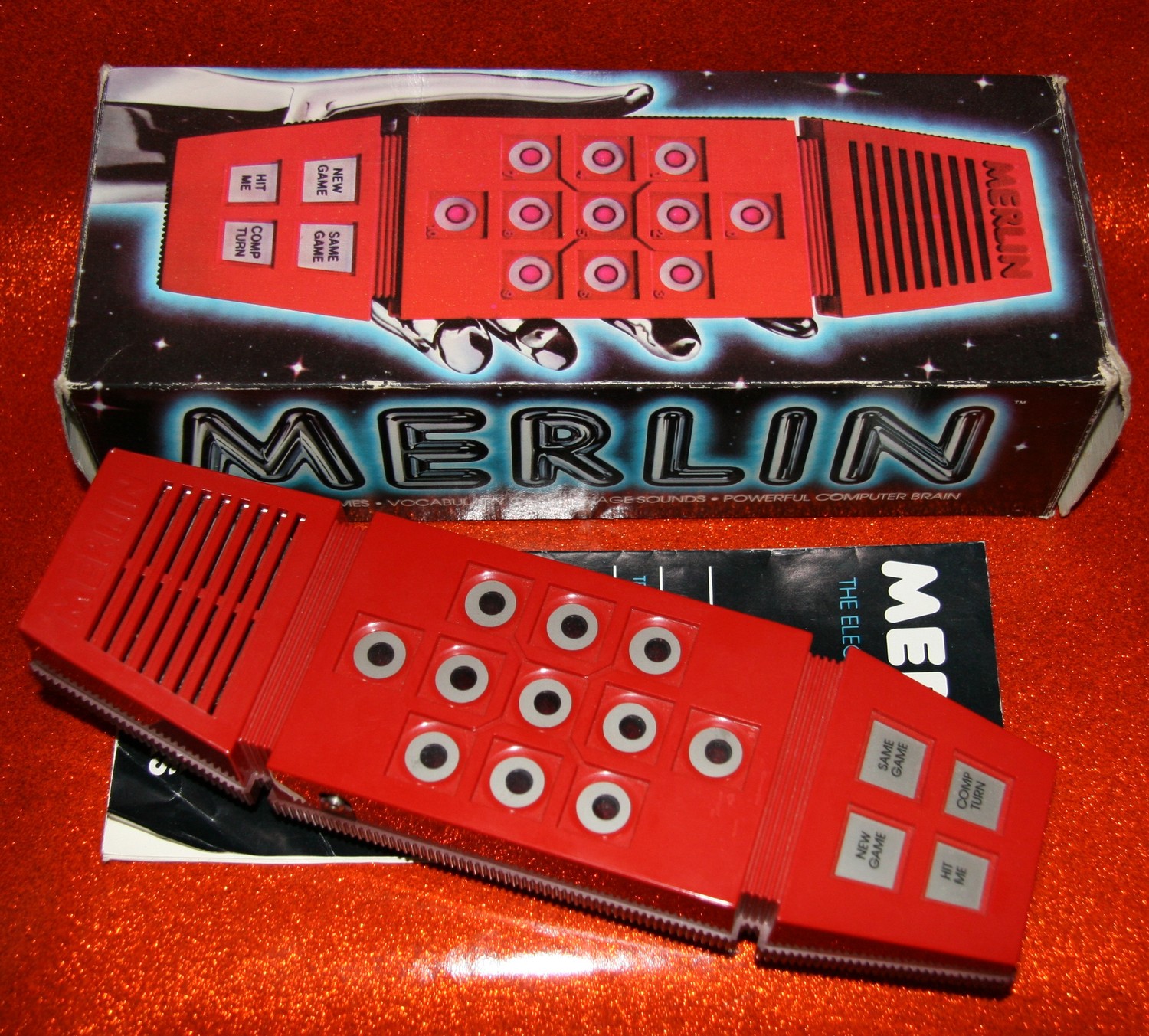
The first superstar of this genre, so popular that it's still around today, was Simon, whose history we charted last time. However Simon wasn't the only kid on the newly built electronic block, for venerable game makers Parker Brothers also had seen the toy potential at the dawning of silicon age. And so in the run-up to Christmas 1978, Simon was locking horns with another bunch of microchips and flashing lights in a plastic case - Merlin

Now despite its name Merlin was not born of the Round Table or cooked up in Camelot, but rather was the brainchild of Bob Doyle, a former NASA engineer, which gives this space-age toy a truly space-age pedigree. Assisted by his wife Holly and his brother-in-law Wendl Thomas, Doyle came up with a device that looked like an over-sized red phone handset studded with eleven buttons that lit up when pressed thanks to inset LEDs. However despite not looking quite as colorful as Simon, Merlin had more than a few tricks up his electronic sleeve, and could in all fairness, quite rightly claim to be a magical marvel of microchippery. Milton Bradley's circular smart-arse might have been heavily marketed as an electronic brain that could think for itself and play against you, but despite looking like a relative of R2D2 who had been flattened in the Trash Compactor, Simon was pretty much a one trick pony. Oh yes, he might have been a clever little bastard, but when you came down to it, he only knew one game.

But Merlin could offer kids not one, not two, not even three, but a whopping SIX different games. And they really were six different games, and not just variant modes of a basic either. Indeed Merlin could convincingly claim to be a whole toybox in electronic form. And the full line-up of electronic delights conjured up by Merlin goes like this... 

1) Tic-Tac-Toe - or Noughts and Crosses as we in this septic isle more commonly call it. Yes, it is as old as the hills, but it is still a classic, and now you could play it against a computer! OK, that doesn't sound terribly thrilling now, but back at the end of the '70s playing a game against a machine was something previously only seen in the realms of SF.

2) Music Machine - Now technically speaking with wasn't a game as such, but more an activity. In this function, Merlin became a primitive synthesizer, with each key on its pad playing a different note. You could program a tune of up to 48 notes and rests - not huge scope there admittedly, but all the same pretty impressive for a toy back then. Certainly there was memory space enough for Merlin to be used as an early sequencer!  The instruction manual also came with some well-known tunes, including tunes as diverse as Beethoven's 9th and Auld Lang Syne, transcribed into ready to program number sequences.


3) Echo - Basically Merlin plays a tune that you had to replicate on the keypad. Yes, very like Simon, but accounting for the development timelines of both toys, I suspect that Doyle and co. had also seen  Atari's Touch Me and, like Simon's creators thought, they could do better.

4) Blackjack 13 - fairly self-explanatory, Merlin plays the dealer for an electronic version of  the famous card game. No gambling involved of course!

5) Magic Square - In this Merlin devised a pattern that the player must deduce from which lights come on or go off when certain keys are pressed.

6) Mindbender - In this game, Merlin ask you to decide deduce a random number - essentially it is an electronic version of the old game Cows & Bulls which earlier had inspired the creation of another best-selling 1970s game we've chatted about before, Mastermind (see here for more details). However the neat thing here, is that you had the option of setting the size of the number, choosing between 2 and 9 digits.

And for more details on all of these games, you can read the original manual online here.

Unsurprisingly "the Electronic Wizard" (as the marketing dubbed him) more than held his own against Simon and would go on to become the best selling toy in America in 1980, notching up sales of over 2 million Merlins in that year alone. Like his rotund rival, Merlin remained popular throughout the '80s, and saw  re-releases periodically over the years. Also like his electronic chum, there were some spin-off versions too, in the shape of Split Second in 1980, Master Merlin in 1981, and Merlin the 10th Quest in 1996.

Now Merlin is just a piece of gaming history, but being a very robust bit of kit, there are still plenty of working units out there. Of course, these days you can play all these games, and hundreds more, on your phone. But considering the unique and eye-catching telephonic design of Merlin, this computerised gadget wasn't just a pioneer of the computerised play, but in a weird way he was a prophecy of the future of gaming! Truly an Electronic Wizard! 


Wednesday, 29 November 2017

THE 'ORRIBLE 'OUSE OF TERRIBLE OLD TAT - Simon Says


Hello dear fiends, and welcome once again to the 'Orrible 'Ouse of Terrible Old Tat! Well then, we are in the toy cupboard once again and continuing our explorations into the strange twilight world of what were known as "electronic games". Now last time we saw how the ancestors of modern handheld video game platforms were a couple of gizmos produced at the end of the '70s.  Mattel Auto Race and Mattel Electronic Football were the first of what would become a huge wave of toys in the '80s, little plastic consoles that delivered a single video game. Yes, they were primitive but they had brought the games arcade into the home, and indeed, into the pockets of kids.

Now we will look at a few more examples of this early form of video gaming in future trips to the 'Orrible Old 'Ouse, but this week I want to look at another particular branch of this toy family. Now the Mattel duo and their descendants sought to recreate an arcade video game experience with chips and some LEDS instead of a real screen. However, around the same time, the first of a new breed of electronic game appeared that wasn't aiming to create a video game in a home or handheld format. Instead these were toys that boasted about microchip brains, games that could play themselves with you!

Our story begins at the Music Operators of America trade show in 1976, where two chaps, Ralph H Baer and Howard J Morrison saw an Atari arcade machine called Touch Me. Now this machine had already been around for a few years, first appearing in 1974, but unlike the games we normally associate with Atari, there were no spaceships, fast cars, things to gobble up or shoot. Instead Touch Me had four big black buttons and a small screen. Basically the machine flashed a sequence of lights at you while making primitive electronic rasping noises, and the player had to press the buttons to replicate the sequence. Baer and Morrison were rather unimpressed - the machine was ugly, the interface dull (all black buttons?!), and the electro-fart sound effects were less than appealing.


And these two chaps weren't just any old passing punters either. Morrison was  - even by the mid '70s - a leading light in the toy industry, working for the legendary Marvin Glass and Associates (click the link to find out why they were so legendary), while Baer had invented a primitive electronic tennis game on a computer which was the forefather of Pong. What's more, Baer had also created the world's first video game console in the shape of the Magnavox Odyssey in 1972, and hence not for nothing he is now known as the father of video games. Now while these learned gents agreed that Touch Me was rather bad, both also thought that the actual game concept - essentially an electronic variant of old playground and kids party perennial Simon Says - definitely had potential.

Hence our two heroes returned to their secret volcano base... (That's not right - Ed) Ok, returned to their workshop at the North Pole (Neither is that, try again - Ed) ... Oh right, returned to wherever it is that toy-makers do their magic, and emerged blinking in the sunlight, to the cheers of elves (Stop that! - Ed) with a round black disc, with brightly coloured panels. And thus Simon was born! Well, at least as soon as they found some batteries to go in it. They thought they had some in drawer but in accordance with one of the fundamental laws of the universe, any toy you buy will require exactly one extra battery of a type that currently you don't have... Even though you'd swear blind you bought a packet of those just the other week. And you put them in that drawer! Who's been in that drawer. eh? C'mon, own up!

Anyhow, once the necessary batteries had been fitted, they were ready to demonstrate this new electronic game. Now much like Touch Me, new boy Simon would light up his coloured panels in a sequence , while making merry beeps, and the player had to replicate them. Now you may say that perhaps this was just stealing Atari's idea, but in fairness as Atari had taken Baer's tennis game and created Pong,  and then later copied his Magnovox to create their own best-selling console, I think it's fair to say that they owed him one. However Baer and Morrison had made some significant advances of their own...


To begin with, the looks and feel of Simon was light years ahead of Touch Me. The round disc design, and brightly coloured lights looked both futuristic and pleasing echoed disco lights and illuminated jukeboxes. Hence it was both space-age and classically retro at the same time. Come to think of it, the curves, beeps and lights also chimed rather well with a certain droid who hit the big screen in 1977 too. However real innovation was perhaps more subtle - for Touch Me was an arcade machine, whereas Simon was designed for the home, and to be played in a group rather than a lone player with an excess of loose change to get rid of. That round disc design was not only visually appealing but perfect for a table or bedroom floor.

Now the marketing of Simon really played up the electronic nature of the game - this was a game you really could play with - a game that played back as it were. And while during its development this new game had been called Follow Me, the name change to Simon was another stroke of genius. Firstly the new name tipped its hat to the game's inspiration, the daddy of all follow and copy game, Simon Says, and in making that connection, people instinctively grasped what this new toy did. Secondly though, giving the toy a "proper" name gave it a personality - something the marketing played up no end. And while the actual electronic gubbins inside Simon were fairly basic, the ads really sold on the idea that this brightly coloured disc was an electronic brain. And that was another winning concept too - where most board games fall down is the fact they you need to get some other humans to play with you. But now you had a game that would happily play with you itself! Naturally a generation who had just fallen in love with R2D2 embraced Simon with open arms.

Simon released in 1978 by Milton Bradley and became the top selling toy that Christmas. Very soon there were several rivals and outright clones on the market. Even Touch Me was resurrected as what were now referred to as a handheld too, although keeping the black and yellow design and the electro farting did little to challenge the dominance of Simon. In the kingdom of the electronic games, the four colour disc was king. And while it's easy to see Simon as relic of those heady days, an iconic of late '70s/early '80s pop culture, our little round pal has continued to sell over the years, in a variety of different formats. There's even a new VR headset version of the old classic! For that design has proved to be iconic and timeless, but more importantly, the gameplay is still there. It's still a whole lot of fun for all the family, or just to play yourself against Simon himself.