Showing posts with label video games. Show all posts

Tuesday, 4 October 2022

COMMENTARY CLUB 067 - Tron


It's cult film time again, and we are voyaging back to the dawn of the video game era to revisit Disney's visionary virtual adventure Tron!

DIRECT DOWNLOAD COMMENTARY CLUB 067 - Tron


Find all the podcasts in the HYPNOGORIA family here plus more articles on the weird and wonderful here-


Sunday, 23 February 2020

HYPNOGORIA 139 - A History of Horror Video Games Part II


In this show we look at horror on the early home computers, with ghastly games released for the likes of the TR-80, the Apple II and the ZX81. Including terrifying titles such as The House of Usher, Deathmaze 5000, Mystery House, Asylum and 3D Monster Maze!

DIRECT DOWNLOAD A History of Horror Video Games Part II


Find all the podcasts in the HYPNOGORIA family here -

HYPNOGORIA HOME DOMAIN - Full archive, RSS feed and other useful links


HYPNOGORIA on TUNE IN

HYPNOGORIA ON GOOGLE PLAY PODCASTS


Sunday, 16 February 2020

HYPNOGORIA 138 - A History of Horror Video Games Part I


This week, we unearth the history of horror in video games. In this episode we explore the birth of video gaming, and take a look at Shark Jaws from Atari, Death Race from Exidy, Hunt the Wumpus on the pc, and Haunted House on the Magnavox Odyssey

DIRECT DOWNLOAD A History of Horror Video Games Part I


Find all the podcasts in the HYPNOGORIA family here -

HYPNOGORIA HOME DOMAIN - Full archive, RSS feed and other useful links


HYPNOGORIA on TUNE IN

HYPNOGORIA ON GOOGLE PLAY PODCASTS


Wednesday, 31 January 2018

THE 'ORRIBLE 'OUSE OF TERRIBLE OLD TAT - The Magic of Merlin


After a somewhat longer than intended Christmas break, welcome dear fiends once again to the crumbling edifice packed with shite that is the 'Orrible 'Ouse of Terrible of Tat! Now then we were last rummaging through this curious collection of pop culture empherea, we had been looking into the ancestry of modern video gaming, specifically the assorted handheld devices that called themselves "electronic games". Now these weren't pocket-sized versions of popular arcade classics - for those would come a little late - but rather in the late '70s there were gadgets using circuits and microchips to make games that could play themselves with you. 

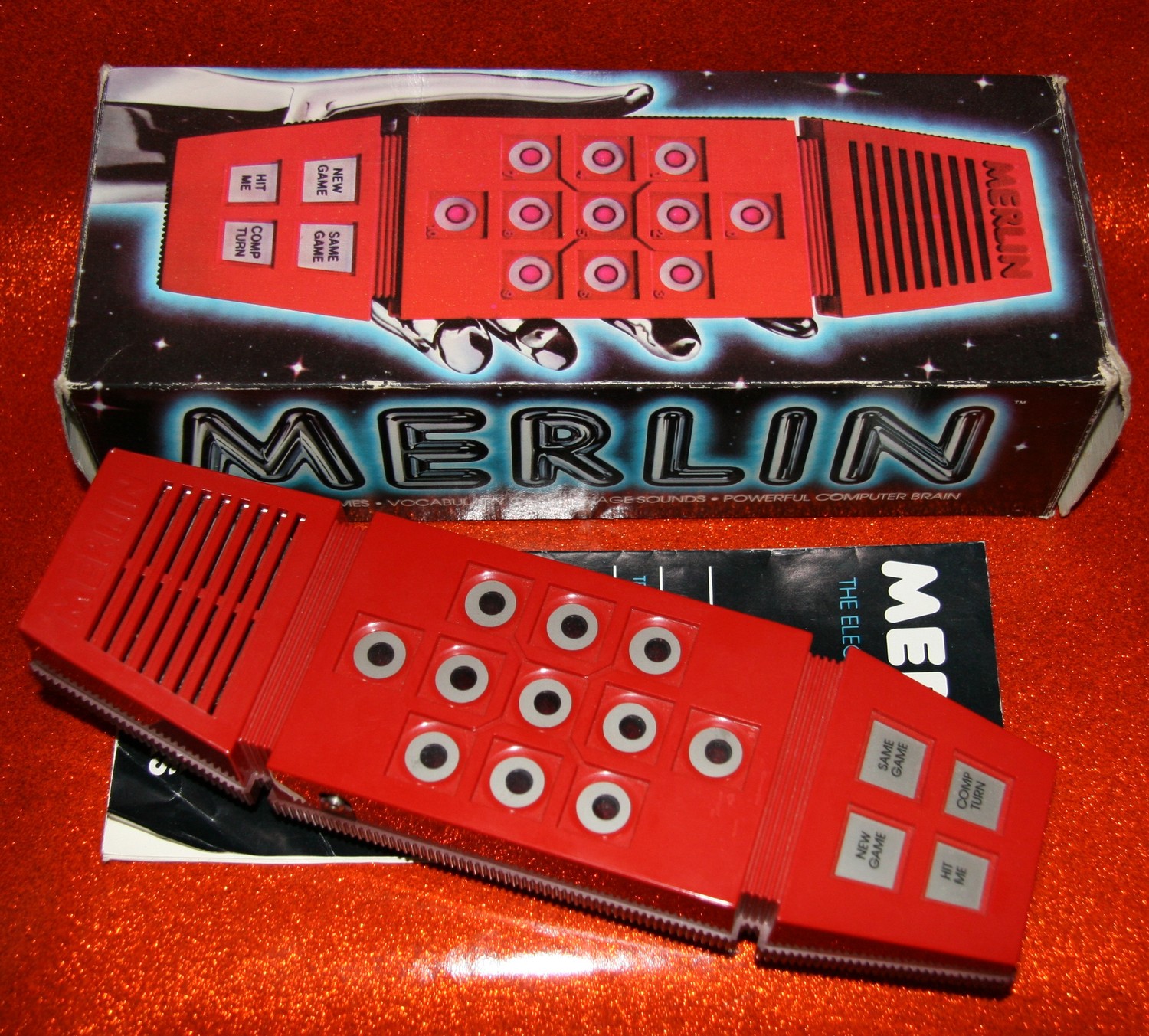
The first superstar of this genre, so popular that it's still around today, was Simon, whose history we charted last time. However Simon wasn't the only kid on the newly built electronic block, for venerable game makers Parker Brothers also had seen the toy potential at the dawning of silicon age. And so in the run-up to Christmas 1978, Simon was locking horns with another bunch of microchips and flashing lights in a plastic case - Merlin

Now despite its name Merlin was not born of the Round Table or cooked up in Camelot, but rather was the brainchild of Bob Doyle, a former NASA engineer, which gives this space-age toy a truly space-age pedigree. Assisted by his wife Holly and his brother-in-law Wendl Thomas, Doyle came up with a device that looked like an over-sized red phone handset studded with eleven buttons that lit up when pressed thanks to inset LEDs. However despite not looking quite as colorful as Simon, Merlin had more than a few tricks up his electronic sleeve, and could in all fairness, quite rightly claim to be a magical marvel of microchippery. Milton Bradley's circular smart-arse might have been heavily marketed as an electronic brain that could think for itself and play against you, but despite looking like a relative of R2D2 who had been flattened in the Trash Compactor, Simon was pretty much a one trick pony. Oh yes, he might have been a clever little bastard, but when you came down to it, he only knew one game.

But Merlin could offer kids not one, not two, not even three, but a whopping SIX different games. And they really were six different games, and not just variant modes of a basic either. Indeed Merlin could convincingly claim to be a whole toybox in electronic form. And the full line-up of electronic delights conjured up by Merlin goes like this... 

1) Tic-Tac-Toe - or Noughts and Crosses as we in this septic isle more commonly call it. Yes, it is as old as the hills, but it is still a classic, and now you could play it against a computer! OK, that doesn't sound terribly thrilling now, but back at the end of the '70s playing a game against a machine was something previously only seen in the realms of SF.

2) Music Machine - Now technically speaking with wasn't a game as such, but more an activity. In this function, Merlin became a primitive synthesizer, with each key on its pad playing a different note. You could program a tune of up to 48 notes and rests - not huge scope there admittedly, but all the same pretty impressive for a toy back then. Certainly there was memory space enough for Merlin to be used as an early sequencer!  The instruction manual also came with some well-known tunes, including tunes as diverse as Beethoven's 9th and Auld Lang Syne, transcribed into ready to program number sequences.


3) Echo - Basically Merlin plays a tune that you had to replicate on the keypad. Yes, very like Simon, but accounting for the development timelines of both toys, I suspect that Doyle and co. had also seen  Atari's Touch Me and, like Simon's creators thought, they could do better.

4) Blackjack 13 - fairly self-explanatory, Merlin plays the dealer for an electronic version of  the famous card game. No gambling involved of course!

5) Magic Square - In this Merlin devised a pattern that the player must deduce from which lights come on or go off when certain keys are pressed.

6) Mindbender - In this game, Merlin ask you to decide deduce a random number - essentially it is an electronic version of the old game Cows & Bulls which earlier had inspired the creation of another best-selling 1970s game we've chatted about before, Mastermind (see here for more details). However the neat thing here, is that you had the option of setting the size of the number, choosing between 2 and 9 digits.

And for more details on all of these games, you can read the original manual online here.

Unsurprisingly "the Electronic Wizard" (as the marketing dubbed him) more than held his own against Simon and would go on to become the best selling toy in America in 1980, notching up sales of over 2 million Merlins in that year alone. Like his rotund rival, Merlin remained popular throughout the '80s, and saw  re-releases periodically over the years. Also like his electronic chum, there were some spin-off versions too, in the shape of Split Second in 1980, Master Merlin in 1981, and Merlin the 10th Quest in 1996.

Now Merlin is just a piece of gaming history, but being a very robust bit of kit, there are still plenty of working units out there. Of course, these days you can play all these games, and hundreds more, on your phone. But considering the unique and eye-catching telephonic design of Merlin, this computerised gadget wasn't just a pioneer of the computerised play, but in a weird way he was a prophecy of the future of gaming! Truly an Electronic Wizard! 


Wednesday, 29 November 2017

THE 'ORRIBLE 'OUSE OF TERRIBLE OLD TAT - Simon Says


Hello dear fiends, and welcome once again to the 'Orrible 'Ouse of Terrible Old Tat! Well then, we are in the toy cupboard once again and continuing our explorations into the strange twilight world of what were known as "electronic games". Now last time we saw how the ancestors of modern handheld video game platforms were a couple of gizmos produced at the end of the '70s.  Mattel Auto Race and Mattel Electronic Football were the first of what would become a huge wave of toys in the '80s, little plastic consoles that delivered a single video game. Yes, they were primitive but they had brought the games arcade into the home, and indeed, into the pockets of kids.

Now we will look at a few more examples of this early form of video gaming in future trips to the 'Orrible Old 'Ouse, but this week I want to look at another particular branch of this toy family. Now the Mattel duo and their descendants sought to recreate an arcade video game experience with chips and some LEDS instead of a real screen. However, around the same time, the first of a new breed of electronic game appeared that wasn't aiming to create a video game in a home or handheld format. Instead these were toys that boasted about microchip brains, games that could play themselves with you!

Our story begins at the Music Operators of America trade show in 1976, where two chaps, Ralph H Baer and Howard J Morrison saw an Atari arcade machine called Touch Me. Now this machine had already been around for a few years, first appearing in 1974, but unlike the games we normally associate with Atari, there were no spaceships, fast cars, things to gobble up or shoot. Instead Touch Me had four big black buttons and a small screen. Basically the machine flashed a sequence of lights at you while making primitive electronic rasping noises, and the player had to press the buttons to replicate the sequence. Baer and Morrison were rather unimpressed - the machine was ugly, the interface dull (all black buttons?!), and the electro-fart sound effects were less than appealing.


And these two chaps weren't just any old passing punters either. Morrison was  - even by the mid '70s - a leading light in the toy industry, working for the legendary Marvin Glass and Associates (click the link to find out why they were so legendary), while Baer had invented a primitive electronic tennis game on a computer which was the forefather of Pong. What's more, Baer had also created the world's first video game console in the shape of the Magnavox Odyssey in 1972, and hence not for nothing he is now known as the father of video games. Now while these learned gents agreed that Touch Me was rather bad, both also thought that the actual game concept - essentially an electronic variant of old playground and kids party perennial Simon Says - definitely had potential.

Hence our two heroes returned to their secret volcano base... (That's not right - Ed) Ok, returned to their workshop at the North Pole (Neither is that, try again - Ed) ... Oh right, returned to wherever it is that toy-makers do their magic, and emerged blinking in the sunlight, to the cheers of elves (Stop that! - Ed) with a round black disc, with brightly coloured panels. And thus Simon was born! Well, at least as soon as they found some batteries to go in it. They thought they had some in drawer but in accordance with one of the fundamental laws of the universe, any toy you buy will require exactly one extra battery of a type that currently you don't have... Even though you'd swear blind you bought a packet of those just the other week. And you put them in that drawer! Who's been in that drawer. eh? C'mon, own up!

Anyhow, once the necessary batteries had been fitted, they were ready to demonstrate this new electronic game. Now much like Touch Me, new boy Simon would light up his coloured panels in a sequence , while making merry beeps, and the player had to replicate them. Now you may say that perhaps this was just stealing Atari's idea, but in fairness as Atari had taken Baer's tennis game and created Pong,  and then later copied his Magnovox to create their own best-selling console, I think it's fair to say that they owed him one. However Baer and Morrison had made some significant advances of their own...


To begin with, the looks and feel of Simon was light years ahead of Touch Me. The round disc design, and brightly coloured lights looked both futuristic and pleasing echoed disco lights and illuminated jukeboxes. Hence it was both space-age and classically retro at the same time. Come to think of it, the curves, beeps and lights also chimed rather well with a certain droid who hit the big screen in 1977 too. However real innovation was perhaps more subtle - for Touch Me was an arcade machine, whereas Simon was designed for the home, and to be played in a group rather than a lone player with an excess of loose change to get rid of. That round disc design was not only visually appealing but perfect for a table or bedroom floor.

Now the marketing of Simon really played up the electronic nature of the game - this was a game you really could play with - a game that played back as it were. And while during its development this new game had been called Follow Me, the name change to Simon was another stroke of genius. Firstly the new name tipped its hat to the game's inspiration, the daddy of all follow and copy game, Simon Says, and in making that connection, people instinctively grasped what this new toy did. Secondly though, giving the toy a "proper" name gave it a personality - something the marketing played up no end. And while the actual electronic gubbins inside Simon were fairly basic, the ads really sold on the idea that this brightly coloured disc was an electronic brain. And that was another winning concept too - where most board games fall down is the fact they you need to get some other humans to play with you. But now you had a game that would happily play with you itself! Naturally a generation who had just fallen in love with R2D2 embraced Simon with open arms.

Simon released in 1978 by Milton Bradley and became the top selling toy that Christmas. Very soon there were several rivals and outright clones on the market. Even Touch Me was resurrected as what were now referred to as a handheld too, although keeping the black and yellow design and the electro farting did little to challenge the dominance of Simon. In the kingdom of the electronic games, the four colour disc was king. And while it's easy to see Simon as relic of those heady days, an iconic of late '70s/early '80s pop culture, our little round pal has continued to sell over the years, in a variety of different formats. There's even a new VR headset version of the old classic! For that design has proved to be iconic and timeless, but more importantly, the gameplay is still there. It's still a whole lot of fun for all the family, or just to play yourself against Simon himself.


Monday, 22 November 2010

Dig For Victory - The Glory of MINECRAFT !


Back when video games were young and dinosaurs ruled the earth, I recall that one fine day an old chum came to visit. Having tethered his pteradon, he dashed up the drive way carrying a strange black box and demanded access to my television’s rear. Despite fearing that my idiot lantern was about to be molested, I let him have his way...

...And thankfully rather than being an early form of teledildonics, that black box of tricks turned out to be was the ill-fated Sega Saturn and what he had to show me was the father of the RTS genre, the original Command & Conquer which he memorably described as “like playing with Airfix toy soldiers again... But the best thing is you don’t have to do all that tedious tidying ‘em away afterwards!”. Needless to say I was very soon hooked again on video games, and the release of the sequel Red Alert was a major factor in buying my first proper PC, and so without that game you might not be here today reading this rambling introduction.

However aside from commanding miniature plastic armies, my favourite toy was Lego. These incredibly painful to stand on in bare feet building blocks* dominated my childhood – a Lego set was one of the earliest Christmas presents I remember, and the huge crate of bricks it eventually became was the last toy to be resigned to the darkness of the attic.

Now there have been many games over the years, including the original Command & Conquer, that have in some way recaptured the love of building stuff that Lego used to deliver. However despite the extensive world building offered by many titles down the years, none have quite completely captured the joys of those multi-coloured plastic bricks, even games bearing the Lego name. That is until the dawn of Minecraft

WARNING! Reading further may lead to you never getting a single damn thing done ever again!

No, seriously! This game is probably more addictive than crack, more dangerous than cake, and more reality warping than the true black meat (the flesh of giant aquatic Brazilian centipede)!

And I take no responsibility for loss of earnings, health issues, relationship break-downs, or any other resultant conditions or circumstances stemming from becoming a minerholic after reading this review...

So with that dire warning and ad hoc legally binding agreement in place, now read on...

To quote its maker, "Minecraft is a game about placing blocks while running away from skeletons. Or something like that”.

What? That’s not sold you already? Oh alright...

In my previous musings on video games, I remarked on my worries that as the hardware wars progress, with bigger and flashier consoles flooding the market on a regular basis, that little attention was being paid actual gameplay, and that the imagination and creativity of blokes hammering out code in bedrooms that spawned so many classic titles over the years was being lost in a fog of corporations and a mire of massive development teams. Indeed it would seem to appear that increasingly modern games are simply retreads of old titles in new and gaudier clothes; fifth hand ideas and concepts tarted up with graphics many times more advanced than their sources but often delivering a fraction of the gameplay of their grandfather titles.

However Minecraft is a glorious return to the days of independent development – it’s wonderfully imaginative, utterly immersive and serves up hours of fun. It’s the creation of just one guy - Markus Alexej Persson, or Notch as he is known to minecrafters the world over. It’s a sandbox game that has been released online - www.minecraft.net
- which you can play in your web browser, or if you buy it, download and play offline. And even though it’s not actually finished yet, already the game is becoming something of a phenomenon.

Minecraft comes in two flavours Classic and Alpha. Classic is available to play for free online and is an early incarnation of the game. It’s missing a lot of the features now in the current version Alpha, but it does give you a taste of what it’s all about, so do go and have a look for yourselves!

On your first look at the world of Minecraft Classic, if you’re not into retro-gaming you may well wonder what all the fuss is about as the graphics look somewhat primitive. But once you start wandering about a bit it all starts to make sense – it’s like rambling through a brand new world made from Lego; it’s colourful and slightly surreal as everything is made from blocks including the shining square sun but utterly charming.

You have an inventory of different blocks and items to build with. A left click with the mouse lets you dig by destroying blocks in the landscape and right clicking places a new block or item. Now although there are no enemies to fight or stuff to harvest and make, it is tremendous fun just messing about trying to build something. A simple pleasure to be sure, but after a few hours of arsing around attempting making a house and generally having a whale of a time, I was warming up the old credit card to get the full version Alpha.

Now Alpha, again the game randomly generates a world composed of blocks and you are free to explore, build and generally muck about to your hearts content. There are no missions, levels or any of that bobbins – you are completely free to do as you will. Of course, as the game’s title suggests, there are great caverns beneath the earth to discover and forgotten dungeons filled with goodies to loot and baddies to vanquish.

But unlike Classic, in this world you have to collect all the blocks you need, so you have to harvest wood, hunt animals, make tools, dig for ore and make all kinds of gadgets and items. However in Alpha the perpetual sunny afternoon of Classic is gone and there is a day and night cycle... And at night the monsters spawn; giant spiders and zombies that reckon you are tea, vicious skeletons that will turn you into a pin cushion with their deadly arrows, and the dreaded creepers which sidle up to you and explode, not only killing you but blowing up everything nearby.


"Sod off! I'm trying to build an aqueduct!"

When you die you respawn and there are no limits to the amount of lives you have. Now some might say that this effectively takes away any challenge, but believe me dying is to be avoided. You see, when you die you drop all the equipment and goodies you’ve gathered, which is a major pain when you’ve worked for ages to create some high quality armour and diamond tools and are loaded to the gills with precious materials. Usually most of it will be lying at the site of your death to pick up again but it is a major headache to reclaim it if that location happens to be far away from the fixed point where you always respawn and/or in an area crawling with monsters.

But while the assorted monsters provide the necessary degree of challenge for a good game, the real fun comes with the creativity. To begin with, a tremendous amount of imagination has gone into the game design, such as a very clever system of crafting different items by combining them in different patterns on a 3 x 3 grid in the inventory. And in terms of gameplay, it’s great fun to try out different combinations of things to and see what appears. But also the game really fires your own imagination – once you get your living arrangements sorted out, do you want to go exploring, delve into dungeons, start farming or perhaps build a giant statue of Homer Simpson?

The genius of Minecraft is that you can do all these things and more. It combines the best elements of RTS, god sims, first person shooters and RPGs but also manages to be a canvas for your creativity. And almost equally addictive as the game itself is looking online at what other people have created in their blocky Edens. YouTube is awash with videos of folk showing off their endeavours - for example, here's a fellow who is building a 1.1 scale replica of the New Gen Enterprise! Impressive stuff to be sure but this team project - a recreation of York Minister in Minecraft - is even more breath taking. Check out these shots - here's an exterior view and this is the choir and altar inside. However to see really see the full beauty of this epic Minecraft construction, check out this video that shows it's construction and tours the finished edifice. It is truly incredible what wonders you can create in this game!

One word of warning however, Minecraft comes with no instructions and you will need to regularly consult the Minepedia wiki to identify items you’ve found or things you’ve encountered. However I’m sure that eventually the game itself will incorporate a tutorial and tool tips. So then, when starting out I would recommend checking out this First Night Survival Guide.

Also if you want to see the game in action and gains some handy advice for how to play, I highly recommend watching SeaNanners' series of Minecraft videos on YouTube. Not only are they are wonderful introduction to how the game plays and a great source of tips, they are also highly entertaining, and often hilarious.


Dawn chez Moon

As I said earlier Minecraft still isn’t actually finished. However it is still fully playable, with the updates being tweaks and additional fun stuff. For example, a major update was released this Halloween which along with adding the ability to make jack-o-lanterns out of pumpkins, introduced a whole other dimension, the Nether to travel to via magic portals. This spooky realm is the Minecraft equivalent of Hell - full of new strange creatures and resources.

And if you do buy Alpha, all subsequent updates and upgrades are free. But as the game is still being developed, Minecraft is currently going for half price which is just under a tenner. Now this is an absolute bargain, but in all fairness, it will still be a steal at £20 when it’s finished.

Why? Well it’s simply the sheer amount of time you can lose playing this game – these days most big name games are often only delivering 20 or 30 hours of gaming before the story runs out. But with Minecraft, as it’s a sandbox game, the only end is when you’ve decided you’ve had enough, and oh boy do you get a lot of game time out of Minecraft - I’ve only had the purchase version for four days and already I’ve had well over 30 hours of gameplay out of it and I’m still just getting to grips with the basics of the game!

But aside from delivering the very best value for money, Minecraft is just an absolute joy to play. I don’t know about you, but I’ve found that over the years increasingly mission and level based games often end up uncompleted in my hands for the simple reason that after a while the game just starts to become more a chore than a fun challenge. Let’s be honest, often in a shooter or RTS you end up wishing they’d just ditch the *ahem* story line, which seems to involve each progressive level becoming more of a massive pain in the arse, and just let you play with all the toys in the game world.

But Minecraft let’s you completely off the leash, with the great god Notch giving you a world of your very own and saying ‘Go ahead, play!”. You make your own story in this game, and whether it turns out be a tale of being the architect of wondrous castles, a farmer, a delver in the dim secrets being the earth’s crust, or even a landscape artist, it’s never anything less than complete fun.

Call me cynical but the bigger the games market becomes it seems the less game content we are being delivered - as games studios always have their eyes on flogging you an expansion pack or a revamped version the following year. Minecraft feels like a return to the simpler values of old – born of a desire to create a fun filled game that you can happily play with for weeks rather than just a handful of hours. And this desire to simply make an excellent game shines through in the myriad ways you can amuse yourself in a world of brightly coloured blocks.

In short, Minecraft is a real triumph of rewarding gameplay over flashy gimmicks, and proof that one man with imagination is still more than a match for bloatware titles made by vast development teams. It’s also a massive victory for independent development and distribution. But perhaps best of all Minecraft is a gigantic win for gamers everywhere.


*”Put your slippers on!!!” – my Mum, virtually every day as a nipper

Thursday, 1 October 2009

DARK FALL: THE JOURNAL


Video games are often seen as the poor country cousin of the other creative industries. Even when the gaming industry is stealing an increasing number of punters away from cinema, television and music, its elder siblings tend to blame their decreasing audiences on illegal downloading rather than acknowledge there’s a new kid on the block. Video games tend be viewed as a species of toy rather than a medium in itself, and rightly or wrongly, video games are seen as incapable of delivering the same level of art as a good film, a literary novel or a classic album.

Unusually for a medium that is over three decades old – the first widely available video game being the coin-op Computer Space in 1971 – there are still no clear aesthetics in place for judging a game’s artistic values. And when the mainstream media covers video gaming, it concentrates on just two things - either the latest hardware/title as the tax on parents’ pockets at Christmas, or outrage over the violent content - effectively writing off gaming as either a gimmicky consumer craze or a medium analogous with cheap exploitation films.

It’s a somewhat ironic state of affairs, as the mainstream media has been banging on about ‘interactivity’ for the last few years and at the same time ignoring the most interactive new medium of all. Frequently the concept of interactive story telling is predicted as the Next Big Thing in film and television but video games have been delivering this style of content for years.

But all too often, games are written off as merely serving up shallow repetitive thrills and being incapable of delivering an emotionally engaging experience. And it’s true many games are repetitive, shallow and catering to the lowest common denominator. Yet, the same charges apply equally for a great many blockbusters and TV shows, or for that matter any art form. As the famous Sturgeon’s Law points out “Ninety percent of everything is crud”.

The closest the video game has come to being recognised as an art form was with Myst. This adventure title was ground breaking in many ways; no only did it help popularise the CD rom disc as a format and take the adventure game to a new level of sophistication, but it’s blend of striking imagery and immersive story led it to be hailed by the likes of Wired magazine and even the New York Times as signs that the video game was in fact evolving into art.

However despite Myst spawning as many clones as its contemporary Doom, an equally ground breaking title, not long after the adventure game started to decline in popularity. And largely this was due to the huge advances in graphics. The advent of chipsets able to render 3D environments populated with numerous polygon denizens brought exciting new depth and dynamics to RPGs, sports sims, and most of all, first person shooters, but left the adventure genre behind. The point and click slideshow format now looked very static and so the adventure genre found itself slipping into a niche market.

But also this waning of popularity was perhaps partly due to the hordes of Myst-clones themselves, which often consisted of little other than pretty scenes framing logic puzzles. However of all the different types of video games, the adventure genre was always the closest to that fabled media grail, interactive fiction and some did see the potential to create a title that could combine artistic and literary depth in the game format…

Now, over the last few years, I had become somewhat disenchanted with the whole video gaming shebang. I was finding that increasingly new games were just retreads of older titles but with ever flashier graphics, and fostering the feeling that I really should be finding more constructive ways of spending my time. However while reading various internet forum discussions on what were the scariest games of all time, as well as a good many of my old favourites like Doom, Quake, Resident Evil, Thief The Dark Project and Silent Hill, one name kept coming up which had bypassed my radar – Dark Fall: The Journal.

Some cursory research revealed the reason for this – Dark Fall was a point and click adventure, released for the PC back in 2002. Now I’d played Myst and a few other adventure titles back in the day, but like a lot of gamers of my generation I’d been seduced away from the genre with the advent of 3D environments, and despite hearing glowing reports about Myst’s successors such as Gabriel Knight and Broken Sword, I’d never bothered to check them out, being more interested in games that offered a wide range of weaponry than puzzle solving.

However now I was somewhat bored with slinging rockets, building armies and crashing cars, and so checking out something that offered a less familiar style of gameplay seemed just the ticket. But more importantly, I was highly intrigued by the accounts of the sheer terror and dread this game invoked. And better yet several people were claiming this game captured the eerie strangeness of the ghost stories of MR James and of cult TV series Sapphire & Steel – two of my all time favourites in the field of weird fiction. And so I took the plunge and tracked down a copy…


“I know what you’re thinking - he only ever phones if there’s something wrong. Well there is something wrong. Very wrong… Come to Dowerton Station, it’s abandoned. I’ll be waiting. I really need your help on this… The sooner you can get here the better as this place is beginning to freak me out… I can hear it. It’s right outside my door, whispering. Whispering my name... It knows my name!”

And so begins Dark Fall: The Journal. Once you arrive at the derelict Dowerton Station, you discover your brother has vanished, as have two student ghost hunters. However you are not entirely alone, for the unquiet dead haunt the long closed down station and a dark presence stalks the empty rooms and corridors…

The game’s premise is fairly straight forward – explore the station and its attached hotel and unravel the mystery behind the disappearances. Unlike other games, there aren’t a series of levels to work through; rather there is just one expansive location to explore as you like. And as you make your way through the dim rooms and shadowed corridors, you gradually piece together the story of the strange events that have occurred here.

Technically the environment is presented as a series of screens and the main interface is a cursor, which as you explore the scene, changes to show you the different directions to move in, things to examine and objects you can interact with. Now at first this may seem a little primitive to those of you who are more used to galloping about 3D environments, but hey this is quite an old game. However this old school system does have its advantages, chiefly that you can get more one end of the station to the other very quickly, cutting down all that tedious trudging about that often blights a lot of first person perspective games – what a friend of mine refers to as ‘keying about’ i.e. having to troll through a lot of already cleared areas to return to unlocked a door at the other end of the level.

More importantly, the screens still look pretty lush even on a new high end system. As you can see from the screenshots, Dark Fall’s graphics have the feel of illustrations rather photo realism, which brings the game a good deal of atmosphere and a look all of its own. Also the screens aren’t entirely static – small touches of animation bring the scenes to life with flickering lamps, mysterious lights flitting about and ominous moving shadows.


However where the game really impresses is the use of sound. Dark Fall uses audio in the same unsettling way as the classic The Haunting (1963); Dowerton is alive with eerie creaks, taps and scrabbling, not mention the voices of the long time dead. Like Robert Wise before him, creator Jonathan Boakes understands that often the most frightening things are those which you can hear but cannot see.

In terms of gameplay, like most adventure games the emphasis is on finding objects and clues rather than amassing weapons. There are no hordes of monsters and ghouls to slay but there is a dark force to be defeated here. And you will do it through detective work rather than firepower, and having played a great many horror themed shooters, I have to say it was a disconcerting experience not having the usual shotgun at my side.

Which brings me to a key point – from Doom onwards there have been many games where inspire fear – any regular gamers will know what I mean – the slow edging through darkened corridors and the shock as some beast leaps out of the shadows to attack you. However the thing is, the various monsters that stalk first person shooters very quickly lose their fear factor; once you work out which weapon takes them down effectively the creatures that early in the game inspired dread very quickly become mere inconveniences.

Now as Dark Fall is an investigation rather than a bug hunt, the game is populated by presences rather than enemies. So you have the growing feeling that you are not alone, that there are unseen malign forces gathering in the shadows, and a sudden crash or a disembodied voice will have out leaping out of your skin as much as any lurking zombie attack. But that sense of terror is never deflated by combat and the eerie atmosphere Dark Fall builds doesn’t dissipate when you turn off the game. Indeed after a few hours exploring the deserted station, an unexpected creak from somewhere in your own home will have your heart racing.

Make no mistake, this is a very frightening game and like the best ghost stories and the best horror films is best enjoyed at night, alone and in the dark. It really is a master class is atmosphere and suggestion. However there is a good deal more to Dark Fall than some finely crafted chills.

The first frequently encountered curse of the adventure game is pixel hunting. For those who don’t know, pixel hunting is the tedious process of having to carefully sweep the mouse over every inch of the screen in order to discover a hot spot only a few pixels wide. Thankfully Dark Fall avoids this, with all the hot spot areas being of a reasonable size.

The second curse is the arbitrary puzzle, as countless Myst clones discovered, with lots of titles comprising of little other than a selection of puzzles linked by the sketchiest framing device. Now there are plenty of puzzles to solve in Dark Fall, but they are skilfully woven into the story and fit logically into the setting. Hence there are torn up notes to reassemble, combinations to find and codes to crack. And there plenty of clues, and in many cases solutions, dotted around to find. Basically to resolve the challenges of the game as a real detective would, working methodically and thinking logically rather than being a subscriber to Logic Puzzler monthly. Often I found that when I was utterly lost as to how to solve something, nine times out of ten it was because I hadn’t yet found the relevant hint or clue yet. Furthermore, the game has an ingenious inbuilt hint system for the bewildered – one of the first spirits encountered can be consulted for clues on any sticky issues.

Like many of you out there, I’ve always fancied trying my hand at sleuthing, and like a lot of horror fans, I‘ve always been tempted to give ghost hunting a go. Dark Fall allows you to do both in a highly satisfying and realistic manner. There’s a real sense of accomplishment when you finally work out the solution to some problem or discover a piece of evidence that that ties two elements of the mystery together.

And in this regard, Dark Fall actually delivers a fuller role playing experience than most video game RPGs. To begin with, the setting is highly immersive; the Dowerton station feels like a real place and the game conjures up a distinct atmosphere for this beautifully rendered location. Secondly, you do not only have to think like an investigator, but also act like one – unless you are blessed with a photographic memory, you will need to record your findings as you explore. And if you play in the dark as I did – which I highly recommend – with the only illumination being the monitor screen you’ll need a torch to flick on while you scribble down notes or sketch a copy of one of the many strange arcane symbols.

There is a great deal of depth to Dark Fall. As well as piecing together the events of the central mystery, equally intriguing is uncovering the intertwining stories of the former residents. Rather than mere ciphers for plot development, real characters emerge as you investigate. And this not only lends verisimilitude to the unfolding spooky tale but gives Dark Fall literary weight – the story is not just one of ghostly phenomena but of history and the relationship between the past and the present.

There are also plenty allusions and references made to other works which adds to the fun for the literate gamer. Any fans of Sapphire & Steel will be instantly reminded of Assignment 2, and as you investigate it becomes clear that this is intended to be the same deserted railway station in that story. And additionally there are several nods to the great MR James. Thematically Dark Fall explores the same territory of both Sapphire & Steel and the Jamesian school of ghost stories, playing with the concepts of time out of joint and the baleful influence of the past breaking into the here and now, but creating something that is unique to itself rather than a mere pastiche or tired retread of either.

In a medium so often decried for its shallow story telling, Dark Fall delivers a well rounded narrative. And as the nature of the game allows you to roam at will, doing things in no set order, what we have here is a non linear text in which no two players will experience in the same way but still telling the same coherent story – something that cannot be said for many experimental novels that attempt something similar.

Dark Fall is a tour de force on many levels, and is all the more impressive for being the work of one man, Jonathan Boakes. In my earlier piece on video games, I made much of the value of gamers being able to make games themselves, and Dark Fall is the perfect example of this. Although made with limited means, like a lot of great works, these constraints have inspired creativity, invention and imagination. And the strength of having one man with vision rather than a committee is borne out here.

Since Dark Fall, Boakes has produced a sequel, contributed to a similar eerie investigation game Barrow Hill, and most recently released The Lost Crown, a highly ambitious ghost hunting adventure. Expect reviews of all of these in due course! Currently he’s working on Dark Fall: Lost Souls which hopefully will be released very soon.

Jonathan Boakes himself has said that his games are really interactive ghost stories and really there is no better description of Dark Fall. If Myst was hailed as showing evidence that video games could approach the realms of art, then surely Dark Fall is the proof that the medium can deliver as a form of literature, if not art itself.

Dark Fall has recently been reissued as a special edition available here. This version has been polished and tweaks to run on modern computers and comes but also a host of other goodies. Firstly there is its sequel Dark Fall: Lights Out – appearing in here in a heavily revised Director’s Cut. If the first game riffs on Sapphire & Steel the second takes the scifi gothics of Philip Hinchcliffe era Doctor Who as its inspiration. Additional you also get walkthrough guides to both games by Boakes himself, a rather lovely ebook collecting some of his favourite classic ghost stories and a CD of the marvellously evocative music of both games.

So as the nights are drawing in and the days are growing shorter, it’s the ideal time of year to check out Dark Fall: The Journal, while the shadows lengthen and the air is haunted by mists. Needless to say I heartily recommend it – not only is it one of the scariest games I’ve ever played (actually it was the scariest game I ever played … until The Lost Crown), but also one of the most satisfying.


Friday, 28 August 2009

Some Thoughts on Video Games...


What follows is a rambling tangent that was originally part of the next review proper. But in the interests of length and relevance, it got cut. So instead I’m presenting it here as a separate piece – think of it as a DVD extra to the coming review!


Now I grew up with video games, being born only slightly before them. I remember vividly the excitement of the Space Invaders craze, with breathless reports trickling in from class mates returning from visits to the seaside, that traditional cornucopia of slot machines and arcades, of this new type of game where you could shoot alien spaceships. Then there were the first home consoles, which offered twenty plus different games and a distinct lack of pocket straining amounts of ten pence coins. Admittedly the games were just Pong tricked out with slightly different graphics to create other sports like football and hockey but these ‘television games’ as they were first called, were still incredibly exciting.

And even better was to come. With the Atari and various hand-held one game gizmos, at last you could play the likes of Space Invaders, Pac Man and Asteroids in the comfort of your own home. But perhaps the most magnificent and influential era came with the birth of the microcomputer. For a start, have a computer in your own house was a sci-fi dream come true – surely the age of hover cars, domestic robots and jet packs was surely not far away now…

Of course, we vastly over estimated the potential of those early machines, but you have to remember that we’d all grown up with the idea that that a computer was a super machine brain that could do anything thanks to decades of science fiction. Computers were unusual and exotic devices back then, and the general attitude to computers is perhaps best encapsulated by a piece of graffiti inscribed into a desk at my school that read “God’s only clever because he’s got a ZX81” – a claim that gets more hilarious with every passing year.

But despite the disappointment that your Spectrum or Commodore 64 wasn’t going to give Hal 9000 or Orac a run for their money any time soon, it did deliver something far better. With a humble micro, not only could you copy games easily from your mates (thus beginning modern piracy) but you could actually create a video game yourself. And naturally many of us had a crack at it, and also many of us found that programming involved a lot of tedious typing out lines of gibberish and included more mathematics than we were comfortable with. But others succeeded and several school boys not only made small fortunes but began a long and noble tradition of independent game development.

With the decline of the microcomputer and the rise of the next generation of consoles, the Sega Megadrive and Nintendo’s SNES for a while video game creation drifted back into the hands of the professionals. However with the advent of Windows and the birth of the modern home computer in the nineties, once again programmers in bedrooms and garages started creating again on a large scale.

Often in the field of computing, breakthroughs come out of the left field and gaming is no exception with some of the most innovative games been created by small teams rather than vast corporations. Little companies like id, Westwood and Cyan Worlds not only gave us such landmark titles as Doom, Command & Conquer and Myst but also spawned whole genres of video games. Roughly speaking, it would seem that every time the home computer becomes the favourite platform for video gaming, there is a blossoming of creativity within the industry and the parameters of the games themselves change.

The magic of the home computer as a gaming platform is that it allows gamers to enter the world of game creation. For example, Doom was a defining moment for the first person shooter but where it was truly ground breaking was that it allowed ordinary gamers to create skins, write levels and modify the engine to create new games. The influence of this ‘mod-ability’ of PC titles is not to be underestimated. Many people currently working in the gaming industry got started by designing such add-0ns for their favourite titles. And more broadly, this type of bedroom tinkering has got many people into coding and graphics work.

Indeed I myself, was inspired to get to grips with the Photoshop from a desire to create a skin of my much loathed driving instructor for Quake 2. And my first steps in the world of coding came from creating skins for Quake 3 Arena which required the creation of text files to instruct the game engine on which part of the models to apply my custom graphics.

However, currently the focus of the industry is on the hardware rather than the game content. The main evolution in recent years has been the Wii, which is changing the way we play games. With the Xbox and the Playstation hurriedly developing similar motion controls, at the moment it would seem that game content is taking a backseat. And with sports sims flourishing again thanks to these new controllers, it looks like console gaming has come full circle.

Of course all of this has happened before; indeed video gaming as a medium has advanced through periodic cycles in which either the gameplay or the technology dominates industry trends. It’s a pattern in which either the hardware or the software becomes the arena for innovation. Advances in the capabilities of the components open new vistas of possibility for game designers and the dreams of said designers push forward the creation of new platforms.

However with ever up grading consoles as the dominant platforms, I do worry a little for the future. Partly this is down the fact that console titles lack ‘mod-ability’ and thus a generation of gamers aren’t getting to dip their toes in the sea of game creation. But more generally, with game production so dependent on the hardware arms race and becoming so technically complex, it would be a shame if the days of independent amateurs knocking out storming titles from the comfort of their bedrooms are over.

But thankfully that sad day has not yet dawned. There are still small dedicated teams out there coding, unencumbered by the ‘horse-designed-by committee” shenanigans of the big corporations. And in the next review, I’ll be looking at a title that was produced by a single set of hands; a title produced in an often overlooked genre of video gaming but fully deserving of the epithet ‘undiscovered classic’…