Showing posts with label witch. Show all posts

Thursday, 21 March 2019

A Little Something for #WorldPoetryDay


Care for an apple?
Come now child,
Its ripe from the tree, 
Raw red and wild, 
Just one taste
And you will be free...

verse and art by Jim Moon 

SUPPORT US ON PATREON

Tuesday, 31 October 2017

INKTOBER WEEK #4


Day 24 - I'm calling this one "Granny Smith" 


Day 25 - "Before the Storm"

"Something clambered up from the dark - a bloated blanched oval supported on myriad fleshless legs. Eyes formed in the gelatinous oval and stared at him. And he prostrated himself as he had been told, and called the horror's name - Eihort - and under the arched roof amid the nighted tunnels, the bargain was sealed"
from Before the Storm by Ramsey Campbell


Day 26 - "The Red Lodge"
"I saw something slip through the door. It was green, thin and tall. It seemed to glance back at me, and what should have been its face was a patch of soused slime..."
from The Red Lodge by HR Wakefield


Day 27 - "The Headless Horseman"
"When the spooks have a midnight jamboree
They break it up with fiendish glee
The ghosts are bad but the one that's cursed
Is the headless horseman; he's the worst
That's right, he's a fright on Halloween night!"


Day 28 - "The Return of Grimsdyke"
Peter Cushing in Tales From the Crypt 1972


Day 29 - "The Phantom of the Opera"
"He is extraordinarily thin and his dress-coat hangs on a skeleton frame. His eyes are so deep that you can hardly see the fixed pupils. You just see two big black holes, as in a dead man's skull. His skin, which is stretched across his bones like a drumhead, is not white, but a nasty yellow. His nose is so little worth talking about that you can't see it side-face; and the absence of that nose is a horrible thing to look at..."
from  Le Fantôme de l'Opéra by Gaston Leroux


Day 30 - "Prince of Darkness"
Sir Christopher Lee as Dracula


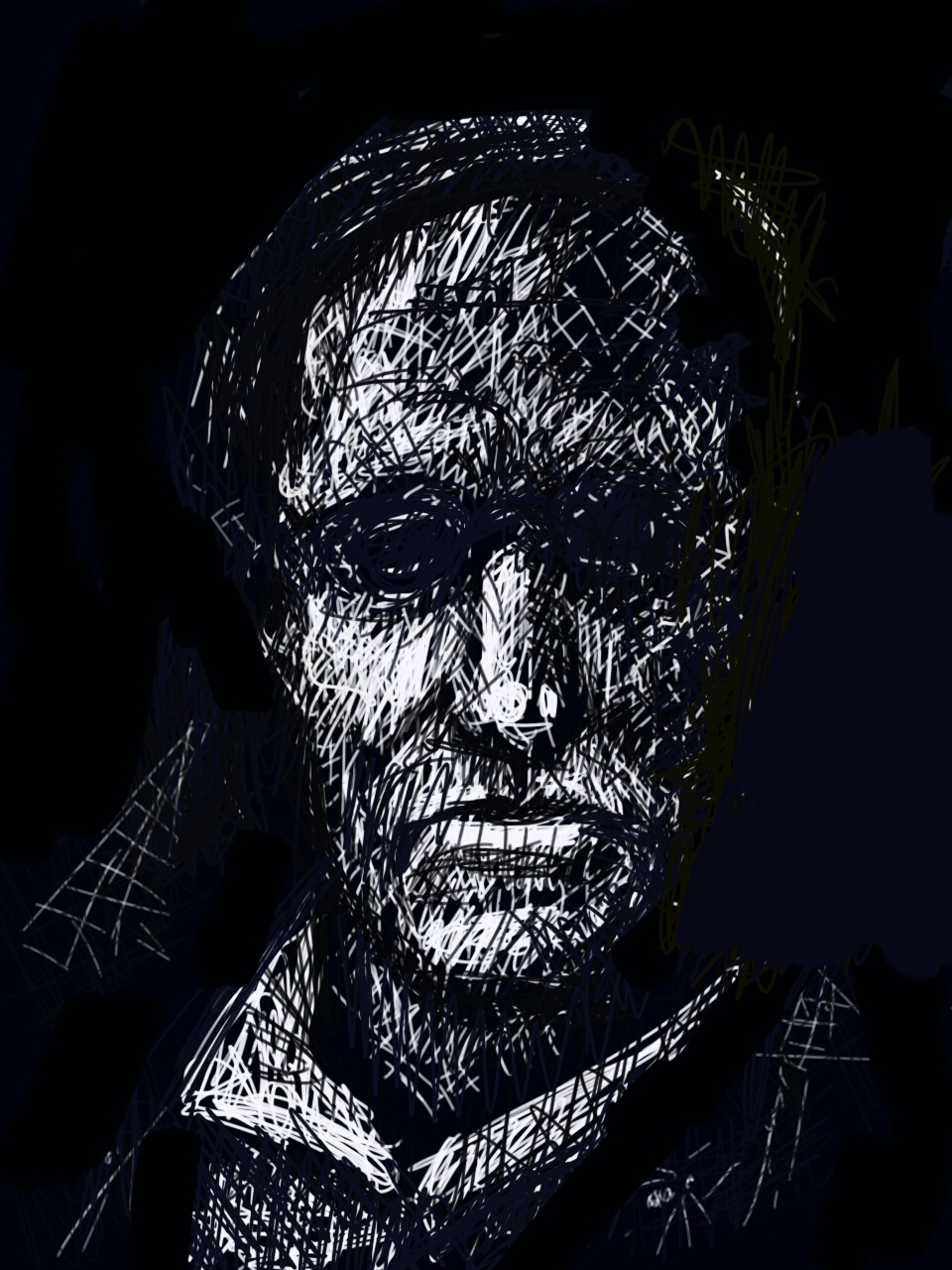
Day 31 - "Portrait of the Artist as a Spooky Man"

And that dear friends brings us to the end of #inktober! This was the first year I actually got it together to give it a shot, and I've had immense fun doing it. For anyone who wants to sharpen their artistic skills or, as it was in my case, revive some long dormant ones, I can highly recommend the simple exercise of doing a sketch a day. It's also a great way to experiment - I had alot of fun trying out some different styles, and while not all of them quite worked, I'm still quite pleased with the results. Certainly I shall be continuing my sketching endeavours into the future from now on! 

Sunday, 8 October 2017

INKTOBER WEEK #1


Hello folks! This year I thought I would have a bash at the annual artistic malarky that is #inktober! I've meant to for a couple of years now, but as October is something of a busy month around here at the Great Library of Dreams I usually end up forgetting. However this year, I did remember, and so then here is the first week's worth of doodles and sketches! 


Day 1 - a little piece inspired by The Tractate Middoth by MR James


Day 2 - a little sketch I entitled "The Witch At The End of Your Bed" 


Day 3 "Late Night by the Fireside" - Thought I'd have a bash at a spooky scene like the ones Ionicus used to do for the covers of ghost stories for William Kimber books. You can see a fine selection of Ionicus cover over here at The Common Swings. On reflection I think this one came out more like Roger Hargreaves, but never mind! 


Day 4 - See the little goblins...


Day 5 "Hallowtide at Exham" - Another attempt at something in an Ionicus/Kimber style! This one was getting closer to what I wanted, and very much a homage to the Ionicus cover for Halloween Hauntings edited by the late great Peter Haining


Day 6 "Tiptoe Through the Tombstones" - another somewhat Ionicus inspired piece, with a touch of Alfred Bestall too


Day 7 - Another piece inspired by MR James - 
"The whispering in my house was more persistent tonight. I seemed not to be rid of it in my room. I have not noticed this before. A nervous man, which I am not, and hope I am not becoming, would have been much annoyed, if not alarmed, by it..." 

from The Stalls of Barchester Cathedral by MR James 


Thursday, 14 September 2017

FOLKLORE ON FRIDAY - Peg Powler


Last week I was writing about a little piece of childhood lore concerning puddles - namely that where I was growing up in the North East of England, puddles rippling with rainbow hues from spilt oil or petrol were referred to as "witches' washing" (see here for the full tale). Now from various responses to that article, it seems that this little piece of puddle lore appears to have been somewhat confined to the North East. However while digging around assorted old tomes on local legends and the like, I discovered a possible origin. 

Now I grew up in the Darlington area, a former mill town built on the River Skerne, a tributary of the mighty River Tees. And as you might expect, these waterways have a rich folklore of their own -  for example, previously I have written of the Headless Hob that haunted the Tees near Hurworth, and of the Sockburn Worm whose slaying is commemorated with a ritual on Croft Bridge. However on the subject of hags and witches, the stretch of the Tees around Darlington is also home to another horror - Peg Powler. According to legend she lived in the valley that is now the Cow Green reservoir, and haunted the Tees around Mickleton and Middleton-in-Teesdale as the High Green Ghost.

However further down the river's run around Darlington, she is better known as Peg Powler. Boasting trailing green hair, long arms, and sharp claws, Peg was very similar to another folkloric hag Jenny Greenteeth. Indeed in their celebrated tome Faeries (1978), Alan Lee and Brian Froud portrayed these two aquatic monsters together on the same double page spread.

Peg Powler as depicted in Froud and Lee's Faeries

She is mentioned in several early texts on folklore and legends. In 1886, Mr William Brockie, in his tome Legends & Superstitions of the County of Durham describes her thus - 
The river Tees has its sprite, called Peg Powler, whose delight it is to lure too venturesome bathers into her subaqueous haunts, and then drag them to the bottom and drown them. Children are still warned from playing on the banks of the river, especially on Sundays, by threats that Peg Powler will catch hold of them and carry them off. Peg has long green tresses, hanging down over her shoulders, but what her costume is we are not told.
And aside from preying upon children and others unfortunate enough to stray too near the water's edge, Peg Powler had another distinct feature associated with her, as Mr Brockie continues to relate - 
The foam or froth, which is often seen floating in huge masses, on the surface of deep eddying pools in the higher portion of the river, is called "Peg Powler's suds"; the finer less sponge-like froth is called "Peg Powler's cream."
And this association with foam or froth on the river with the water hag Peg, immediately made me think of the witches' washing puddles.  Might there be a connection between my childhood lore and this older legend? As it happens, Mr Brockie mentions a possible link - 
"A goblin or sprite of the same evil character is said to haunt the river Skerne."  
So who was this other watery monster? Some further digging unearthed a footnote the Denham Tracts (1892), a compendium of legends and lore gathered  by  Michael Aislabie Denham, in the mid 1800s. Early on in this tome, there is a list of folkloric beings, and this includes "Peg Powlers". And what is more, there is a most illuminating footnote 
This oulde ladye is the evil goddess of the Tees. I also meet with a Nanny Powler, at Darlington, who from the identity of their sirnames, is, I judge, a sister, or it may be a daughter of Peg’s. Nanny Powler, aforesaid, haunts the Skerne, a tributary of the Tees.
Given the close connection of the two rivers in the town, it is perhaps not surprising that another hag called Powler had colonised the waterway that ran through Darlington itself.

Now up until the 1980s, the River Skerne was sadly very polluted, a legacy of the days when Darlington was an industrial mill town. Indeed when I was growing up, locals used to joke that the Skerne was now so polluted that even traditional waterway wildlife such as abandoned shopping trolleys could no longer live in it. Thankfully now the river has recovered, but back in the 1970s foam, scum, and bright rainbows of chemical hues were not an uncommon sight on the Skerne.

.Peg Powler by Russell Dickerson

And I can't help wondering if this pollution was also identified as Peg Powler's suds and cream. Given that folklorists see the likes of Peg and Nanny as warning tales to caution children to keep away from hazardous rivers and ponds, the talk of her cream and suds may well have an origin in a story to stop kids from playing in waters that were dirty and poisonous as well as dangerous. Therefore in the local area, it is not a huge leap to suppose that this lore may have led to the oily spectrums in puddles being dubbed witches' washing too. 

Of course, this is pure speculation on my part. And on balance, we should note that the strange rainbows of oil on water quite naturally suggest a magical or eldritch origin in the minds of imaginative children. Indeed when asking if anyone else had heard of witches' washing, several folks responded that they had been told it was created by fairies, while many more were delighted to learn of this bit of North-eastern lore as it chimed with their own childhood feelings that these weird rainbows in puddles were somehow magical and strange.

However on the other hand, while a great many places in the United Kingdom have some sort of monster, ghost or witch to ward off the unwary from dangerous waters, it is unusual that stories of Peg Powler incorporate floating foam and froth as part of the legend. Other well-known aquatic predators such as Jenny Greenteeth, grindylows or kelpies don't share this feature. And given that foam and suds in the tales told of Powler and her brood centre around the old mill town of Darlington, possibly there is a connection to the idea of witches doing their washing in puddles. Certainly it would explain why this piece of rainy day folklore seems so confined to a small area of the North East.


Thursday, 7 September 2017

FOLKLORE ON FRIDAY - Witches Washing


Just the other day, while out and about, I happened to notice some children on their way to school. They were happily bouncing in the little puddles left after a recent shower, naturally much to the disapproval of their parents. 

And thus it ever was! I was instantly reminded of my own childhood, and those simpler days when there was no greater joy than coming out after the rain had stopped and playing in puddles. However besides happy memories of splashing about on pavements and gutters, and of course, less happy remembrances of being scolded later for being dripping wet and covered in muddy water, I did also recall a curious little fragment of folklore from those now distant times. 

For when I was growing in in the North-east of England, there was a little bit of lore associated with puddles. Now back then, it was not uncommon to find puddles brimming with strange rainbows, born of little spills and drips of oil and petrol from cars. But even though as little kids we soon found out how these colourful puddles were formed, I remember vividly also hearing that they were the result of witches doing their washing in the puddles. Whether they are doing their laundry or personal ablutions was never made entirely clear to me. But either way, it was firmly embedded in the lore of my playground at least, that these puddles were the result of "witches' washing", and it was considered remarkable to find some on your path. 


Quite in what way it was remarkable was never quite clear either, and was a matter of some debate. Some claimed it was good luck to find a puddle of witches' washing, but others held that it was a bad sign, for it showed wicked hags were abroad nearby. But the practical upshot of this little piece of modern folklore was that something ordinary and mundane was transformed into a little splash of magic on the pavements. 

However despite trawling assorted books on folklore and consulting the ever-expanding hive-mind that is the internet, this little tradition appears to have been somewhat localised, with only a single report of it being alternatively called "fairies' washing" coming from a fellow North-easterner. But of course, if any of this rings a bell with you, please do share your lore in the comments below.

However, I suspect there might be a good reason why this bit of puddle lore is perhaps found only in one area of the North East of England, but that's a story for another day... 

from The Witch Next Door by Norman Bridwell

Friday, 3 October 2014

FOLKLORE ON FRIDAY - Witch Bottles


While either renovating, demolishing or excavating old dwellings, builders where often to puzzled to find curious objects buried or embedded in the fabric of the house. Common odd finds included old shoes, dead cats and animals skulls, concealed in chimneys, bricked up over windows or buried under doorsteps. However most puzzling were the sealed jars and bottles which when opened were found to contain rusted needles and nails and a foul smelling fluid. 

So then why did the good folks of ages past include these bizarre items in the construction of their homes? Well the answer can be found in the ancient tome Saducismus Triumphatus, or Evidence concerning Witches and Apparitions written by Joseph Glanvil in 1681. In this noted volume, the creation of one of these curious bottles is detailed - a man's wife was suffering from a mysterious ailment, and witchcraft was the suspected cause. An old man advised the troubled husband to take some of his wife's urine and seal it up in a bottle along with nails and pins to counter the evil magic. Initially the wise old fellow recommended heating the bottle on the fire. However when the bottle exploded, he advised instead burying the bottle and when this was done, his wife recovered. Furthermore later on it was discovered that a man of the town had died mysteriously and his wife confessed that her husband had been a wizard and had been responsible for the original troublesome spell. 

Many such bottles have been discovered in houses built from 1600 onward, and witch bottles have been discovered all across the United Kingdom, and even in the United States. The bottles themselves are often a bartman or bellarine, a piece of Rhenish stoneware from Germany popular the 16th and 17th centuries. And while the pins, needles and nails (and sometimes other sharp objects such as thorns or shards of glass) are common ingredients, sometimes salt, red thread, feathers and all manner of other items that local folklore deemed good against evil forces were included. Sometimes the liquid was replaced with wine or sea water, but nearly all included some highly personal ingredients, such as hair, nail clippings or blood - experts have even found one that included bellybutton fluff! 

The witch bottle works on the principle of sympathetic magic. We have all heard how a witch would take a personal item or hair or nail clippings and use them to fashion a poppet or effigy in their victim's image - the traditional voodoo doll - and whatever affected the doll, would magically be transferred to the victim. And these counter charms exploit on the same magical principle - by concealing such an object that contained your personal essence at the thresholds of your house (such as doors, windows and chimneys), any spell targeting you would be absorbed by the bottle. Furthermore the sharp objects and other counter charms would entangle the incoming bad magic and/or send the spell back to the sender in the most painful manner!

Scholars believed that the concealed shoes, one of the most common odd finds in old houses - is a product of the same magical thinking - any spell directed at you would be drawn harmlessly into the old shoe which through years of wear had soaked up enough of your personal essence to act as a decoy. 

So then should wish to keep your home safe from evil influences, you now known exactly what to do - and given that large numbers of shoes and witch bottles found over the centuries, obviously they are very effective! I recommend making and concealing some kind of witch repelling item today! If nothing else, it is a great chance to baffle an archaeologist or builder in the far future!