Showing posts with label the devil. Show all posts

Wednesday, 4 June 2025

HYPNOGORIA 286 - The Chime of the Bluebells


In the UK at this time of the year the woodlands are awash with a carpet of bluebells. However as beloved as these wild flowers are, they have a lot of folklore surrounding them, and links to faeries, the dead, witches and the Devil himself! 

DIRECT DOWNLOAD HYPNOGORIA 286 - The Chime of the Bluebells


Find more writing and  podcasts on the weird and wonderful here -


Friday, 3 February 2017

FOLKLORE ON FRIDAY - The Stones Are in Town!


Last week we began exploring the curious legends of stones that move by themselves, and this time we are looking at two more such rotating rocks, both of which can be found in heart of English villages.

In the lee of the Malvern Hills in Herefordshire, just near the border with Worcestershire, lies the little village of Colwall. And as you drive through the village, you will see, literally in the middle of the road, albeit on a traffic island, a large squarish stone, known unsurprisingly as the Colwall Stone. As is traditional for such prominent rocks, there are local legends that it was the work of giants, or had been dropped by The Devil. However another tale claims that every night, at the stroke of midnight the Colwall Stone turns itself around, and according to some versions, Old Nick Himself comes to do the turning. Quite why the stone turns, and indeed why it should be one of the Devil's chores, local lore never actually explains. Much like many of the old stones we are discussing in these articles, in previous times when archaeology was much younger, it was guessed that the stone was some relic of our pagan past. However in the second edition of The British, Roman, and Saxon Antiquities and Folklore of Worcestershire published in 1852, the pioneering antiquarian and folklorist Jabez Allies writes - 
There is a large block of limestone called Colwall Stone, situated by a cottage (formerly named the "Old Game Cock"), on the road-side at Colwall Green. Some have supposed that it was placed there in ancient times as a memorial of some event, or as evidence of some custom; but, upon my visiting the spot in 1846, I learned from a person in the neighbourhood, that his late father, Francis Shuter, and others, about seventy years ago, got it out of the limestone quarry, in a copse at the foot of the Wytch, and, assisted by a strong team of oxen, dragged it to its present locality; but whether it was brought there in lieu of a more ancient memorial I could not learn. It is four feet long, three feet broad, and two feet six inches thick; and I was informed that the landlord receives one penny a year rent for it.
And before we go any further, I should point out that the Wytch is a nearby place and not a local hag! So then, it is quite probable, given the local source mentioned by Allies, that in fact the stone had only been in place since around 1770. While we cannot rule out that the current stone was a replacement from an older monument, the fact that at that time rent was changing hands for the stone, one does wonder if it was some crafty ploy to give Colwall a bit of history and attract some antiquarian tourists. Certainly around this period there was a growing interest in Britain's past, and giving your home turf a bit of ancient history, the more mysterious the better, was a shrewd way to attract visitors. 

However deliberate tourist trap or not, the tales about Colwall Stone appear to be the standard lore that grows up around ancient megaliths i.e. left by giants, turning themselves. And given the stereotypical nature of the legends attached, and the extreme thinness of their details, I do rather suspect the stone, and the associated lore too, to be an 18th century *ahem* recreation, rather than something authenticly ancient. 


Another stone that has been presumed to be an ancient megalith but is actually thought to be a more recent addition to the landscape is found in the village of Pyrford in Surrey. This small standing stone sits by the side of a road and is now thought to be a boundary stone, and dating from no further back than Norman times. However this stone too is reputed to revolve at cock crow or when Pyrford church clock strikes twelve. Again there are no other details or any other attached stories, so I rather suspect that this is another case of a local stone having common legends from other megaliths grafted onto it. Indeed this theory that the lore surrounding the stone has been transplanted is strongly supported by the fact that the only church in Pyrford, St Nicholas', doesn't actually have a clock! 

However in an article Scraps of English Folklore, XII. (North Bedfordshire Suffolk, London and Surrey) by Barbara Aitken, published in  Folklore, Vol. 37, No. 1. (Mar. 31, 1926), her research conducted in the early 1900s turned up some rather more interesting local lore about the stone - 
A gardener, a resident in Pyrford but not a native, said, "I expect it was put up in remembrance of someone being killed. There's a cross scratched on it, so I expect it's like kicking a cross. Don't you know that? I've been in many parishes, and they always kick a cross in the road where anyone's been murdered or killed in an accident." Here he made a cross in the dust with his foot. "If a man's been killed in an accident on the road, the policeman'll always kick a cross; and some people keep on kicking a cross in the same place year after year. There've been several people killed on Pyrford Rough, but no one seems to trouble to keep up the crosses."
Now that sounds far more like authentic local lore - indeed so far I've been unable to find more examples from other regions of this particular little tradition. While historians think the Pyrford stone is mostly an old boundary stone, this folk rite of kicking a cross would seem to indicate that rather than being considered some ancient relic with supernatural powers, this stone was thought to have more mundane connections, a community memorial for a death on that road. 

However as fascinating as all of the above is, all it really tells us is that in the popular imagination the properties of revolving and turning were such a common feature of legends surrounding standing stones that this sort of story almost automatically becomes attached them, regardless of their actual history or folklore, in a similar way to how old empty houses quickly gain a local reputation for being haunted despite no one ever reporting ghosts and spectres there. But still we are no closer to uncovering the origins of these strange tales of rotating rocks. Next time on Folklore on Friday we shall look at some more ancient stones and see if we can shed any more light on this little mystery...


Friday, 13 May 2016

FOLKLORE ON FRIDAY - The Tale of the Holbeach Gamesters Part II

Inside All Saints, Holbeach by Gazmando

Last time on Folklore on Friday, we enjoyed the tale of the Holbeach Gamesters (find it here), a story of gambling and grave-robbing going badly awry. Now like many a folk-tale, this legend from Lincolnshire operates on a variety of levels. To begin with, it  is simply an entertaining yarn, one that may raise a shudder or two, or depending on the teller, possibly some ghoulish laughter. And certainly it appears to have been a popular tale, given that it exists in several variations, for as a rule of thumb, the more enduring an old tale is, the more variants of it you can find.

Initially it would appear to be a fairly standard European folk-tale, and given that it features ghosts, goblins and the Devil himself  dealing out supernatural vengeance or justice, you could be forgiven for thinking its origin was as a cautionary tale. Certainly its narrative seems tailor-made to illustrate the moral message that cards, ale, and a disrespect of the dead and the church will drag you down to Hell. However there is more to the story of  the Holbeach Gamesters than first meets the eye, for while it definitely fits the traditional pattern of the cautionary tale, a little research uncovers a rather different origin.

Now I first encountered a stripped down version of the tale in a most unusual place. British confectionery giant Trebor launched a new range of sweets at the end of the 1970s called Mummies. These rolls of black hard sweets promised a "taste of the tomb" in the form of  "hidden fruit flavours". They came two varieties with different fillings - soft centres in red packets, and sherbert in green ones. However both varieties featured one of Trebor's marketing gimmicks - printed on the inside of the roll's paper sleeve was a "Tale from the Tomb". There were twelve to collect and featured some well-known spooky legends such as the curse of King Tut's tomb, but many featured more obscure tales drawn from folklore. And #2 in the series was entitled "The Gambling Corpse" -  a pocket-sized version of the legend of the Holbeach Gamesters!


Now as we have noted there are several variations of the story, ranging from the simplest where the three friends break just into the church to play cards and disturb the body of woman laid for a funeral, to a more elaborate version recounted by a former vicar of All Saints that folklorist Ethel Rudkin recorded in 1931. Delving further back in time, we find the story being recounted in verse, with the very popular Victorian poet Eliza Cooke retelling the tale in the poem The Sacrilegous Gamesters which appeared in her collection Melaia, and Other Poems in 1843. 

However the earliest properly dated version was written in 1800 by Thomas Hardwicke Rawnsley, a rector in Bourne, Lincolnshire, who is now best remembered for his friendship with the poet Tennyson. However Rawnsley penned some verse too, in particular this ballad, which when it was first printed was billed as a true story...

The Three Revellers; or Impiety Punished
A Legend of Holbech

In the bleak noxious Fen that to Lincoln pertains
Where agues assert their fell sway,
There the Bittern hoarse moans and the seamew* complains
As she flits o'er the watery way.

While with strains thus discordant, the natives of air
With screams and with shrieks the ear strike,
The toad and the frog croaking notes of despair
Join the din, from the bog and the dyke.

Mid scenes that the senses annoy and appal
Sad and sullen old Holbech appears,
As if doomed to bewail her hard fate from the Fall,
Like a Niobe washed with her tears.

From fogs pestilential that hovered around,
To ward off despair and disease,
The juice of the grape was most generous found.
Source of comfort, of joy, and of ease.

At the "Chequers" long famed to quaff then did delight
The Burghers both ancient and young.
With smoking and cards, passed the dull winter night.
They joked and they laughed and they sung.

Three revellers left, when the midnight was come.
Unable their game to pursue.
Repaired, most unhallowed, to visit the tomb
Where enshrouded lay one of their crew.

For he, late-departed, renowned was at whist.
The marsh-men still tell of his fame,
Till Death with a spade struck the cards from his fist
And spoiled both his hand and his game.

Cold and damp was the night; thro' the churchyard they prowled,
As wolves by fierce hunger subdued,
'Gainst the doors they huge gravestones impetuous rolled
Which recoiled at such violence rude.

From the sepulchre's jaws their old comrade uncased,
(How chilling the tale to relate),
Upreared 'gainst the wall on the table was placed
A corpse, in funereal state.

By a taper's faint blaze and with Luna's faint light
That would sometimes emit them a ray,
The cards were produced, and they cut with delight
To know who with "Dumby" should play.

Exalted on basses the bravoes kneeled round
Exulting and proud of the deed,
To Dumby they bent with respect most profound
And said "Sir! it is your turn to lead."

The game then commenced, when one offered him aid,
And affected to guide his cold hand
"While another cried out, "Bravo! Dumby, well played,
I see you've the cards at command."

Thus impious, they jokèd devoid of all grace.
When dread sounds shook the walls of the church,
And lo! Dumby sank down, and a ghost in his place
Shrieked dismal "Haste! haste! save your lurch!"

Astounded they stared; but the fiend disappeared
And Dumby again took his seat,
So they deemed 'twas but fancy, nor longer they feared
But swore that "Old Dumb should be beat."

Eight to nine was the game, Dumby's partner called loud
"Speak once, my old friend, or we're done
Remember our stake 'tis my coat or your shroud
Now answer and win — can you one?"

"What silent, my Dumby, when most I you need
Dame Fortune our wishes has crossed,"
When a voice from beneath, howled, "your fate is decreed
The game and the gamesters are lost."

Then strange! most terrific and horrid to view!
Three Demons thro' earth burst their way:
Each one chose his partner, his arms round him threw
And vanished in smoke with his prey.

* a local term for seagull

Now it is interesting to note that while this version is highly detailed, other versions of the tale do actually name the men involved. As we saw last week, one claims the men were Slator, Watson, Barker and Codling, while another puts two other fellows in the frame - Abraham Tegerdine, Mr Slater, Dr Jonathan Watson and Farmer Guymer. It is also curious that some versions actually give us a date for these eerie events at Holbeach, with the Barker/Codling variant reporting it took place in 1793, while other versions placing them a decade earlier in 1783. Now usually folklore tends to be somewhat vague on details such as names and dates, so then could this tale be, as Rawnley claimed, a true tale?

In the 19th century the first proper scholarly studies of folklore began - indeed the term 'folklore' was originally coined by the antiquarian William Thoms in 1846. Fortunately for us, the legend of Holbeach was one that was investigated by the pioneers of this new field of study, and the surprising truth is that the story was inspired by actual events! What really happened was this - there were indeed four fellows who loved a game of Long Whist - apparently named Dr John Watson, John Key, William Slator and a chap called Whedale. And in 1783 three of these fellows were indeed drinking in the Chequers Hotel, and mourning the death of their friend. Just like the legend, a mixture of grief and alcohol led these fellows to think it would be a fine idea to dig up their recently buried pal for one last game. And again just like the old tale, they broke into the church and sat round the altar with the corpse of their late friend to play cards.

But rather than ghosts and goblins breaking up the macabre party, it was something far more mundane. A local man was passing by All Saints and saw lights flickering inside the darkened church. He peered through the window and was rightly horrified by the ghoulish game, and hence ran to the Chequers and raised a gang of stout fellows to apprehend the gamesters. As far as we know the men escaped any criminal charges, but records preserved in local history tomes by Grant W. Macdonald, the clergyman at another Holbeach Church St. Marks in the 1890s, show that the gamesters did make payments for the damages to the grave.

However while they escaped criminal charges and the affair was very much hushed up, there was a deep sense of scandal with Ethel Rudkin reporting that years later the villagers still did not like to speak of it. In her introduction to The Sacrilegious Gamesters, Eliza Cooke claims that the stories she heard said that "the affair created so much horror and disgust, that the wretched profligates who enacted it were eventually compelled to quit the town". And according Rudkin, it was said that locals became a little nervous of venturing round All Saints after dark, and thus tales of a haunting began.

However, as ever with folklore, some mysteries still remain. Some twenty years later in 1803, one of the gamesters, Dr John Watson, apparently took his own life, although whether this was anything to do with the infamous gaming night at All Saints we do not know. What we do know though, is that ironically the doctor was denied a burial in the churchyard of All Saints. But this was nothing to do with his previous ghoulish antics, but because he was supposed a suicide, and therefore not allowed to be buried in consecrated soil. However rather being interred just outside the churchyard,  Dr Watson was apparently buried in accordance with another piece of old folklore - out of town, on the Spalding Road, so that should he return as a ghost, his restless spirit would not be troubling the local people.


Friday, 6 May 2016

FOLKLORE ON FRIDAY - The Tale of the Holbeach Gamesters Part I


Once upon a time, not so long ago, decks of cards were referred to as "the Devil's picture-books", for card games lead to gambling, and gambling leads to damnation. And there have been many tales told over the years to illustrate this point. Take for example the legend of the Holbeach Gamesters... Now Holbeach is a little market town in the fenlands of southern Lincolnshire, believed to date back to Roman times at least. And to this day, stories are still told that warn the unwary not only of the perils of card playing but also to steer clear of All Saints Church after nightfall. Like many old tales, there have been several variations told over the years, but the essential details remain the same. 

According to most versions, the strange events took place in 1793 after a man named Codling, or sometimes Farmer Guymer, passed away. He was part of a group known locally as the Holbeach Gamesters, four friends who loved to play cards, often at the Chequers Hotel. After this jolly gent's passing, the surviving three, men named Watson, Slator and Barker according to most versions, were drinking together and mourning their friend. They were bemoaning the fact that their games would never be the same now their quartet was shrunk to a trio, when one of them had a great idea - well, what seemed a great idea to a drunken fellow that is - they would have one last game with their departed friend! So the three made their way from The Chequers Hotel over the road to All Saints Church. Many versions of the tale hold that there, Codling's coffin was already lying inside, ready for his funeral on the morrow. But some insist that the departed gamester was already buried, and so armed with lanterns, shovels, and pitchers of ale, the three friends set about disinterred him from his freshly filled in grave. 


Either way, the end result was the three men ended up sat inside the church with the corpse of their friend, and set about a final session of cards with him. The tale often has them using the very altar as a table, others the coffin, and another version has them propping up the cadaver of their old chum by wedging him in the altar rail. However regardless of the specifics, a game of cards was had with the corpse playing a dummy hand (it is often said whist was their game of choice), or his surviving friends taking his turn for him. Full of ale, the gamesters had a fine old time, joking that the dear departed was doing better than ever. Of course, things were to take a darker turn. As the hands of the clock crept towards midnight, they noticed that their dead friend's face had developed a nasty leering grin. And worse was to come - for as the chimes of midnight sounded, the corpse began to laugh. One version goes further, and has our card playing fellows looking around to see the Devil himself taking the place of their dead compatriot.

What followed is the subject of some controversy. In some variants, the foolhardy fellows continued their game, determined to finish the hand even after these ominous events. However most versions end up in the same place - with demons or goblins rising up from the church floor or flying out of the crypt, and dragging the trio off to Hell. And according to some there is a final ghoulish detail, that the only trace of the gamesters was that on the morrow the congregation were met by the grinning corpse still propped up by the altar. 

But one version reckons that Slator managed to avoid the clutches of the fiends and escaped out of the church door. He dashed back to the Chequers Hotel and there, no doubt fortified with yet more drink, he gathered a party of men and hurried back to rescue his friends from the horrors. However, on reaching the benighted church, they did not dare enter. For coming from within, they heard peals of hideous laughter and horrible screams. It was only when morning broke that they chanced venturing inside. They found no sign of Watson and Barker. 

But it is said that if you should pass by All Saints after dark, you may see flickering lights within the church. And should you be brave enough, or maybe that should be foolish enough, to take a look inside, there you will see the lost gamesters, presumably now damned to play for all eternity. And according to some, the phantoms will eagerly invite the foolish join them in their infernal never-ending game... 


Friday, 18 March 2016

FOLKLORE ON FRIDAY - The Great Pyramid of Liverpool


While only officially a city since the 18th century, history abounds in Liverpool. Originally founded in a charter from King John, over the centuries Liverpool grew from a small borough to a bustling port and then into a centre of international trade. Naturally this rich heritage is reflected in the landscape of the city itself, and coupled with the scousers' love of a good yarn, there's a story waiting around every corner. Take for example Rodney Street - this row of impressive Georgian houses was the birth place of British Prime Minister William Gladstone and the poet Arthur Clough. It is famed for being the residence of numerous doctors over the years, and has been dubbed the Harley Street of the North. However what often attracts the eyes of visitors these days is the graveyard of St. Andrews Church. For many years the church itself was derelict, having been gutted by a fire back in the early 1980s, But now it has been restored and the site redeveloped. However the original churchyard remains, and among the usual leaning tombstones and weathered crosses stands a large pyramid, some 15 feet high. 

Now at first one might very reasonably assume that this is a relic of the great crazes for all things Egyptian that swept through fashionable society in the 19th and early 20th centuries - for example, in the famous Highgate Cemetery in London, there is a whole array of tombs known as Egyptian Avenue. And while the dating of the monument would fit into the general trend for Egyptian inspired architecture, in local lore this monument, often called the Great Pyramid of Liverpool, has far stranger tales attached to it.  

For this is the grave of a Mr William Mackenzie, born in 1794, and who died in 1851 at 74 Grove Street where he had resided since 1843. Son of a Scottish contractor, but born in Nelson, Lancashire, Mackenzie started out as an apprentice weaver but went on to train as a civil engineer. And it was in this field that he was to make his mark, becoming one of the leading engineers of his day, working on railways and canal projects not just all over England, but all over the world. We know much about his life thanks to detailed journals he left, that were published as The Diary of William Mackenzie, by Thomas Telford Publishing in 2000. He became a very wealthy man from his endeavours, and when he died left an estate of £341, 848 - a massive amount today but relatively worth even more back in the 1850s. 

William Mackenzie

When he died, he was buried in the Scottish Presbyterian church of St. Andrews, back then a new building having being constructed in 1824. The inscription on the pyramid actually gives us it true origin - 
In the vault beneath lie the remains of William Mackenzie of Newbie, Dumfriesshire, Esquire who died 29th October 1851 aged 57 years. Also, Mary his wife, who died 19th December 1838 aged 48 years and Sarah, his second wife who died 9th December 1867 aged 60 years. This monument was erected by his Brother Edward as a token of love and affection A.D. 1868. The memory of the just is blessed.
We should note here that Edward had good cause for affection, as he had inherited a good proportion of his brother's estate. However despite the inscription telling anyone who cares to read it that this curious monument was actually erected some 16 years after Mackenzie's death, that hasn't stopped some remarkable stories springing up around the pyramid.

To begin with Mackenzie's ghost has been spotting in the vicinity of the graveyard. But this is no amiable old phantom merely walking the streets of his old home town, for Mackenzie's spectre is something of an imposing figure in top hat and cloak, and seemingly delights in giving those who see him a ruddy good scare. Passers-by have been terrified by the sight of Mackenzie striding through the tomb, and even walking out through the the old blackened church walls. In fact according to local legend, Mackenzie's spectre has even been seen brawling with another local phantom.

For Rodney Street is allegedly home to several different ghosts, indeed it is claimed to be one of the most haunted streets in Liverpool. Now one of these other ghosts is a fellow dubbed Lantern Jaw - a tall figure in top hat and opera cape. And if you are thinking that this spectral gent sounds very similar to the reported appearance of Mr Mackenzie's shade, you would be quite right - for one is often confused with the other, and the only way to definitely tell them apart is that Lantern Jaw is somewhat taller. Of course, another way of telling betwixt the two is if you see the ghostly pair together - which according to local legend some folks have. Allegedly the two are sometimes spotted arguing and even fighting! No one is sure what the pair are squabbling about, but one cannot help but wonder if perhaps this is some spectral turf war over haunting rights! 

Now if you know anything of ghost lore, you will know that ghosts rarely haunt their burial places. Contrary to decades of spooky stories and horror movies, cemeteries and graveyards tend to be some of the least haunted places, for as a rule the shades of the dead tend to reappear at either places they were close to in life or at the locations where they passed away. So then why does old Mr Mackenzie stride around the tombs of St. Andrews and pavements of Rodney Street?

Well, the story goes that Mackenzie was a gambler and had lost his soul to the Devil in a game of cards, the deal being that Old Nick would claim his prize when the old Mackenzie was buried. However being a wily old fellow, Mackenzie therefore arranged to be interred above ground, hence the construction of his pyramid tomb. It is said he was entombed inside, sat up at a table, and therefore as he was never laid to rest six feet under, the Devil is still waiting for his soul. However as his soul still is promised to Hell, Heaven has no claim to him either, and so Mackenzie's spirit still walks the earth. However local legend has another twist to the tale - for it is claimed that several years ago, the police were called to St. Andrews one night. Apparently some one had thought to break into the old tomb. And inside the now opened pyramid, the police discovered a skeleton propped up at a table, just as the local tales claimed. But what's more, in its bony figures were clutched a winning hand of cards...


Next time on Folklore on Friday - we shall be , if you'll pardon the pun, digging a little deeper into the origins of these strange tales... 

Friday, 20 November 2015

FOLKLORE ON FRIDAY - Changelings

The Changeling by Henry Fuseli

Across the world, one of the most common beliefs is that we share this world with other races. Many cultures tells of these others, and the tales about them are strikingly similar. They are closely tied to the natural world and are mostly invisible to us. They are somewhat capricious, sometimes kinds other times malevolent, and they appear to hail from some kind of parallel plane, another world that is connected to ours through certain portals; often certain hills, caves, and forests, and sometimes even individual trees and stones. We are of course talking about the faery folk, and many different types of these supernatural beings are said to predatory; alleged to kill and even devour us mortal folk. However a more general trait that seems to be a popular pastime for many species of faery across the world, even the ones usually less inclined to grind our bones to make their bread,  is their love of spiriting people away to their own world. 

However while there are many tales of trips to fairyland, elfhame and other places the strangers inhabit, more troubling are the legends of the changelings. From the icy Scandinavia to sun-baked Africa, there are sinister stories of children not just being abducted, but switched with strange impostors. Parents would find their baby child had been replaced by odd beings who were almost but not quite human. Often changelings are described as being ugly and wizened, while others appeared normal but demonstrated weird abilities such as being able to stretch their limbs at will. However strange appearances aside it was their behaviour that marked them out - changelings were said to be either extremely badly behaved - constantly crying and prone to violence, or at the other end of the spectrum strangely docile, often mute and seemingly unable to comprehend anything about the human world they had been left in. Another common characteristic to changelings was an insatiable hunger - a changeling could eat a family out of house and home, a troubling prospect as some changelings were believed to never grow up, constantly needing care and food, while others were said to be extremely long lived, possibly even immortal, being a burden on whole generations of families.

There were several theories about why changelings were left. In the case of changelings that were said to be wizened and sickly, it was said that these creatures were actually ancient, elderly faeries, left by their compatriots to enjoy the love and comforts of a human family in their dotage. Other changelings were so infirm that they soon sickened or died, leading to folk beliefs that the impostor had been nothing more than a magical fake, such as piece of rotting wood crudely enchanted to mimic a human child. And why did the faeries steal children? Well, some traditions held that the faery folk were an old, dying race who sought new blood to strengthen their numbers. However other traditions had darker ideas - the human children were to be used as servants and slaves in their other world. Worse still, some traditions held that the faeries owed a tithe of souls to Hell, and hence they stole human children to pay the debt to the Pit. On a similar note, some folk beliefs held that changelings were mere sent to vex mankind, and in tales of particularly violent or troublesome changelings, they were said to have been left by witches or the Devil himself to increase the sum of human misery.

The Changeling by Arthur Rackham

Now, like many folk traditions, there is more than a grain of truth in these old tales, and a reason that stories of changelings are so prevalent in so many cultures across the globe. The sad fact is that changelings did indeed exist, however they were not faery cuckoos, but rather children with disabilities and diseases. One does not have to read too deeply between the lines to realise that these elf children were in fact nothing more but human babes suffering with a variety of debilitating conditions. While many illnesses and diseases could be recognized in the pre-modern era, other conditions such as gradual degenerative ailments or being born with mental conditions such as autism or schizophrenia were poorly understood. It is a natural reaction for people to seek explanations and answers, and hence in cases where what had been a seemingly healthy baby was suddenly sickly, behaving strangely, or developing in what seemed a weird fashion, supernatural forces were the only explanation available. It is very telling that beliefs in changelings begin to wane when better medical knowledge becomes available.

From the wide range of preventative rituals and charms in folklore, it was clear that finding oneself the parent of a changeling was a real and widespread fear in ages past. Various methods existed that would protect the child from being snatched by the faeries, and hanging some kind of protective charm over the crib was perhaps the common. In some regions, this would be a plant or herb with magical properties - such mistletoe or a sprig of rowan. The faeries were widely believed to have an aversion to iron, and this was also utilized, by hanging a pair of scissors or a horseshoe over the cradle. However should such measures have failed there were several possible course of action to get your child back.

Now there were many regional cures, often involving some local place, such as bathing the child in the nearby holy wells, visiting a shrine or taking it to standing stones. But there are three main ways of dealing with a changeling that occur time and time again in many different countries and cultures. The first is basically to abuse the child, often beating it with sticks, with the idea being that the changeling's real parent - the faeries or the Devil - would promptly appear and give back your own child to prevent further cruelty to their own. In a similar fashion, placing the changeling either in a fire or a hot oven would cause the malign being to take its leave, often said to fly off up the chimney, and your own offspring would be returned. Sadly however these two methods rarely resulted in happy endings, and indeed in the 18th and 19th centuries we begin to find parents and guardians appearing in court on charges of cruelty, neglect, and murder of their own children who they believed to be changelings.

However thankfully there was a third method of dealing with a changeling which while probably ineffective in the real world, at least did not involve cruelty to the suspect child. And what's more, it is somewhat amusing - indeed it is the basis for many of the more entertain changeling folk tales. This third method was based around the premise of tricking the changeling into revealing its true nature, and once its cover were blown, the faeries had to return the real child. And weirdly enough there was an exact way to do this which is recounted in many different countries. Basically in full view of the changeling child one had to cook using eggs - but these was not merely whipping up a quick omelette, rather you had to brewing beer or make stew using the egg shells as tiny containers. This culinary performance was said to be sufficiently surreal and bizarre to make the changeling reveal its true nature,with old folk tales holding that the creature would suddenly sit up, exclaim that it had never seen anything like it in its long and strange life - often the exclamation followed this pattern as related by the Brothers Grimm -
Now I am as old 

As the Wester Wood, 
But have never seen anyone cooking in shells!
from Children's and Household Tales (1812)

And then, having revealed itself as an impostor the changeling would vanish - or again fly off up the chimney - and the stolen child would be magically returned. Quite why this egg based method is so widespread is something of a mystery. Possibly there is a forgotten symbolic significance to eggs in this context - and certainly they seem appropriate given that one can draw parallels between the concept of changelings and the behaviour of birds like the cuckoo which leaves its eggs in other birds' nest to raise as their own. However I would like to think that if this performance art cookery was actually ever carried out to cure a changeling in the real world, then perhaps the oddness of the act caused the troubled child to smile or laugh, providing a valuable point of connection between parent and child, and making them realise that while their offspring may be different they were in fact human after all.

Titania's Changeling by John Anster Fitzgerald

Friday, 7 November 2014

FOLKLORE ON FRIDAY - Turning the Devil's Stone


Remember, remember the 5th of November... Yes, in the United Kingdom the first week in the eleventh month sees countrywide celebrations involving firework displays and bonfires. Variously known as Firework Night or Bonfire Night or Guy Fawkes Night supposedly commemorates the foiling of a plot to blow up Parliament in 1605. Now I say 'supposedly' for two very good reasons: firstly that old Guido Fawkes has over the years become a bit of a folk hero and is widely, and these days only slightly comically, dubbed "the last man to enter Parliament with honest intentions". And secondly there's good reason to assume that the British custom of having great bonfire parties at the start of November is linked to older celebrations originally held at Halloween.

Now the links between Halloween and Firework Night customs are very hotly debated, with many serious historians insisting it is a British tradition born of political events in the early 17th century. However, given that there are historically proven traditions of lighting bonfires on Halloween, this view would seem to be somewhat myopic. The traditional parkin - a form of cake - baked and eaten for Bonfire Night would seem to be highly suspiciously close to the earlier traditions of cooking soul cakes at Hallowmas. And furthermore while today we make effigies of Guy Fawkes to burn on the bonfire, in the early days of the celebration revellers actually dressed up as Guido Fawkes and went around soliciting "pennies for the Guys" with a threat of mischief if pennies weren't to be had -  a practice clearly derived from going Hallowmas mumming and going a-souling, the roots of our tradition of trick or treating.

More tellingly however, there are some curious folk customs occurring on November 5th that seem to address the supernatural world growing close to us, something more suited to Halloween, and indeed there are some that have nothing to do with fireworks or bonfires. One such tradition, which may well have had its date moved from October 31st to November 5th, occurs every year in a little village in North Devon.


Shebbear is a small rural community of under one thousands souls but an ancient one. It is mentioned in that great survey of England carried out by William the Conqueror in 1086, the Domesday Book and the village boasts a very beautiful medieval church, St Michael Parish Church, built in 1358. Nearby this venerable place of worship, by an ancient oak tree, is a large stone locally called The Devil's Stone.

Quite how the stone got there nobody knows. Geologists have ascertained that it is not composed of the local rock and stone, hence some experts have theorized that it is what is called a glacial erratic, that is a stone pushed from its native place by the growth of glaciers in the Ice Age and deposited miles away. Others have wondered whether this stone was deliberately brought to the area for ritual purposes like the altar stones of Stonehenge. Whatever the truth, the villagers have evidently long recognised the stone was not of local origin and there are several legends accounting for its origins.

Firstly some say the great boulder was dropped by the Devil, while fighting with St. Michael when the Dark One staged his rebellion in Heaven. Another states that the Devil so opposed the building of the church that he threw a great stone at it and missed. A further tale says that the mystery rock was to be the foundation of a church at Henscott but the wily Devil kept on rolling the stone away to Shebbear, and as I can find no trace any church there, it looks like Old Nick won that time.


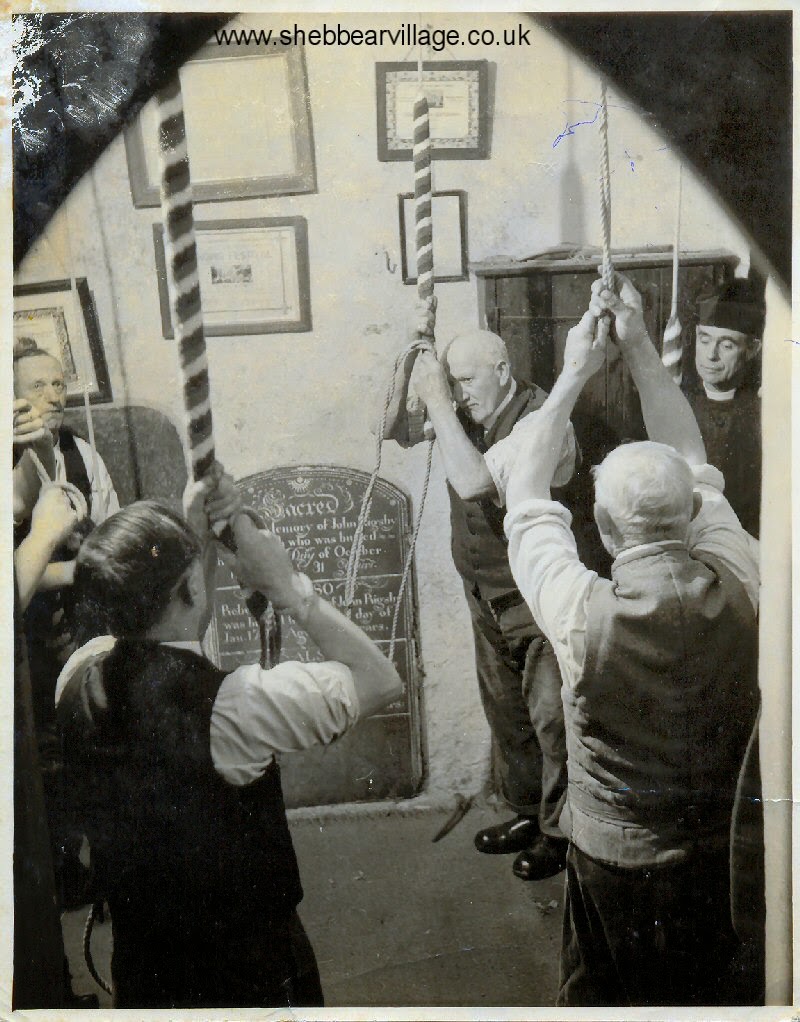
However the most interesting legend also gives us a curious rite carried out every 5th of November. It is said that the Devil is actually trapped beneath the stone itself. Hence on the night of November 5th, the strong folk of the village process to the stone with spades and pickaxes, and while the six bells of St Michael's are vigorous rang to ward off evil spirits, the great stone, which weighs around one tonne, is lifted and turned over by the locals to keep Old Nick imprisoned for another year.

And does this actually work? Well, in 1913 the villagers neglected their ancient duty and a string of misfortunes befell the village, and only ceased when the stone was turned. Furthermore in 1940, when all the brave menfolk of the village had been called away to fight, the stone was not turned. However as the news from the front turned increasing grim, the stone was at last turned that year and from then on, the ritual has been always carried out without fail...


Friday, 3 October 2014

FOLKLORE ON FRIDAY : The Devil's Blackberries!


Once again autumn is here, and in the old medieval calendar the start of the new season was marked by one of the four quarter days - Michaelmas. Also known the Feast of All Angels and the Feast of the Archangels, Michaelmas falls upon the 29th of September, close to the Autumn equinox. In Christian legend, this was the date that the Heavenly Host triumphed against Lucifer and the rebel angels, with St. Michael defeating the Devil and casting him out of Heaven (as envisioned above by Albrecht Dürer).

However according old legends found in the British Isles, when the Devil was flung from Heaven, the Dark Lord fell to earth and landed, somewhat painfully in a blackberry bush. His Satanic Majesty was obviously not best pleased, and spat and trampled upon the errant bushes. As an old Irish proverb sums it up - “On Michaelmas Day the devil puts his foot on blackberries”! However Old Nick was so enraged he also laid an everlasting curse upon them, and hence it was said that after Michaelmas Day, any blackberries on the bushes now belonged to the Devil Himself and it was most unwise to pick them. 

As colourful and fantastic this old tale is, there is a certain wisdom buried within it.  For by the end of September any remaining blackberries may well have felt the touch of a first frost, or be spoilt by worms and larvae that feed upon them. However for those who would heed the legend's warning, this legend predates the re-organisation of the calendar in England, when thanks to the Calendar (New Style) Act of 1750 we adopted the corrected Gregorian calendar. Famously this saw the English "losing" eleven days, something that didn't sit right with many folks. And therefore several festivals and notable dates were still celebrated under the old system - hence on October 10th, some parts of England celebrated what was now called Old Michaelmas. And so if you go with the adjusted date of the Old Michaelmas, you can get a week and half extra of Devil-free blackberry picking!