Showing posts with label toads. Show all posts

Sunday, 31 July 2022

HYPNOGORIA SUMMER SPECIAL 05 - The Legend of the Berkeley Toad


In this show we go hunting for a most sinister cryptid, and uncover monstrous secrets in the writings of Ramsey Campbell, the cosmic horrors of the Cthulhu Mythos, and a dark British legend lurking in an ancient castle!

DIRECT DOWNLOAD The Legend of the Berkeley Toad


You can find all the podcasts in my series on toads and witchcraft here

Find all the podcasts in the HYPNOGORIA family here -

HYPNOGORIA HOME DOMAIN - Full archive, RSS feed and other useful links


HYPNOGORIA on TUNE IN

HYPNOGORIA ON GOOGLE PLAY PODCASTS


Sunday, 16 October 2016

MICROGORIA 37 - Familiar Spirits


In a the final part of our explorations of toad lore, Mr Jim Moon looks the role of familiars in witchcraft, and examines the trials of three witches in 16th century Essex, in which these demonic animal companions, including several in amphibious forms, featured heavily...


DIRECT DOWNLOAD - MICROGORIA 37 - Familiar Spirits

Find all the podcasts in the HYPNOGORIA family here -

HYPNOGORIA HOME DOMAIN - Full archive, RSS feed and other useful links

HYPNOGORIA on iTunes

HYPNOGORIA on STITCHER

CLICK HERE FOR DETAILS

Saturday, 17 September 2016

MICROGORIA 35 - Murder In Lower Quinton Part III


In the third and final part of our investigation into the Lower Quinton murder, we attempt to get to the truth of the witchcraft angle of the case, take a close look at the suspects, and attempt to discover who was most likely to have committed this infamous murder.


DIRECT DOWNLOAD - MICROGORIA 35 - Murder In Lower Quinton Part III 

Find all the podcasts in the HYPNOGORIA family here -

HYPNOGORIA HOME DOMAIN - Full archive, RSS feed and other useful links

HYPNOGORIA on iTunes

HYPNOGORIA on STITCHER

CLICK HERE FOR DETAILS

Friday, 9 September 2016

MICROGORIA 34 - Murder In Lower Quinton Part II


In the second part of our investigation into the Lower Quinton witchcraft murder, we unravel an occult history of magic in Britain, exploring Satanism in the press, and how the story has been presented and misrepresented over the years. We strip away the layers of myths, mistakes and misconceptions that have grown up around the Walton case, and discover how this notorious unsolved crime has shaped popular culture.

DIRECT DOWNLOAD MICROGORIA 34 - Murder In Lower Quinton Part II 

Find all the podcasts in the HYPNOGORIA family here -

HYPNOGORIA HOME DOMAIN - Full archive, RSS feed and other useful links

HYPNOGORIA on iTunes

HYPNOGORIA on STITCHER

CLICK HERE FOR DETAILS

Sunday, 4 September 2016

MICROGORIA 33 - Murder In Lower Quinton Part I


In the first episode in an epic three part investigation, Mr Jim Moon uncovers the facts in the case of the murder of Charles Walton - an unsolved crime that rumours of witchcraft, toads, and ancient cults have grown up around.


DIRECT DOWNLOAD - MICROGORIA 33 - Murder In Lower Quinton Part I 

Find all the podcasts in the HYPNOGORIA family here -

HYPNOGORIA HOME DOMAIN - Full archive, RSS feed and other useful links

HYPNOGORIA on iTunes

HYPNOGORIA on STITCHER

CLICK HERE FOR DETAILS

Sunday, 3 July 2016

MICROGORIA 29 - Bubble, Bubble, Toads and Trouble


Once again we are exploring the weird world of toad-lore! In this episode we are learning the secret of the toad bone and looking at the uses of toads in witchcraft and sorcery!


DIRECT DOWNLOAD - Bubble, Bubble, Toads and Trouble

Find all the podcasts in the HYPNOGORIA family here -

HYPNOGORIA HOME DOMAIN - Full archive, RSS feed and other useful links

HYPNOGORIA on iTunes

HYPNOGORIA on STITCHER

CLICK HERE FOR DETAILS

Sunday, 22 May 2016

MICROGORIA 28 - Toads on the Whole


Following on from the magic toad biker mayhem of Psychomania last week, Mr Jim Moon explores the strange world of toad lore. In this episode, we learn of assorted strange beliefs about toads, monstrous tales of their antics, and the bizarre magical and medical uses of their parts.


DIRECT DOWNLOAD -  Toads on the Whole

Find all the podcasts in the HYPNOGORIA family here -

HYPNOGORIA HOME DOMAIN - Full archive, RSS feed and other useful links

HYPNOGORIA on iTunes

HYPNOGORIA on STITCHER

CLICK HERE FOR DETAILS

Saturday, 14 May 2016

HYPNOGORIA 35 - Psychomania


Roaring back from the grave, comes Psychomania! Mr Jim provides a commentary track for the cult Brit horror flick, directed by Hammer veteran Don Sharp, and starring George Sander, Nicky Henson and Beryl Reid. This movie tells the tale of a gang of motorcycling hoodlums who return to life to wreak havoc thanks to a pact with a toad! It's the only biker-zombie-magic-toad movie you need to see! 


DIRECT DOWNLOAD - Psychomania Commentary

Find all the podcasts in the HYPNOGORIA family here -

HYPNOGORIA HOME DOMAIN - Full archive, RSS feed and other useful links

HYPNOGORIA on iTunes

HYPNOGORIA on STITCHER

CLICK HERE FOR DETAILS

Friday, 26 June 2015

FOLKLORE ON FRIDAY - The Toad Stone


As we saw last week, toad bones were highly prized for their alleged unusual powers. However in ages past, despite their unfounded and undeserved reputation as being poisonous predators, toads were sought out for another bizarre but commonly believed reason, which William Shakespeare alluded to  in As You Like It.  In Act 2, Scene 1, the Bard of Avon has Duke Senior say:

Sweet the uses of adversity.
Which, like the toad, ugly and venomous,
Wears yet a precious jewel in his head

Yes, as strange as it sounds for several centuries a belief flourished which asserted that toad's heads contained a curious gem stone. Now aside from the monetary value of a jewel, these toadstones were also alleged to possess extremely useful properties. In the early encyclopedia, De Proprietatibus Rerum, written by the Franciscan scholar Bartholomaeus Anglicus in the 13th century, a toadstone was described as - 
A precyous stone somdeale whyte: other of dyuers colours. It is sayd yt this stone is take oute of a toodes heed... this stone helpith ayenst bytynh of serpentis & of creeping wormes: & ayenst venym. For in the presence of venym, yt stone warmyth & brennyeth his fynger yt towchyth him
Now this might seem to be absolute nonsense to the modern reader, but in earlier ages, when medicine was primitive, and poisoning was a common method of assassination, it is easy to understand why the idea that certain gems could not only ease, but also detect poisons, would be very appealing. Naturally it wasn't long before there was a flourishing trade in toadstones, and by the 16th century these gems, allegedly taken from the heads of amphibians, were being set in jewelry, most commonly rings, and were highly prized items. 

In later ages, their claimed magical properties shifted slightly. Presumably as the fear of being bumped off by poisoning receded, the toadstone became more generally known as a magical remedy, with  Thomas Lupton in his compendium of science and technology Thousand Notable Things, Of Sundry Sortes (1576) alleging that - 

A Tode stone (called Crapandina) touching any part be venomed, hurte or stung by Ratte, Spider or Waspe, or any other venomous Beast, ceases the paine and swelling thereof

What's more, being a tome full of handy practical hints and guides for the learned Elizabethean gent, Lupton handily gives us a method of making our own - 
A Goode way to get the stone called Crapandina, out of the Tode. Put a great or ouergrowne Tode, (fyrst brused in dyvers places) into an earthern potte, and put the same in an Antes hyllocke, & couer the same with earth, which Tode at length ye Antes wyll eate: So that the bones of the Tode and stone, wyll be left in the potte
As those of you who read last weeks article on toad bone amulets will recognize, clearly Mr Lupton (or his source) had read their Pliny. Various other writers and sages in later years would continue to recommend the "ante hyllock" method of extracting a toadstone, however obviously one expects there were many disappointed folks who found naught but ant-flensed bones when opening their "eathern pottes". And perhaps this is why seminal bestiary compiler Edward Topsell detailed an alternative and more arcane method in his 1608 work The Historie of Serpents
There be many late Writers, which doe affirme that there is a precious stone in the head of a Toade, whose opinions (because they attribute much to the vertue of this stone) it is good to examine in this place, that so the Reader may be satisfied whether to hold it as a fable or as a true matter, exemplifying the powerfull working of Almightie God in nature, for there be many that weare these stones in Ringes, being verily perswaded that they keepe them from all manner of grypings and paines of the belly and the small guttes. But the Art (as they terme it) is in taking of it out, for they say it must be taken out of the head alive, before the Toad be dead, with a peece of cloth of the colour of red Skarlet, where-withall they [sc. the toads] are much delighted, so that they stretch out themselves as it were in sport upon that cloth, they cast out the stone of their head, but instantly they sup it up againe, unlesse it be taken from them through some secrete hole in the said cloth, whereby it falleth into a cestern or vessell of water, into which the Toade dareth not enter, by reason of the coldnes of the water.

Very bizarre indeed I'm sure you'll agree! But no matter how strange and fruitless these methods of extracting the fabled stones from the toad's heads were, from the trade in toadstone jewelry quite clearly some one was managing to get them. However by the 17th century, some inquiring minds were begining to wonder quite where the toadstones were coming from. One such sharp fellow was Sir Thomas Browne, who in his 1646 work Pseudodoxia Epidemica, or Enquiries into Very many Received Tenets, and commonly Presumed Truths, wittily debunked many commonly held misconceptions and myths. In this work, he rigorously investigated the subject of toadstones, basically highlighting the anatomical and biological unfeasibility of such things existing before revealing his own conclusion on what they were, and even proposed a test for alleged toadstones - 
But these Toadstones, at least very many thereof, which are esteemed among us, are at last found to be taken not out of Toads heads, but out of a Fishes mouth, being handsomely contrived out of the teeth of the Lupus Marinus, a Fish often taken in our Northern Seas, as was publickly declared by an eminent and Learned Physitian. But because men are unwilling to conceive so low of of their Toadstones which they so highly value, they may make some trial thereof by a candent or red hot Iron applied unto the hollow and unpolished part thereof, whereupon if they be true stones they will not be apt to burn or afford a burnt odour, which they may be apt to do, if contrived out of animal parts or the teeth of fishes.
 The Lupus Marinus is of course Latin for Sea-wolf, the archaic name for a shark. However while Sir Thomas was on the right track, he hadn't quite found the origin of the toadstones, for indeed many of these alleged mystic stones would have passed his hot iron test. A later writer (whom we encountered while talking of another alleged magical item the Fairy Flag of Dunvegan),  Thomas Pennant came closer still in his epic work British Zoology (1766). Pennant wrote of the toadstone that - 
all its fancied powers vanished on the discovery of its being nothing but the fossil Tooth of the Sea-Wolf, or some other flat-toothed Fish. 
And hence as they were fossils, a toadstone could be subjected to Browne's test and not give off the tell-tale smells of burnt calcium and enamel which would signify a fake. However again, while Mr Pennant was close to the truth, he was just a shade away from getting to the bottom of this batrachian mystery. In fact, he was quite correct on all counts except identifying the exact species of  fossilised fish teeth.

Modern science has of course now given us the answer: toadstones were in fact the teeth from fossils of a species of Lepidotes which flourished in everyone's favourite ancient time zones - the Jurassic and Cretaceous periods, when dinosaurs ruled the earth. And looking at the stony remains of these primordial piscines' jaws, one can see why they were passed off as toadstones, for in their shape and colouring, they do resemble the wart, knobbly hide of monstrous toads. 


Friday, 19 June 2015

FOLKLORE ON FRIDAY - Toad Bones


As we discovered a few weeks ago, in ages past there was a whole branch of early medicine (and I use that term loosely) based about using toads, in whole or in part, as a remedy for a wide variety of ailments. Many of these dubious cures were in that strange borderland where early pharmacy emerges into folk magic, with some cures being derived from pills, lotions and potions made from toads while others worked by the patient carrying a dead specimen or some parts thereof as an amulet or charm against catching certain diseases and maladies. 

However, in a related set of folk beliefs, there is a long tradition of using toads for more purely magical purposes. As we have seen in previous articles, folk beliefs about the venomous nature of the creatures and assorted alleged familiar spirits appearing in the shape of toads, has resulting in the toad being associated with witchcraft and black magic, an idea that still persists today in the popular imagination. However the idea that toads possess magical properties stretches back further than the witch trials and medieval times, for like many widespread European superstitions, the origin of these beliefs can be traced back to Classical times. 

Now the surviving writings of assorted Greek and Roman scholars formed the basis for Western philosophy, science and history for hundreds of years, unfortunately our ancient sages weren't always on the mark with their data and theories. For example, Pliny the Elder gave the world one of the first encyclopedias - the epic tome Naturalis Historia (or Natural History) which covered topics such as astronomy, mathematics, geography, ethnography, anthropology, physiology, mineralogy, zoology, botany, agriculture, pharmacology, mining and art history. But while this massive book was an important reference work for learned men for literally centuries, in Naturalis Historia we also learn dubious facts such as burying a toad in a jar will ward off diseases on a crop of millet, the ashes of toad mixed with grease is a good treatment for gout, and that sick pigs can be cured with water in which a toad has been boiled. 

And it is also in this epic work by Pliny that we discover the root of a very common folk belief about toads - namely that their bones have magical properties. When writing on what he referred to as the rubetæ or bramble-frog (the Classical terms for toads) our seminal scholar notes that - 
Authors quite vie with one another in relating marvelous stories about them; such, for instance, as that if they are brought into the midst of a concourse of people, silence will instantly prevail; as also that by throwing into boiling water a small bone that is found in their right side, the vessel will immediately cool, and the water refuse to boil again until it has been removed. This bone, they say, may be found by exposing a dead bramble-frog to ants, and letting them eat away the flesh: after which the bones must be put into the vessel, one by one.
Naturalis Historia 32.18

However Pliny goes to to relate that after your ants have flensed your toad, don't chuck the rest of the skeletal remains away, for certain other bones have even more remarkable properties - 
In the left side of this reptile there is another bone, they say, which, thrown into water, has all the appearance of making it boil, and the name given to which is "apocynon." This bone, it is said, has the property of assuaging the fury of dogs, and, if put into the drink, of conciliating love and ending discord and strife. Worn, too, as an amulet, it acts as an aphrodisiac, we are told. The bone, on the contrary, which is taken from the right side, acts powerfully as a refrigerative upon boiling liquids, it is said: attached to the patient in a piece of fresh lamb's-skin, it has the repute of assuaging quartan and other fevers, and of checking amorous propensities. 

Now then, I'm sure you'll agree they sound like very useful bones to possess! Indeed over the years, right up until the present day, there is a continuing tradition of magical belief in the power of toad bones. What is most remarkable however is that these superstitions are clearly drawn from Pliny, albeit with some added embroidering over the centuries. For example, nearly all toad bone rituals follow the Classical lore in using ants to strip the flesh from the bones, and while the alleged properties of the toad bones do vary from place to place, they have remained generally consistent - namely that a certain part of the skeleton can cure diseases and/or give its owner the power to influence both people and animals.

And while Pliny rather unhelpfully doesn't specify which bone it was, over the centuries it seems plenty of folks thought they could find the right one! In some traditions a specific part  of the toad is identified, most often usually the pelvis or breast bone. However what is very interesting is that over time new stages have been added to the process to magically correct Pliny's vagueness. Hence after the flensing by ants, we have an additional rite whereby by the magical bones will be revealed, most usually by using running water. On a an alleged propitious night - new and full moons and various Saint's days are common - the bones were cast into running water and the magical bone reveals itself by floating up against the current.

Now here we can clearly see some deductive thinking at work. As Pliny mentions that the bone has the property of cooling hot water and boiling cold water, hence at some stage a prospective healer or magician reasoned that therefore given the magical bone's contrarian effects on water, it would logically float against a current and thereby reveal itself. Interestingly though, even in times and places where the local tradition identified which part of the toad skeleton was magical, the rite of immersing the bones in running water was still carried out, indeed in some areas the process of acquiring a toad bone was known as 'going to the river' or the rite of  'waters of the moon'. However in these cases, it seems that the act of immersing of the bones in running water was now seen as part of the magical charging of the resulting toad amulet -
Then take the bones and go down to a good stream of runnin' water at midnight an' throw the bones i' the stream. All the bones but one will go downstream, an' that one as wont go downstream is the breast-bone. Now you must get 'old of this 'ere bone afore the Devil gets it, an' if you get it an' keep it allus by you - in your pocket or wear it - then you can witch, as well as that, you'll be safe from bein' witched yourself
from Lincolnshire Folklore (1936)
by Ethel H Rudkin

While the simpler versions profess to create a charm that is good against certain diseases and grants a power over animals - in English traditions usually over horses - as the above quote illustrates, where the method of acquiring a toad bone becomes more magically, more of ritual than a technical process, so too the reputed powers of the bone grow. While in the 16th and 17th centuries, English witchcraft thought to be dependent on the powers granted by familiar spirits and animals, in the 18th and 19th centuries magical prowess came from possessing a toad bone.  
There was one charm she told me of witch was practiced when any one wanted to get command over there fellow creatures. Those that wished to cast the spell must search until they found a walking toad. It was a toad with a yellow ring round its neck, I have never seen one of them but I have been told they can be found in some parts of the Country. When they found the toad they must put it in a perforated box, and bury it in a Black Ant’s nest. When the Ants have eaten all the flesh away from the bones it must be taken up, and the person casting the spell must carry the bones to the edge of a running stream the midnight of Saint Marks Night, and throw them in the water. All will sink but one single bone and that will swim up stream. When they have taken out the bone the Devell would give them the power of Witchcraft, and they could use that power over both Man and Animals.

from I Walked by Night: Being the Life & History of the King of the Norfolk Poachers (1935) 
edited by LR Haggard

Indeed being the holder of a toad bone amulet was so seen as being the key to possessing magical powers that in some areas folks possessing arcane knowledge and skills were known as toadsmen. In some cases, a toadsman was seen as a beneficial member of the local community, similar to horse whisperers or cunning folks: some one who could provided remedies against all manner of maladies, both natural and supernatural for people, livestock and crops. However in others these folks had a more sinister reputation, with toadsman being a byword for witch; indeed in the county of Norfolk casting spells was known as 'tudding', a corruption of 'toading'. And correspondingly the rituals had a darker nature too, as an old horseman called Albert Love recounted in 1966
While you are watching these bones in the water, you must on no consideration take your eyes off it. Do (if you do) you will lose all power. That’s where you get your power from for messing about with horses, just keeping your eyes on that particular bone. But when you are watching it and these bones are parting, you’ll hear all the trees and all the noises that you can imagine, even as if buildings were falling down or a traction engine is running over you. But you still mustn’t take your eyes off, because that’s where you lose your power. Of course, the noises must be something to do with the Devil’s work in the middle of the night...
from The Pattern under the Plough  (1966)
by GE Evans

Furthermore some traditions had additional rituals, to give the toadsman even greater powers. In East Anglia it was said that some time after acquiring the toad bone, usually five nights later, the toadsman would spend the night in a barn and call up the Devil, who he would then bind - presumably exercising the powers of influence in the bone - to his will. Interestingly in a call back to earlier English witchlore about familiars, the  pact or bargain with the Devil involved the toadsman offering up his blood. However the price of gaining such powers was high - as Nigel Pennick recounts in Secrets of East Anglian Magic (1995) the toadsman could expect all manner of infirmities, hallucinations and even a sudden death. So then, despite the alluring powers that having a toad bone amulet grants, perhaps it is best to leave the bones where they belong - in the toads.  

The toad-bone ritual making an appearance in cult BBC children's serial The Moon Stallion in 1978


Friday, 5 June 2015

FOLKLORE ON FRIDAY - A Cure of Toads


Last week we discovered what a fearsome reputation the humble toad enjoyed, or rather perhaps suffered from, in times past. Folklore associated it with poison and disease, and it was commonly thought of as a venomous predator or a witches familiar. However despite allegedly being noxious both physically and spiritually, toads were surprisingly highly sought after for a huge variety of charms and folk remedies. Both the Romans and the ancient Chinese widely employed toads both live and dead, in whole and in part, for the treatment of a huge variety of ailments. And hence in the murky world of early health care, which was as much about magic as medicine, and where superstition was mingled with science, toads remained a prized ingredient for many a cure for several centuries. 

One of the best known medical superstitions about toads, and one that is still doing the rounds today, is the belief that you can catch warts from a toad. Of course this is completely untrue, however there is a factual basis, albeit a distorted one, to this old wives' tale. Essentially warts are caused by a viral infection in the skin, and it is true that the virus can be passed on by contact. Indeed you can not only catch warts from touching someone with warts but also by using items such as towels or clothes that have been in contact with infected areas of skin. Now as toads were erroneously thought to be covered in warts, it did therefore make sense to not touch them. Actually the characteristic lumps on their skin are completely natural and harmless, however many varieties will secrete toxins as a defense against predators if picked up, and these defensive poisons can be a mild irritant to human skin, sometimes causing lumps, bumps and swellings that folks in the past would have termed warts. 

As toads were thought to cause warts, it was also assumed that they would also be good for removing warts, in accordance with the ancient common belief which held that in nature like was drawn to like. Hence in some regions it was said the trick to getting rid of your warts was to rub a live toad on them, and the warts would be drawn to join its fellows on the toad's hide. And this was the common underlying concept for a wide variety of folk cures and charms involving toads. It was known as the law of sympathy, and hence as toads were thought to be poisonous and venomous, naturally they were also thought to be good for treating all manner of noxious complaints. Sir Kenelm Didgy in his 1656 tome Discourse on Sympathy explains it perfectly - 
In time of common contagion, they used to carry about them the powder of a toad, and sometimes a living toad or spider shut up in a box; or else carry arsnick, or some other venomous substance, which draws unto it the contagious air
And this belief was very prevalent right up to the 18th century. For example, Notes & Queries in 1869 reported the following case where a toad was being used to combat a disease that was considered both poisonous and to cause lumps and boils on the skin -
An old woman, whom I well remember, always carried in her pocket a dried toad, as a preservative from small-pox. One day... she went into the village without her toad. The small-pox prevailed in the place at the time, and the old woman caught it.
Another of the toad's natural defenses also qualified it for folk medical uses. For as well as secreting toxins when seized by a predator, toads also inflate their bodies to make themselves too big to swallow. Hence as they possessed the ability to cause swelling at will, it was assumed that therefore toads would be good for treating swellings in the human anatomy too.


For example in rural Scotland it was said that the way to relieve a sprain was by rubbing live toad in it. Likewise many 'medicines' were developed to harness this property. In 1678 W Salmon in his London Dispensary, no doubt counting on the toad's ability to cause swelling, advised -
A dried Toad steept in Vinegar... smelt to it stops bleeding at Nose, especially laid to the forehead... or hung from the neck
Wearing either a live toad, or portions of one was a common feature cure in many a toad cure. Sometimes these remedies were more like a charm or a ritual. For example, in Cornwall, if one was suffering from quinsy, a complaint that causes ulcerations and abscesses around the tonsils - again note the key symptoms of growths and swellings - toads once again held the key to a cure...
A 'wise woman'... prescribed for him as follows: 'Get a live toad, fasten a string round its throat, and hang it up till the body drops from the head; then tie the string around your own neck, and never take it off, night or day, till your fiftieth birthday. You'll never have quinsy again'.   
And if you think that cure is rather gruesome and cruel, then Worcestershire appears to have been an even worse county to have been a toad in. For Gentlemen's Magazine 1855 reports that - 
In the neighbourhood of Hartlebury (and also in Tenbury) they break the legs of the toad, sew it up in a bag alive, and tie it round the neck of the patient... the life or death of the patient being supposed to be shadowed forth by the survival or death of the animal.
However other cures were of a more medical flavour, with the 17th and 18th century seeing a boom in self qualified 'toad doctors'. A popular complaint they treated was scrofula, colloquially referred to as king's evil in ages past. This is an infection of the lymph nodes, and its symptoms manifest with the appearance of large warty growths and swellings on the face and neck. And naturally, as this was both a warty and swelling disease, toads were employed as a remedy. In an 1875 edition the ever-reliable Notes & Queries reports - 
A man came in a gig, who was known as 'the toad doctor'. He brought with him a number of small bags, and the people flocked to him from far and near with toads. The 'doctor' cut off the hind legs of these toads and put the severed portions into the bags, and hung them around the necks of his patients, the newly cut limbs quivering on their naked chests. This was held to be a certain remedy for the king's evil.
Selling bags of toad legs was a profitable venture, as was the sale of assorted toad bones, toad skins and dried toad powders. Aside from 'poisonous' humors that caused plague and small-pox, or a variety of complaints that caused swellings, inflammations and ugly growths, toads were also used in another set of treatments, usually in the form of ground up powders and pills. From Roman times onward, if you were having problems with your *ahem* waterworks, or your physician believed you needed to flush your system of poisonous humours, then dried toad was prescribed as a diuretic.

Again the belief that toad would be a good medicine for causing urination came from one of the animal's natural defenses - and that is, if you pick up a toad it will urinate on you in order to persuade you to put it down again. Mind you, considering what happened to many toads collected by humans in ages past, them widdling on us might well just be sheer bloody fear of being used as a medicine!


Friday, 29 May 2015

FOLKLORE ON FRIDAY - Toads On the Whole

Late on Monday night a toad came into my study: and, though nothing has so far seemed to link itself with this appearance, I feel that it may not be quite prudent to brood over topics which may open the interior eye to the presence of more formidable visitants
MR JAMES, Stories I Have Tried To Write

The humble toad has often suffered from a somewhat bad reputation. While today many gardeners welcome the presence of a toad as they happily gobble up slugs and other pests, not that far back in history toads were considered bad news. Even in more recent sources from the early 20th century, folklore held that a toad entering the house signified an enemy nearby or that misfortune would come calling soon. A belief well illlustrated by our opening quote from MR James, first published first in November 1929.

However delving back further into older texts, we find a clear origin for this curious belief. In The History & Antiquities of Lyme Regis and Charmouth (1834) G Roberts tells us that - 
Toads that gained access to... a house were ejected with the greatest care, and no injury was offered, because they were regarded, as being used as familiars by witches, with veneration and awe.
And as recently as 1876 this belief persisted - Trans. Devon. Ass. 52 (Ashbourne) relates - 
He had a heart to work but no strength... One evening on entering his door, he saw a great toad which he killed with a pitchfork, and threw into the fire. The next evening he saw another... and did the same... He believes they were witches. Soon he recovered, and has not suffered the like since. 
Indeed as we have seen in previous articles on the English witch trials (see here) we have court records that alleged that witches possessed familiar spirits in the shape of toads that they sent out to cause ill. And evidently the sight of a toad remained ill-omened, in folklore at least,  long after the belief in witches and witchcraft dwindled away.

However the toad was associated with pestilence and poison long before the witch trials, and these beliefs evolved from biological rather than supernatural reasons. The  idea that toads are poisonous arises from their natural defences; most species of toad will secrete a substance that causes irritations to the skin to persuade predators to let the hapless amphibian go. And this was observed and documented by many ancient naturalists.

Now before the discovery of bacteria and viruses, diseases were thought to be caused by miasmas - clouds of diseased air. Damp or foul smelling places such as marshes, wetlands, dunghills, and caves were seen as prime sources of these poisoned airs. Now the medieval worldview operated on a 'like goes to like accordingly' philosophy, that is to say, things that were similar were somehow linked together. And hence it was thought that toads frequented marshes, sewers and middens in order to consume noxious humours and miasmas in order to create their poisonous secretions. As Shakespeare has one of his doomed heroes say -   

I had rather be a toad. 
And live upon the vapour of a dungeon

Othello, Act I Scene III

Indeed the toad was so closely associated with poison and disease that in ages past that the harmless animals were mistakenly thought to be venomous creatures. For example in Thomas of Monmouth's Life of St William of Norwich - whose modern edition was translated by MR James incidentally - it is said in the reign of King Stephen, who ruled from 1135 to 1154, that prisoners in dungeons suffered "enduring miserably cold, hunger, stench, and attacks of toads". While in the Second Continuation of Peterborough Chronicle, the entry for 1137 tells of the following dire fates for prisoners taken by King Stephen - 
They were hung by their thumbs or by the head, and corselets were hung on their feet. Knotted ropes were put round their heads and twisted till they penetrated to the brains. They put them in prisons where there were adders and snakes and toads, and killed them like that. 
However the medieval histories contain an even more horrifying tale. Giraldus Cambrensis, better known as Gerald of Wales, was a clergymen of Welsh and Norman descent, who wrote many chronicles and travelogues. He was also a keen naturalist and a good many of his writings feature descriptions of the habits of local wildlife. However like many ancient scholars, Gerald was prone to mixing fact with folklore, and hence in his 1191 tome, Itinerarium Cambriae or Journey through Wales, we get the following (hopefully fictional) dire events that befell a unfortunate young man whom he names as "Seisyll Esgairhir, which means Longshanks". Gerald tells the following troubling tale -  
In our own days a young man who lived in this neighbourhood, and who was lying ill in bed, was persecuted by a plague of toads. It seemed as if the entire local population of toads had made an agreement to go to visit him. Vast numbers were killed by his friends and those looking after him, but they grew again like the heads of the Hydra. Toads came flocking from all directions, more and more of them, until no one could count them. In the end the young man's friends and the other people who were trying to help him were quite worn out. They chose a tall tree, cut off all its branches and removed all its leaves. Then they hoisted him up to the top in a bag. He was still not safe from his venomous assailants. The toads crawled up the tree looking for him. They killed him and ate him right up, leaving nothing but his skeleton. 
Yes, I know! It's like a tale from an 11th century Guy N Smith paperback! And some people say history is boring!

Anyhow, what is particularly fascinating is the reason that Gerald of Wales proffers for this horrific attack by  flesh-eating toads. One might expect that an Archdeacon such as Gerald would obviously be asserting that witchcraft was the cause of this horrible unnatural death. However while belief in witchcraft was strong in Gerald's time, interestingly the general attitude of the church in that era was that witchcraft and sorcery were the product of superstition, and it would be another few centuries before witch-hunting became an obsession in England.


Now this was partly because the clergy in the first centuries of the second millennium were intelligent enough to realise that most claims of witchcraft were sorely lacking in evidence and rather preposterous. But it was also partly due to the then current theological thinking, which asserted that humans could not command such supernatural powers - there was only one fellow who could do that, the Boss Upstairs! And this was illustrated in scripture with the story of the plagues that the Lord inflicted upon Egypt. And appropriately enough for this article, the key passages for this argument concern a plague of frogs, as recounted in the book of Exodus. In order to demonstrate His power,  the Lord had Moses call up swarms of frogs from the Nile. The Pharoah's magicians then demonstrated that they too could make frogs appear but their conjuring could not get rid of the teeming amphibians. Hence the Lord instructed Moses to ask the Pharoah when he would like the bratchian plague to vanish, and so the beleaguered ruler named a date, and duly the Big Fella made all the frogs disappear. God 1, Pharoah 0.

Therefore being a theologian, and knowing his scriptures well, Gerald concluded that this toad horror death must be a judgement from God, and therefore just. Although he does concede "it is sometimes hard to understand". Gerald also mentions that he has heard of "another man was persecuted the same way by a large species of rodents, called rats" but that's a story for another day...

So then considering these medieval horror tales concerning toads, it's no surprise that, regardless of the association with witchcraft, you really wouldn't want a toad in your house to start with. I mean, they might not just poison you with venom but actually strip the flesh from your bones! However much like that other historically much maligned animal. the black cat, not all superstitions held that meeting a toad was ill luck. Indeed in some places it was said that a toad in the house or crossing your path was a sign of good luck to come. Furthermore despite their reputation for being noxious and toxic, toads were thought to possess some very useful properties. And hence as we will discover next week when we explore the various remedies derived from parts of toads, it was often very bad luck for a toad to cross your path... if you happened to the toad that is!  


Friday, 15 May 2015

FOLKLORE ON FRIDAY - The Berkeley Toad


Byatis by Luis Nessi

One of the more entertaining aspects of writing this little series of articles on folklore is the fact that my researches often throw up a huge number of surprises. Often these are the unexpected connections between different things, surprisingly ancient origins for common customs, or simply discovering that the received wisdom on a particular topic is complete hogwash. But every now and then, you unearth something that will give you a little chill...

Over the last week or so, I've been researching the folklore that has grown up around toads; and a very fascinating area of study it is too, as you will discover in the coming weeks. Now then, I was just doing a bit of digging, hoping to discover more about a secretive group of yesteryear called the Toadmen, when I chance upon an article discussing a creature that I was fairly sure was the invention of a favourite author of mine. Now as regular readers of my Great Ghosts of the Shelves articles will know, I have long been a devotee of the fiction of Mr Ramsey Campbell. So then it was something of a strange surprise to find an article by a cryptozoologist on a being that I had always assumed to be one of his creations. 

Mr Campbell began his writing career at an early age, having his first weird short stories published while still a teenager. And in these early years he had fallen under the spell of HP Lovecraft, as many of us do at that age, and hence his first tales were stories in a Lovecraftian vein, expanding the canon of the Cthulhu Mythos. Following his hero's lead, Campbell constructed a milieu of fictional towns, located in the Severn Valley, where his own pantheon of evil Elder Gods and beings from Outside brought the gifts of madness and death to all those disturbing their ancient slumbers. One such early tale was entitled The Box in the Priory, which under the mentoring of Lovecraft's friend and publisher August Derleth, would become The Room in the Castle. And this tale would appear in Campbell's first book, published in 1964 by Arkham House, The Inhabitant of the Lake and Less Welcome Tenants (and can also be found in the Campbell anthologies Cold Print 1985, Dark Feasts 1987, and Alone With the Horrors 1993) which collected together these Lovecraftian pastiches from our young author. 


Now Cthulhu Mythos tales are very much exercises in myth making with writers inventing monsters, alien races and demon gods that haunt accursed places and are referenced in blasphemous grimoires and ancient legends. The approach was pioneered by Lovecraft, who being rather disappointed by conventional occult lore and feeling the likes of ghosts and vampires were a bit too familiar to be frightening, decided to create his own horrors and constructed their own histories and myths to give them life. Other authors - at first friends of Lovecraft such as August Derleth, Robert E Howard, Clark Ashton Smith and Robert Bloch, but later new generations of writers - joined in the game, dropping names and references picked up from each others stories, weaving together a new dark mythos. 

Therefore The Room in the Castle, like many Cthulhu Mythos tales, takes an obscure name found in an earlier story and spins a new yarn with it. In this case, Campbell had picked up on a reference in a Robert Bloch story entitled The Shambler from the Stars (first published in Weird Tales, September 1935). In this tale  Bloch (the man who would later write classics such as Psycho) has his narrator say "I recall allusions to such gods of divination as Father Yig, dark Han, and serpent-bearded Byatis". And as no one else had written anything about the last in that roll call of ancient evil, Campbell decided to pen a story about the snake-fringed Byatis. Hence in the tale we learn the monster god was accidentally freed from its in a primordial tomb by the Romans in ancient Britain, and had haunted the Severn Valley for centuries ever since. Byatis's manifestations was the dark truth behind a local legend of a monster known as the Berkeley Toad, and the alien horror would later be captured by a wicked nobleman who practiced the dark arts, who trapped the horror in a dungeon in the ruins of a crumbling Norman castle. It is a fun little story, and given that it has been reprinted in two best of collections, it's fair to say it's one of the better Lovecraftian pastiches the young Campbell wrote. And indeed it is a favourite of mine too, and not just because its hero is a researcher into folklore!   

So then, imagine my surprise when I stumbled upon a site relating the tales of the Berkeley Toad as actual fact. At first, I simply assumed that this was merely the product of the kind of sloppy journalism for which the interwebs are notorious. And the paucity of the results yielded by an initial causal Googling seemed to confirm this, with the Berkeley Toad only appearing on pages relating to Byatis, the Cthulhu Mythos and of course Mr Ramsey Campbell. However one should never give up after the first attempt, and with some more extensive and careful searching, I discovered to my surprise that actually the reverse was true - that what I had assumed to be a fictional entity was in fact real. Or rather, a real life legend I should say...

Now it is fair to say that this is a rather obscure local tale, and I had trouble in finding sources for some of the claims in the original article, and its recounting of Romans discovering a curious tomb sound suspiciously like a garbled version of Campbell's backstory for Byatis. However I have established the following facts...

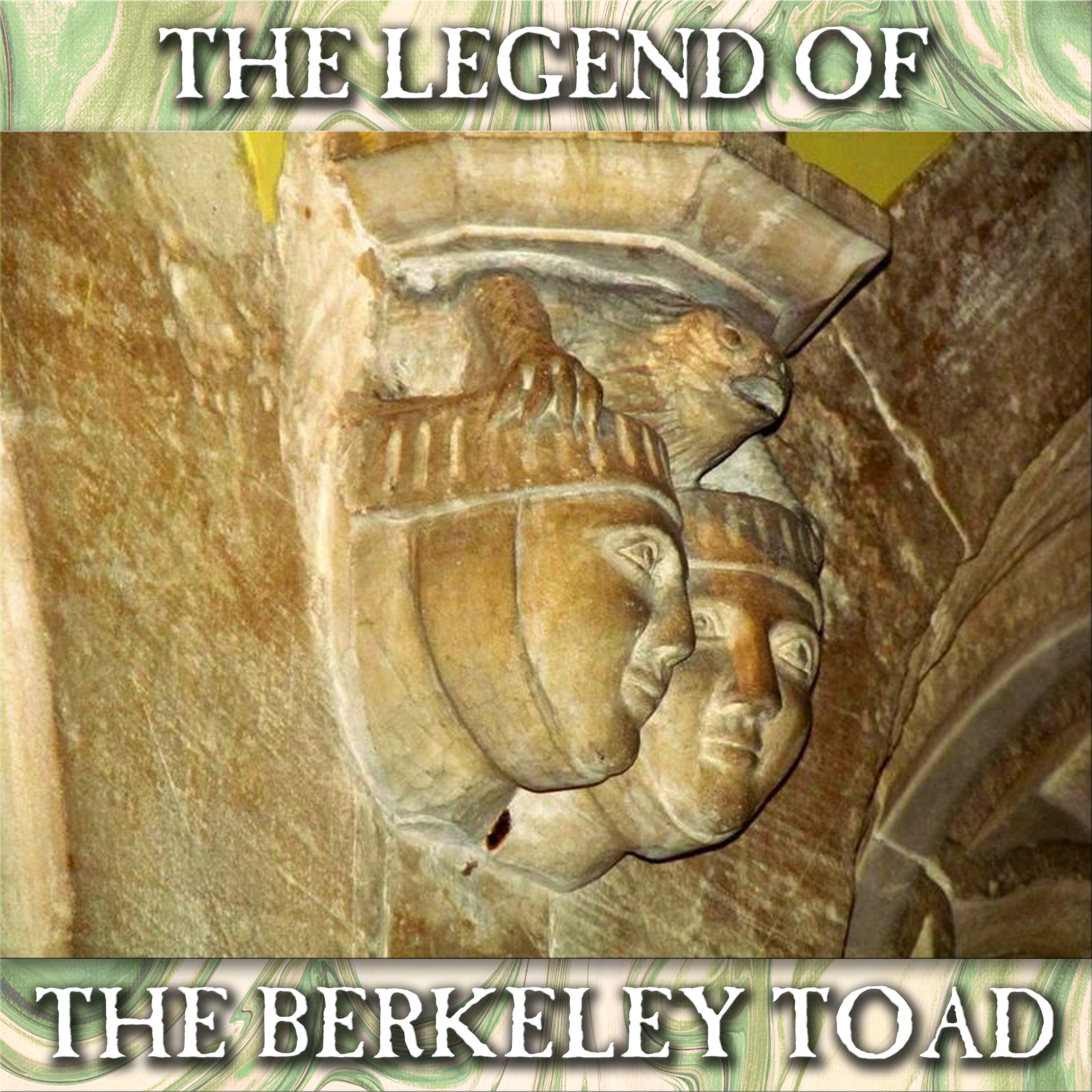
Berkeley is a small market town in Gloucestershire, and indeed just like in Campbell's story there is a Norman castle there. However rather than being the isolated ruin of the tale, Berkeley Castle is still in relatively good order and is the home of the Berkeley family - indeed it is the one of oldest continuously inhabited castles in England.  However in the Morning Room of the castle there is a curious carving which depicts a monstrous toad-like thing squatting upon two human heads. More curious still, a very similar carving of a toad and two heads is found carved on a corbel in a local church, St. Marys. And significantly this carving adorns the chapel of the Berkeley family tombs.

Toad carving in the Morning Room of Berkeley Castle


According to the conventional wisdom, these carving are supposedly what is often called a sermon in stone. The medieval world had a complex system of symbolism, and hence many odd features in old churches that feature seemingly un-Christian things are actually visual lessons using this  language of imagery. In the medieval mind toads were associated with poison (for they secrete toxins as a defence) and romantic jealousy (due to their breeding habits where several males will attempt to mount the same female), therefore these two Berkeley carvings are traditionally interpreted as warnings on the sins of gossip and envy, with the toad figure poisoning the minds of two women as they speak. 

However local legend has a different interpretation - allegedly the carvings show not two women but two children, a pair of unfortunates who were gobbled up by the monstrous toad!  Now quite where the horrible creature came from I have been unable to ascertain, but it was claimed that the skin of the beast was exhibited in Berkeley Castle. In his 1837 tome A History of British Quadrupeds including the Cetacea zoologist Thomas Bell quotes an associate, a Mr Broderip who relates the tale in a letter -
The legend ran, that this was the great toad which inhabited the dungeons of the castle, and victimised the captives. Two of his own children were said to have been sacrificed to this monster by a Marquis of Berkeley of the olden time. I remember hearing the tale from our old nurse, and afterwards venturing to dispute the truth of the story. I can see her now, with her close white cap and shaking head, reproving me for my want of faith, and settling the question, as she thought, by solemnly announcing that the skin of the toad was still seen at the castle.
Delving further into the matter, I discovered that in the early 1600s, a faithful servant, John Smyth of Nibley,  the steward of the castle, had compiled a history of both the Berkeley family and their home. And in these voluminous writings, which historians have named The Berkeley Mss.,  Symth writes -
Out of which dungeon in the likenes of a deepe broad well goinge steepely down in the midst of the Dungeon Chamber in the said Keepe, was (as tradition tells,) drawne forth a Toad, in the time of Kinge Henry the seventh, of an incredible bignes, which, in the deepe dry dust in the bottom thereof, had doubtlesse lived there divers hundreds of yeares; whose portraiture in just demension, as it was then to me affirmed by divers aged persons, I sawe, about 48 years agone, drawne in colours upon the doore of the Great Hall and of the utter side of the stone porch leadinge into that hall; since, by pargettors or pointers of that wall washed out or outworne with time; which in bredth was more then a foot, neere 16 inches, and in length more. Of which monstrous and outgrowne beast the inhabitants of this towne, and in the neighbour villages round about, fable many strange and incredible wonders; makinge the greatnes of this toad more than would fill a peck, yea, I have heard some, who looked to have beleife, say from the report of their Fathers and Grandfathers that it would have filled a bushell or strike, and to have beene many yeares fed with flesh and garbage from the butchers; but this is all the trueth I knowe or dare believe.
Now for those of you unfamiliar with archaic measurements, the terms mentioned were weights for dry goods - a peck was two gallons, a bushel was eight gallons (four pecks), and a strike was sixteen gallons (or two bushels). So then we have a beast that was several feet in size - far from Godzilla proportions of course, but all the same a toad, an animal usually only a few inches long, that was the size of a large sack of grain would indeed be a "strange and incredible wonder". And more to the point, big enough to chomp on people...
Corbel in St. Marys

Here we also have the origin of the legendary beast - an old well deep in the castle dungeons. However it is interesting to note that as the loyal servant he undoubtedly was Symth somewhat glosses over the fact that the old tales claim that prisoners were fed to the monstrous toad. Nor does he mention the legend that two of the family's children were once upon a time fed to the beast. So far I have not been able to locate any Marquis of Berkeley, or any other worthy of that family for that matter, who had a reputation for dabbling in the black arts as did Sir Gilbert Morley in The Room in the Castle.

Was the beast ever real? Well toads in captivity can live up to fifty years and do indeed grow larger with age. Hence it is possible that a very long lived specimen might have exceeded the usual six inches or so. And so, taking the lower end of the range of sizes mentioned by Symth it is perhaps just feasible that there was such a creature - although a toad around a foot long would hardly be able to chow down on prisoners. Alternatively it may have been a specimen of some larger foreign species acquired as an unusual pet - the largest on record was a cane toad that measured 15 inches, which is certainly in the same ballpark as the smaller estimates of the Berkeley Toad.

But what of the skin that hung in the castle? Well sadly, it was long ago identified as something rather different. In his 1836 book Berkeley Castle: An Historical Romance, Volume 1Grantley Fitzhardinge Berkeley writes - 
One thing, which I remember well as a child has been removed; on yonder shelf was the stuffed skin of a huge seal, often pointed out to me by my nurse, as the great toad of old, which my ancestry used to keep in the donjon to feed upon their captives; and to which, as an ancient legend run, (doubtless derived from as authentic a source) the Marquis of Berkeley was supposed to have abandoned his two children.
Yes, the hide of the Berkeley Toad was nothing more than a badly stuffed seal it would appear. Whether this was acquired to embroider the legend of the carvings or maybe was their inspiration we cannot say. However it seems likely that some noble of the Berkeley family at some time either had the stuffed seal ,or perhaps a live toad of amazing proportions, as a curiosity. For in the pre-modern age, it was not uncommon for aristocrats to furnish their homes with such wonders and curiosities - such things were the blockbuster movies of their day. For like having ornate gardens and exhibiting works of art, owning an unusual animal would make one very fashionable, and draw many eminent visitors and guests to one's home. And the tales of feeding the creature on human flesh would only spice up the attraction of the curiosity. 

However one mystery remains - and that is why as a long time devotee of the folklore of the British Isles, and indeed having a love of mythical monsters, I had not come across legends of the Berkeley Toad before.  
But perhaps I had read of these tales before, and merely forgotten... For after all, did not Ludwig Von Prinn write in the horrible De Vermis Mysteriis that Byatis had the power to cloud the minds of men?
Byatis, the serpent-bearded, the god of forgetfulness, came with the Great Old Ones from the stars, called by obeisances made to his image, which was brought by the Deep Ones to Earth. He may be called by the touching of his image by a living being. His gaze brings darkness on the mind; and it is said that those who look upon his eye will be forced to walk to his clutches. He feasts upon those who stray to him, and from those upon whom he feasts he draws a part of their vitality.
But surely that cannot be. Indeed, one hopes not, for might not dwelling upon the legend constitute a modern version of making obeisances to its image. No, of course not, that is mere folly born of poring over too many old and dusty tomes. But wait... What is that slithering I hear at the window...