Showing posts with label dragons. Show all posts

Wednesday, 18 October 2023

Hypnogoria Halloween Advent Calendar - Door 18 - The Guardian of the Threshold


Not far from Haggleton is the village of Fring, which boasts a lovely little church which dates back to at least mediaeval times. It has many fascinating features of the antiquarian but the most prominent is the dragon that coils on the pillar between the big church doors. And what’s more, this is a carving with a tale... 

Local folks say that the carved dragon that adorns the column between the double doors of St. Bartolph’s commemorates a fearsome beast. This monstrous wyrm, according to local legend, stalked Thistle Forest, scoffing down livestock, ruining crops and poisoning waterways with its venomous breath. So toxic were its exhalations that anyone who approached it would fall down dead, and hence while many would be heroes attempted to slay the monster, none actually got close enough even to land a blow on the beast. 

However where assorted knights failed, the local blacksmith would triumph - for he forged an extra long lance which he mounted on a barrow fortified with sheets of steel. He tracked the beast to the top of the nearby Ringstone Hill, and charged the beast with his armoured contraption. The long length of the lance and the steel shielding protected the canny smith from the worm’s noxious breath, and with one mighty lunge he impaled the scaly horror to a tree. However unusually for dragon legends, the attack didn’t slay the beast, for although the monster was gravely wounded and pinned fast to the trunk, due to its poison breath, no one dared get close enough to finish it off. Instead the villagers left the beast impaled there, and after a week or so the monster starved to death. Allegedly the villagers then skinned the monster and its hide was hung up as a trophy in the church. 

But unfortunately for us all, the alleged dragonskin vanished many years ago. It is usually claimed that it was burnt at some point in the 19th century when a new vicar took up residence and objected to the now mouldering hide hanging up in his church. However if you were to get talking to the old boys in The Brown Trout, you might hear a different tale. 

For according to the greybearded gaffers, the skin is still in the church, but is now safely bricked up in a secret spot in the walls. This was done at the end of the 18th century allegedly, after an attempted theft. It is said that a gentleman in Ashlington, some say he was antiquarian, others a zoologist, heard that the local church displayed a piece of dragonhide, and made an offer to buy it. However despite the sum offered being very generous, the vicar and villagers decided that they could not sell this ancient piece of their heritage, and so declined the offer. 

Obviously the proposed sale of the dragon-hide was the talk of the town, and news of it unfortunately reached a rather unscrupulous pair of ears. Jonas Herd was a down-at-heel market trader, and his fortunes were so poor due to the fact that he knowingly sold poor produce and often swindled his customers on the deals. In fact he had been recently barred from trading in the local market after being caught several times using rigged scales to weigh out his dubious wares. 

Now when the money-grasping Herd got wind of this generous offer for the dragonskin and having an axe to grind with the locals, he hatched a seemingly cunning plan. He would break into the church, steal the skin and sell it himself to that fellow in Ashlington. Thus rendering him both a tidy profit and some petty revenge into the bargain. And so, one foggy night in October, he packed up a bag of tools and set to work... 

But alas as is so often the case, crime goes hand-in-hand with stupidity, and Herd’s greed certainly outweighed his intelligence. To begin with, rather than selecting the rear door or one of the back windows, Herd decided to break in through the main double doors. Quite how he was planning to get inside is something of a mystery, but whatever he was attempting went badly wrong. 

For in the dim watches of that misty night, the peace of the village was shattered by dreadful screaming, and the roused villagers discovered Herd, covered in blood, in a dead faint on the village green. His break-in had resulted in a terrible accident, and the greedy little fellow had managed to sever one of his own hands. A doctor was called but to no avail, and Herd died from blood loss. 

Quite how the accident occurred is something of a mystery. Some folks claim he was attempting to saw the doors off their hinges, while others reckon he was trying to cut out the big iron locks. And it is true that both of these foolhardy approaches to burglary could explain how the despicable Herd had managed to lop off one of his own hands. However, as the old boys will tell you with a sly grin, no one, but no one, could explain quite why the severed hand was found clamped in the little dragon’s jaws... 


DIRECT DOWNLOAD Door 18 - The Guardian of the Threshold


Find all the podcasts in the HYPNOGORIA family here plus more articles on the weird and wonderful here-


Thursday, 11 October 2018

Inktober 2018 - Week 1


Well, it's that time of the year once again, so here are my collected scribbles for #inktober! This year, I thought it would be fun challenge to produce drawings every day using the official list of prompt words pictured above. And so far, it's working out rather well! Whether I stick with it, remains to be seen... Tune in next week to find out! Anyway, here's the first week's results! 

Day 1 - "Poisonous" - fairly straight-forward this one!


DAY 2 - "Tranquil" - This is my Mum's dear old little dog Penny, who went to her permanent rest aged 17 not long ago 


DAY 3 - "Roasted" - I went for something with an old school RPG vibe for this one! 


DAY 4 "Spell" - I stuck with the white on back and D&D flavours for this one too


Day 5 - "Chicken" - Toughest word so far... And I couldn't bring myself to do some doodle of an ordinary fowl so went for intergalactic space-bastard, the cyborg kaiju Gigan... who looks a little bit like a chicken...


Day 6 "Drooling" - I stuck with the big monsters vibe, and created this chap who may be a distant relation of 2000 AD's Satanus!


Day 7 "Exhausted" - Another tough one, but I thought I'd even up the odds with this one...


Monday, 23 October 2017

INKTOBER WEEK #3


Day 16  - "Uninvited Guests" - another homage to old school RPG art


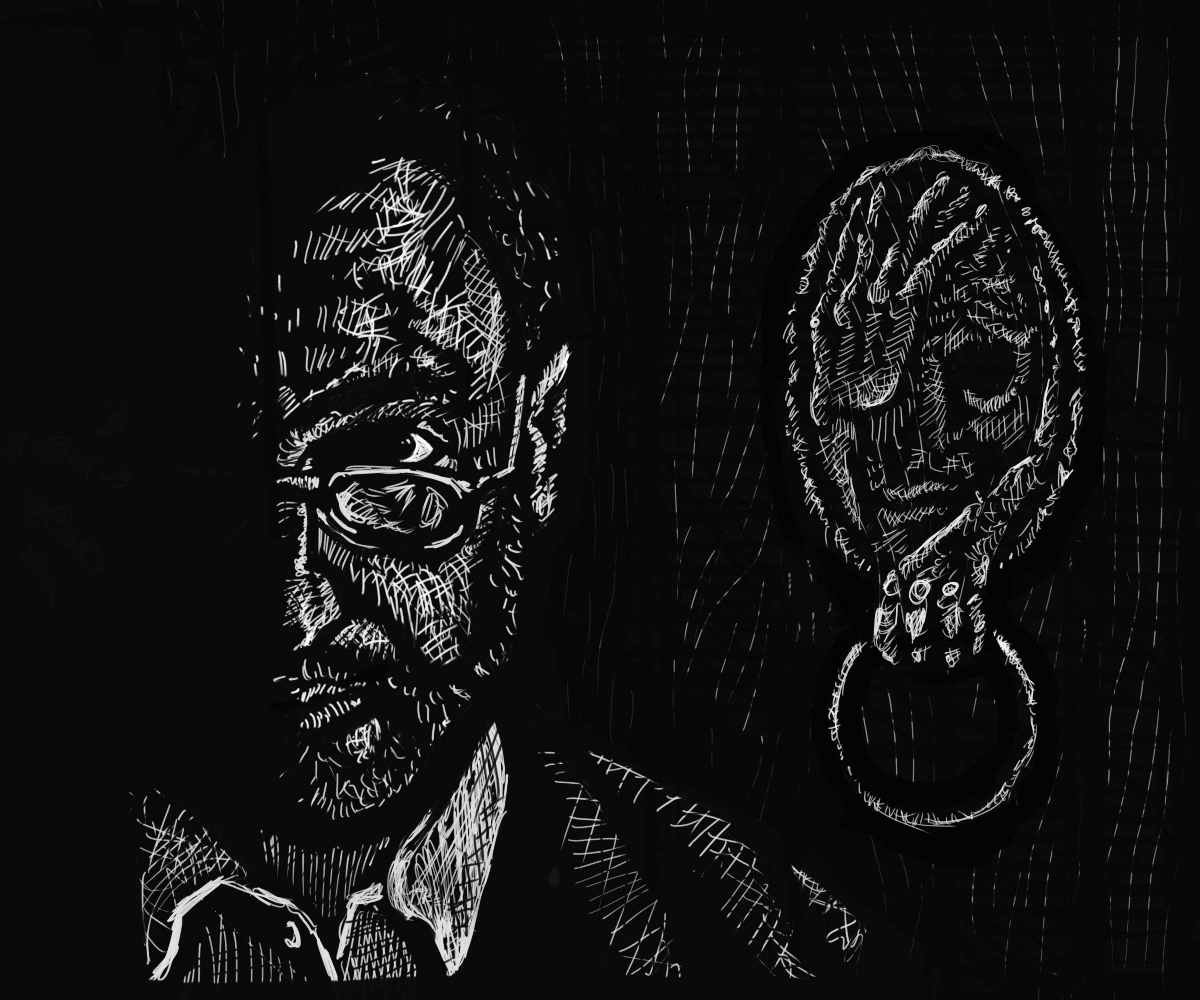
Day 17 - Crooked House with Mark Gatiss as the Curator


Day 18 - I think I'm calling this one "Black Goat Kaleidoscope"


Day 19 - Ghastly McNasty, Editor at Large #inktober2017


Day 20 - A regular face at the Great Library of Dreams...


Day 21 - Misty


Day 22 - another piece inspired by MR James
"One thing I did notice in the carving on the well-head, which I think must have escaped you. It was a horrid, grotesque shape — perhaps more like a toad than anything else, and there was a label by it inscribed with the two words, “Depositum custodi” - "Keep that which is committed to thee"...

from The Treasure of Abbot Thomas


Day 23 - The Stain of Vampirism - this piece was very much an exercise in seeing what suggested itself from some random splashes.

Friday, 14 August 2015

FOLKLORE ON FRIDAY - The Brawny Beasts of County Durham Part II


Last week, we uncovered a tangled legend from Bishop Auckland about a brave knight who slew either a dragon or a monstrous wild boar. And this tale of Sir Pollard and the Brawn shared many similarities with the legend of the Sockburn Worm, a story hailing from a few miles south in County Durham. A highly suspect coincidence to be sure. However stranger still, even closer to Bishop Auckland, the virtually neighbouring town of Ferryhill has its own legend of a monster hog.

The tale is found in The History and Antiquities of the County Palatine of Durham: Volume 3, Stockton and Darlington Wards by Robert Surtees published in 1823. While detailing the history of the area, and noting the various historical traces and relics left by one Sir Roger de Fery, Surtees' recounts this 13th century knight's great claim to fame - the slaying of the Brawn of Brancepeth. He writes - 
The Boar or Brawn of Brancepath was a formidable animal, which made his lair on Brandon-hill, and walked the forest in ancient undisputed sovereignty from the Wear to the Gaunless. The marshy, and then woody vale, extending from Croxdale to Ferry-wood, was one of the brawn's favourite haunts, affording roots and mast, and the luxurious pleasure of volutation. Near Cleves-cross, Hodge, of Ferry, after carefully marking the boar's track, dug a pitfall, slightly covered with boughs and turf, and then toling on his victim by some bait to the treacherous spot, stood armed with his good sword across the pitfall,— “At once with hope and fear his heart rebounds.” At length the gallant brute came trotting on his onward path, and seeing the passage barred, rushed headlong on the vile pitfall. 
Now according to local historians this is the earliest record of the story of the slaying of the beast by Roger/Hodge of Fery. However is it curious that Surtees includes a quote in this recounting of the tale - “At once with hope and fear his heart rebounds” - and quite where this line comes from is unclear. I can find no trace of it anywhere else. Is it a quote from Surtees' source for the tale?

Some digging on my part turned up what appears to be an earlier version, told in verse, although annoyingly lacking Surtee's mystery quote. In another old tome The History of the Urban District of Spennymoor published in 1893, by author James J Dodd relates the Ferryhill legend, often almost quoting some of Surtees' phrasing. However deviating from his predecessor's account, he includes the following verse- 
He feared not ye loute with hys stalfe,
Ne yet for ye knyghte in his mayle;
He cared ne more for ye monke with his boke,
Than ye fiendis in depe Croixdale.
Then out spake Hodge yt wyghte soe bolde,
Yt wous on Fery hye;
And he hathe swome by Seynct Cudberte hys rode,
Yt thys horride brawne shall dye;
And he hathe dygged a depe, depe pit,
And strewed it with braunches so grene
Clearly Dodd's quote is but a fragment, and one that tantalizingly cutting off just where the Surtees line might have appeared. And so far, I have been unable to discover either a complete version or a definite origin for it.  Now I have found this old poem appearing with a date of 1208 attached to it, but its actual provenance has been difficult to ascertain. To further muddy the waters, the Victorians, with their passion for heritage and history, recreated a great many old traditions, and hence there is the possibility that this verse, despite being penned in convincing early English, is actually the product of a later century, a Victorian recreation of an imagined lost ballad perhaps.

However the 1208 date does match the historical record, for indeed there was a knight named Roger de Fery in that time. Local tradition has it that the name of the local area 'Brancepeth' is actually derived from 'brawn's path', as this is where the beast reputedly roamed. However scholars in recent times have cast doubt on this, claiming it more likely comes from 'Brant's path', named after a family that made its home in that locale. But as Surtees remarks "The story has nothing very improbable, and something like real evidence still exists", and goes on detail the legacies of Sir Roger that still exist today. These including his alleged tomb in the parish church of Merrington, a twelfth century grave whose slab bears the carved sign of a crossed sword and a spade. As Mr Dodd remarks - 
Seeing that the sword and the spade were the instruments of his famous victory, it needs a very slight stretch of imagination to identify this stone as the actual tombstone of Hodge of Fery. 

However local lore identifies two other places linked with the legend. As Dodd relates, in 1867 the remains of a large pit were discovered while repairing a stackyard, which was quickly assumed to be the very trap dug by Sir Roger. This may seem like a leap of logic, but some years earlier on the same farm, a large stone was dug up which is purported to be all that remains of a cross erected to mark the spot where Sir Roger slew the beast. The area where it was discovered is now known as Cleves Cross after it, and there is a plaque set into a nearby wall that claims - 
The large stone just above ye part of Cleves Cross marks the site where by tradition the Brawn of BRANCEPETH was killed by ROGER de FERY about the year 1200
The current plaque is a recent facsimile, but the original can still be seen in Ferryhill town hall (which also sports the gorgeous stained glass window seen at the heading of this piece).


While the stone is definitely the remains of a medieval monument, in truth we cannot be sure the cross does actually commemorate the slaying of the beast. Some historians postulate that the cross was more probably a way point or marker for pilgrims to Durham Cathedral, but to be frank that is unsupported supposition too, and  I suspect is more a product of an attempt to rid history of something embarrassing like a monster legend. But is a 13th knight hunting down a ferocious wild hog really that unlikely?

To begin with wild boar were still to be found in England at that time, although by the start of the 13th century their numbers were falling and they were being considered something of a menace. Furthermore as tales of monster slaying go, the tale of the Brawn of Brancepeth is highly plausible; the legend actually lacks all the mythic touches one would expect. It features a real animal, and there are no charms or magic involved. It is in fact a rather straight forward account of hunting a dangerous animal, with none of the usual narrative embroidery of the boar's ferociousness or size, nor some lavish reward for brave Sir Roger to round it out into a traditional story or folk tale.

More importantly, the historical record has some very strong evidence to back up the old tale. The traditions of heraldry in that period allowed a man to place in his arms the likeness of any notable beast he had slew. And hence, as Surtees' records, the seals of the de Fery family in that era do indeed show a boar - with Sir Roger's own showing the full beast, while his daughter Maude's just the head.


Given these seals and the carved device on Sir Roger's tomb, it is therefore very much looks like we have a story here rooted in fact rather than fiction. And as we shall discover next time, slaying wild boars was a not uncommon feat for brave men of that era, however many such stories are not as well supported as Sir Roger's by the historical record... And returning to the Pollard legend we will discover why having a beast slayer in the family was so desirable.


Friday, 7 August 2015

FOLKLORE ON FRIDAY - The Brawny Beasts of County Durham Part I


While browsing local legends online, I came across a brief mention of a tale of a limbless worm that reputedly made its lair in a wood outside Bishop Auckland, a little country town literally just down the road from my own. Now the North of England has many legends of great wyrms and dragons, but this one was new to me. And so I did some digging, and in The Works of Sir Walter Scott Volume III (1806) I discovered a fuller account. While discussing the border ballad Kempion, Scott talks at length about the tradition of dragons and wyrms in the North; he recounts the tale of another local dragon, the Sockburn Worm which we have discussed before, and tells of how tradition demands that a new Bishop of Durham is presented with the falchion that slew the beast on his first entrance into the diocese at Croft-on-Tees. But then he goes on to mention a knight slaying a worm at at Bishop Auckland. 

Now what was interesting was that Scott relates that this legend inspired a suspiciously similar ritual involving a falchion and the Bishop of Durham too. I say suspiciously similar for what are the odds of having two dragon-slayers, in the same county, within a few miles of each other, who are both  rewarded with lands and commemorated by presenting exactly the same type of weapon to the local bishop? Surely this was but the same tale but mistakenly attributed to the wrong town and noble family. 

Fortunately for us, Scott quotes his sources, an old tome called Ancient Tenures. It was written by one Thomas Blout in the early 17th century, but was later expanded by other scholars. And hence an edition published in 1815 by by S.Brooke for Butterworth & Son of London has the full title - Fragmenta antiquitatis: or, Ancient tenures of land, and jocular customs of manors (Enlarged and corrected by Josiah Beckwith; with considerable additions from authentic sources, by Hercules Malebysse Beckwith) - and in it we find the following passage - 


Now judging by the dates given in the text, the account of the Pollard's Lands falchion rite dates from long after old Thomas Blout had passed away, and hence is clearly a later addition, most likely a new expansion for this 1815 edition. Now as the scholarship of the 18th and 19th century can be sometime a little muddled with its facts, I tried to find other, and preferably earlier, mentions of the Pollards and a serpent. And in an even older tome I found this reference, which although brief, sheds a very different light on the matter -  
The owners of the land are to doe at every Bishop's first coming to be Bishop here to present him with the Falchion with which the Bore was slayne
from Parliamentary Surveys of the Bishopric of Durham 1649-1650


And so, here was the key to the mystery - there was good reason why I hadn't heard of a dragon tale from Bishop Auckland, for the monster in question was actually a vicious wild boar rather than a serpent! And with that important fact uncovered, it was not difficult to uncover many versions of the tale of the Brawn of Bishop Auckland and its slaying by a knight of the Pollard family.

Now Bishop Auckland was once a place of deep forests and wildwoods, indeed it is said that the town grew from a hunting lodge built there by the Bishops of Durham. With the local woodlands and hills providing excellent sporting opportunities, the little town grew and the Bishops of the county built a great hall there, and later a palatial castle. At some point, alleged in the Middle Ages, a monstrous boar appeared in the woods. Reputedly the size of a cow, this gigantic porker terrorized the area, attacking both man and beast. Naturally this dangerous brawn (as such boars were called) was a great menace to the local folk and was putting a serious dent in the nobility's hunting trips too. Therefore the Bishop of Durham placed a bounty on the beast's head in the hope some brave soul would slay go out and slay it.

A knight named Sir Richard Pollard took up the challenge and tracked the dreaded brawn into the woodland lair, and after a long battle he finally slew the monstrous hog. Sir Richard cut out the boar's tongue and then, being extremely fatigued by the mighty and bloody battle, collapsed into a deep sleep by the still cooling carcass of the brawn. However a cunning fellow happened by the sleeping knight and knowing of the bounty on the brawn, spirited its body away and claimed the reward from the bishop. Naturally Richard was horrified when he awoke, and rode with all haste to the Bishop's palace at Bishop Auckland. The trickery was soon revealed when Sir Richard produced the beast's missing tongue, and in recompense the Bishop offered Sir Richard ownership of all the lands he could ride around before the Bishop had finished his meal. The Bishop however was rather shocked when Sir Richard returned mere minutes later, and the clergyman was even more horrified when he discovered the reasons why. For the wily Sir Richard had rode around Auckland itself, which of course included the Bishop's beloved castle, palace and lands. Of course the Bishop would not honour the agreement but was so impressed by Sir Richard's cunning, he awarded him tracts of the most fertile lands in the county, which of course became Pollard's Lands, and which now survive as Pollard's Dene.

A highly entertaining tale no doubt. But how did a monstrous boar become confused with a great serpent? Well it has been suggested that the confusion arises from an old Germanic word Gewurm which referred to any sort of dangerous wild animal, and has the same origin as the English word 'vermin'. It's a nice theory, however it is one that is rather problematic - firstly there is a clear mismatch of several centuries from when it was possible such Germanic words were still readily peppering the developing English language and the period from which this story purportedly dates, for it is a medieval tale not a Saxon one. Furthermore the Oxford English Dictionary has no entry for 'gewurm' which rather suggests the word was never in common currency in  these isles, and likewise lexicons of Old English  fail to include it too.

A more likely explanation in my view is that thanks to the often broad nature of North Eastern accents, somewhere along the line a visitor from Southern England misheard 'brawn' as 'wyrm'. While accents in County Durham might not always be as thick as Tyneside's Geordie, however the different vowel sounds and speaking cadences in the region could very easily result in a visitor to the area confusing 'wyrm' with 'brawn'. And in the realm of folklore it would not be the first time the confusing of a name lead to the birth of a new legend.

So then, that is one possible explanation for Bishop Auckland having twin legends of knights fighting dragons and boars. However this neat wrap-up of the mystery is somewhat unraveled when you learn that the little town of Ferryhill, which lies less than ten miles away, has a suspiciously similar legend of a brave knight slaying a monstrous boar! Clearly there is some chicanery going on here as we now have three separate but over-lapping legends in the same twenty mile area!

If you will pardon the pun, someone somewhere here is telling porkies! And next time we will discover which naughty knight is telling fibs and discover more about the monster brawns of the North East! 


Friday, 27 February 2015

FOLKLORE ON FRIDAY: The Wyvern of Wonderland


The green and pleasant lands of Britain are full of delightful flora and fauna. However if our folk tales are to be believed, this ancient land was once haunted by creatures far more fearsome than the usual well-loved woodland favourites. For according to legend, many counties in England harboured larger wildlife than just badgers, bunnies, foxes and squirrels, with old tales telling of great worms that roamed the countryside preying upon all and sundry. And no, not the kind you get in the garden! In European folklore, a worm is monstrous serpent or dragon, a term derived from the Old English: wyrm, the Old High German: wurm, and the Old Norse: ormr, all which mean snake or serpent. And the North-East of England seems to have been something of a favoured habitat for these monsters, home to famous legends such as the Lambton Worm, and the Laidley Worm of Bamburgh. However one lesser known beast has had a curious literary legacy, spawning a monster more famous than the worms of Lambton or Bamburgh. 

If you venture to the southern reaches of County Durham, you find the mighty River Tees. And not far from the little town of Croft, this North Eastern river takes something of a wandering path, almost going into a complete loop, and forming a patch of land known as the Sockburn peninsular. A few miles from here is the market town of Darlington, and on the heraldic arms of the borough one can see a shield, supported on one side by a lion and on the other by a wyvern with a falchion - a type of  medieval sword - embedded in its neck. Now this is no mere heraldic symbol or decoration, for this scaly beast is the legendary Sockburn Worm which terrorized the area back in the Middle Ages.

Borough of Darlington coat of arms

The Sockburn area is the seat of Conyers family, and according to old manuscripts this noble house was founded by one Sir John Conyers, who lies buried at Sockburn church. And while most of the church is now in ruins, a portion known as the Conyers Chapel is still standing and the tomb of Sir John, complete with his effigy in full armour, can still be seen there. And a further relic can be seen at the Treasury of Durham Cathedral - Sir John's own falchion. Originally housed at Sockburn Hall, until the late 18th century the falchion was used in a ceremony when a new Bishop of Durham entered the bishopric for the first time. The Lord of Sockburn would present and hand over the falchion to the newly appointed bishop on the bridge at Croft. This little ritual symbolised the noble family recognizing the authority of the incoming Prince-Bishop, and while there are many similar historic customs where a token is passed to show fealty to a ruling authority, in this case the falchion was more than a symbolic prop. For this ancient weapon was the foundation on which the nobility of the Conyers family was built upon. 

Historians believe that the Conyers originally came over to England during or just after the Norman conquest of 1066. However the family were not ennobled and granted lands until several centuries later, at some point between 12th or 14th centuries. However according to tradition, it was Sir John who won these honours. For back in those dark days, a monstrous worm was ravaging the lands of Sockburn, devouring both livestock and people. The Sockburn Worm was not only highly ferocious and but it  was also very toxic, for like many European dragons, rather than breathing fire, its breath and bite were lethally poisonous. Sir John, then just a humble knight, undertook to challenge the beast. What happened is documented in the Bowes Manuscript - 
Sr John Conyers, Knt. slew yt monstrous and poysonous vermine or wyverne, who overthrew and devoured many people in fight, for that ye sent of yt poison was so strong yt no person might abyde it. And by ye providence of Almighty God this John Connyers, Kt, overthrew ye saide monster, and slew it. But before he made this enterprise, having but one sonne, he went to the Church of Sockburne in compleate armour, and offered up yt his onely sonne to ye Holy Ghost. yt place where this great serpent laye was called Graystane; and as it is written in ye same manuscript, this John lieth buried in Sockburne Church in compleat armour before the Conquest. 
So then the Conyers gained their lands and title from Sir John slaying the Worm of Sockburn, and indeed it is the brave knight's falchion that we see on the coat of arms of the Borough of Darlington. And while the Conyers family is long gone, the custom of handing of Sir John's falchion to the new Bishop of Durham was revived in 1984, with the Mayor of Darlington handing over the ancient blade and intoning the time-honoured words - 
My Lord Bishop. I hereby present you with the falchion wherewith the champion Conyers slew the worm, dragon or fiery flying serpent which destroyed man, woman and child; in memory of which the king then reigning gave him the manor of Sockburn, to hold by this tenure, that upon the first entrance of every bishop into the county the falchion should be presented.
The Conyers Falchion

However was there ever really a Sockburn Worm, and if so what exactly was it? Some historians have suggested that the beast was a symbol for Viking invaders, and that Sir John actually slew a ferocious marauding Norseman. The theory goes that the worm legend was inspired by the carved dragon heads that adorned Viking long ships. However as the Northern counties abound with first hand accounts and handed down tales of such raids, it seems unlikely that in this case Viking pillagers should be transmogrified into a reptilian monster. And then there is also the additional problem that Sockburn, Croft and Darlington are a fair way from the seas, around twenty-five miles away in fact. 

Furthermore we should not jump to the conclusion that the Worm was a dragon. Now the account quoted above uses the term 'wyvern' which refers to a specific type of dragon - namely one with wings and two legs. And indeed this is how the Sockburn Worm is often depicted, for example it  is seen on the Darlington coat of arms. However this classification comes from 17th century heraldry rather than folklore. And while the manuscript account quoted above is thought to have been written in 1600s, the tale is prefixed by the author stating that "In an ould Manuscript wh I have sene of ye descent of Connyers, there is writ as followeth..." Therefore "wyverne" is very likely to have been used in an older sense of the word, one derived from Middle English, in which it meant simply "viper".

And considering the serpentine forms of other Northern Eastern monsters, and indeed many British dragons, it would seem likely that the original tale is speaking of a monstrous serpent rather than a winged and clawed traditional dragon. Indeed when one considers the accounts of these monstrous worms found all across Northern Europe, which are all are oddly consistent with each other, it is tempting to wonder if there is perhaps some truth behind the old tales... However that is a subject for another day.

Whatever the true nature of the Worm of Sockburn, the beast has sired some notable spawn. Firstly after the Conyers line died out, the Sockburn estate came to the hands of the Hutchinson family. And in 1799, Thomas Hutchinson and his family had some famous visitors come to stay, the poets William Wordsworth and Thomas Coleridge. It would prove to be a memorable stay for all concerned - Wordsworth fell in love with Mary Hutchinson, who he would married in 1802, and Coleridge found romance with her sister Sara. In his ardour for Sara, Coleridge wrote the poem Love and both drew inspiration from, and made allusions to, the local legend and the effigy of Sir John in the chapel.

However this isn't the only literary progeny of the Sockburn Worm, for about forty years later another literary luminary was in residence in the district. In 1843 a new clergyman and his family took up residence in the rectory at Croft-on-Tees, and the eldest son, then eleven years old, was one Charles Lutwidge Dodgson - a boy who would grow up to follow in his father's footsteps as an Anglican deacon, but also become a noted mathematician, a logician, a photographer and ultimately become better known to the world as Lewis Carroll, author of the Alice in Wonderland books.

Dodgson remained very fond of Croft and the North East, and often came back to stay for long periods throughout his entire life. And it was on one such trip back to Croft in 1855 that he penned a short poem that he entitled Stanza of Anglo-Saxon Poetry. It went like this...
Twas bryllyg, and ye slythy toves
Did gyre and gymble in ye wabe:
All mimsy were ye borogoves;
And ye mome raths outgrabe
...And I'm sure that most of you will recognise those lines. For a little later Dodgson was to expand this verse, one that would eventually appear in Alice's second round of adventures - Through the Looking-Glass (1871), as the classic poem Jabberwocky.

The Jabberwock by Sir John Tenniel

Now over the years it has often been thought that given Dodgson's love of the North East, Jabberwocky, must have been inspired by the tale of the Lambton Worm. However it is now generally agreed that the legend of the Sockburn Worm is most likely the sire of the dreaded Jabberwock. Firstly while the beast itself, now one of the famous monsters of literature, is clearly a draconic horror, and may appear to be different from the Sockburn Worm, it is consistent with the later wyvern depiction that Dodgson would have been familiar with.

Furthermore however this celebrated piece of nonsense poetry has the hero slaying the Jabberwock with a special sword, a vorpal blade. This clearly parallels Sir John and his falchion, whereas the Lambton Worm required a more arcane means of disposal. Finally of course, given Dodgson's close association with the church and Croft, he would have certainly known the Sockburn legend. Indeed when the Dodgson's' took up residence at the rectory, the last falchion ceremony would have still been within living memory. Interestingly Carroll scholars have suggested that 'vorpal' is an amalgam of 'verbal' and 'gospel' - an allusion perhaps to Sir John's prayers and pact with the Lord to gain victory over the beast? 

The final clue to the Sockburn link is perhaps the most obscure, but is also possibly the most interesting, for it sheds a new light on the literary nature of Jabberwocky itself. This hint lies in the title of the seed version of the poem - Stanza of Anglo-Saxon Poetry. For while most writing on the Sockburn legend these days dates the tale to around the 14th century, based upon the real Sir John Conyers dying in the early 1400s, accounts in books from Dodgson's era mention that it was then believed that the events of the tale occurred far earlier. For example, Bulmer's History and Directory of North Yorkshire published 1890 has this to say on the dating of the Sockburn Worm story -
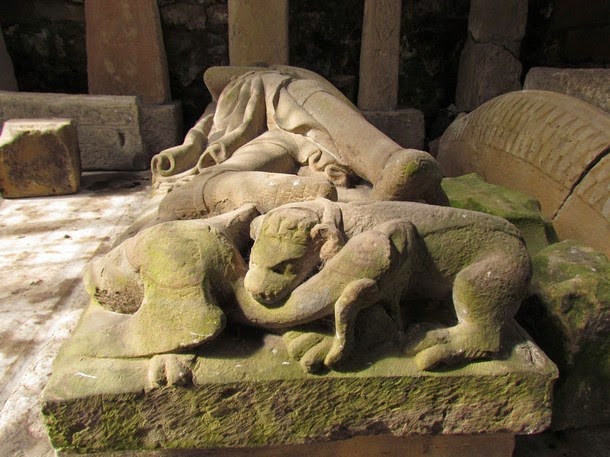
This story, as handed down by tradition, is very much out of harmony with the recorded facts of chronology. The ancestors of the Conyers came to England in the train of William I., at the time of the Conquest, and an effigy, said to be that of Sir John Conyers, the hero of the Worm story, now in Sockburn Hall, whither it was removed at the demolition of the old church, represents a crosslegged knight of the 13th century, clad in chain armour, with his feet resting on a lion engaged in a deadly conflict with a winged worm or griffin. But the exploit, according to the tradition, occurred before the Conquest. 
And so, suddenly the title of the original short poem suddenly makes a lot more sense. Whereas we think of the Sockburn Worm as a medieval story, folks of Dodgson's time considered it a legend from the Dark Ages. And in this light we can clearly see the nonsense language of Jabberwocky, rather than being just linguistic tomfoolery, is also a deliberate echo of the archaic spellings, phrases and cadences of pre-modern English, not dissimilar the kind of language found in the original account, recorded  in the Bowes Manuscript. Many of Carroll's poems are deliberate parodies of other poems, and so considering the Sockburn inspiration for Jabberwocky, it is possible that the nonsense wordplay of this famous poem is in fact a humorous approximation of the tongue of the Dark Ages, a form of speech halfway between Middle and Modern English. 

All in all then, whilst it remains one of the lesser known British dragon stories, the old Sockburn Worm has proved to be a most remarkable monster, inspiring literary greats such as Coleridge and Carroll and fathering one of the great legendary beasts of literature. Long may it continue to burble in the tulgey wood and seize our imaginations with its claws that catch! 


Effigy of Sir John Conyers at Sockburn Church, with a dragon at his feet

A reading of Jabberwocky by Mr Jim Moon

Thursday, 27 March 2014

THE BLACK DOG PODCAST 191 - Berkshire Hunt


In another epic lengthed show we discuss such diverse subjects as... The Flash, Teddy Robinson retro love, Nebulous, and running and twisting a testicle. Add to that more superhero crappiness and the joy at Prometheus 2 news and a fine dragon profanisaurus entry, before we review this weeks film How to Train Your Dragon.

Next week we break out the casual racism and chilled monkey brains of Indiana Jones and the Temple of Doom... With points awarded if a feedbacker can get through a reply without mentioning Short Round.

DIRECT DOWNLOAD - THE BLACK DOG #191

THE BLACK DOG HOME PAGE & ARCHIVE

THE BLACK DOG on iTUNES


THE BLACK DOG is hosted by GeekPlanetOnline 


Sunday, 22 April 2012

HYPNOBOBS 75 - Favourite Childhood Monsters Part II


Continuing our ramble through favourite childhood monsters, Mr Jim Moon explores fairy and folk tales, the horror of Grendel, and discusses dragons and sea serpents at length. And there's also a look at some of your favourite monsters too...


DIRECT DOWNLOADFavourite Childhood Monsters Part II

Find all the podcasts in the HYPNOGORIA family here -

HYPNOGORIA HOME DOMAIN - Full archive, RSS feed and other useful links

HYPNOGORIA on iTunes