Showing posts with label Washington Irving. Show all posts

Tuesday, 15 December 2015

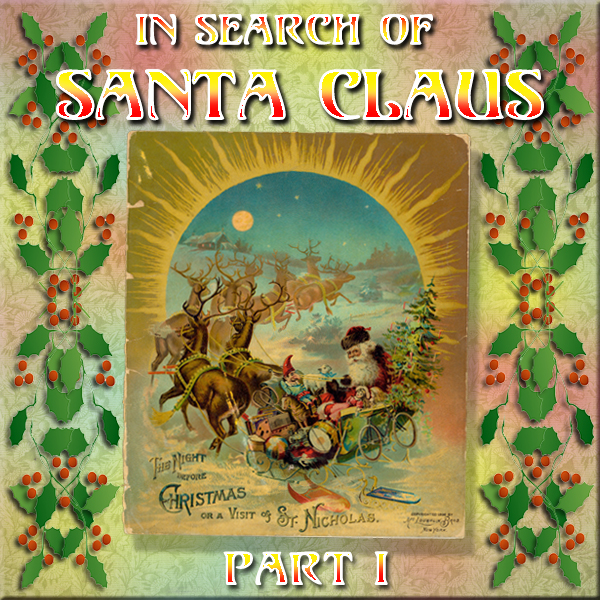
HYPNOGORIA 23 - In Search of Santa Part I


In this first in a series of Christmas specials, Mr Jim Moon sets off in search of Santa. Travelling down the centuries in a borrowed magic sleigh, we bust some myths about the Bearded Gentleman himself, before uncovering the roles played by the poem A Visit From St. Nicholas, the writings of Mr Washington Irving, and the drawings of Mr Thomas Nast in the development of legend of Santa Claus.


DIRECT DOWNLOAD -  In Search of Santa Part I 

Find all the podcasts in the HYPNOGORIA family here -

HYPNOGORIA HOME DOMAIN - Full archive, RSS feed and other useful links

HYPNOGORIA on iTunes

HYPNOGORIA on STITCHER

CLICK HERE FOR DETAILS


Friday, 10 October 2014

FOLKLORE ON FRIDAY - Headless Horsemen


As Halloween approaches many of us will be planning a revisit to a certain old classic that has long been associated with the spooky celebrations at the end of October - Washing Irving's The Legend of Sleepy Hollow. This well-loved tale has been adapted many times over the years, and the story of Ichabod Crane's encounters with a sinister rider, in one form or another, has become a staple of many people's Halloween festivities.

Now in modern pop culture, spectres who carry their own severed heads are, after the classic sheeted spook, the most common image we associate with ghosts. And over the years many have assumed that the headless ghost owes its popularity to Irving's famous tale. However decapitated phantoms were very common in folklore and legend well before The Legend of Sleepy Hollow - for example Henry VIII's wife Anne Boleyn, who was executed by beheading, is reputed to haunt several places, strolling through the night with her head tucked underneath her arm. Indeed many areas across the world have a local legend featuring a headless ghost - sometimes they are historical personages, like the afore-mentioned Anne Boleyn, who were executed by beheading, but others lost their heads in war, by accident or in bloody murders, and these latter spirits are often alleged to be searching for their missing bonces!

But more specifically, headless horsemen are common too, and indeed there is an abundance of tales featuring cranially challenged riders which could have inspired Mr Irving. The Legend of Sleepy Hollow first appeared as a tale in a larger work The Sketch Book of Geoffrey Crayon, Gent. which detailed a tour of Europe conducted by Irving. And while on his travels, Irving particularly enjoyed various eerie tales, for example in the section Old Christmas he recounts hearing spooky tales told by a Yule fireside, and he records he was particularly impressed by a collection of German ghost stories.

Scholars believe this was probably one of the collections of folk tales and strange tales by Karl Musäus (1735-1787), namely Volksmärchen der Deutschen - as sections of this volume had been translated into English in 1791 and published under the title Popular Tales of the Germans. And indeed there are several tales of headless spectres, indeed including confrontations on lonely bridges and shattered pumpkins, which seem to have provided the model for Irving's tale.

Incidentally a tale from Musäus was translated into French and appeared in Jean-Baptiste Benoît Eyriès' Fantasmagoriana (1812), the volume that was read by Byron, Shelley, Polidori and Mary Shelley while on holiday at Lake Geneva. The party enjoyed reading these stories so much that they decided to try to craft tales of terror of their own, resulting in the creation of the vampire Lord Ruthven, the forerunner of Dracula, and most famously Doctor Frankenstein and his monster. Hence if it was a tale from Musäus that inspired Mr Irving, then the Headless Horseman of Sleepy Hollow may claim to be a close relative of the famous Gothic monsters.

However Musäus might not have been been the sole inspiration, for Tam O'Shanter by Robert Burns is a similarly horrific but humourous tale, and also which features a fellow pursued by ghosts and witches who is only saved by crossing a bridge... but more on the powers of crossing running water another day! Furthermore we know that Irving was much influenced by Sir Walter Scott who made much use of local lore and legend in his own works, and the folklore of the United kingdom is full of headless spooks and spectral riders.

Probably the most gruesome of these legendary headless riders is the Irish Dullahan, which means literally 'Dark Man'. Also known as as Gae Ceann (meaning 'without a head'), this being was a malevolent faerie that rode at night on a gigantic coal black horse carrying his own rotted head and brandishing a whip. This whip was made from a human spine used by the Dullahan to whip out the eyes of those who saw it riding. Sometimes the Dullahan was seen pulling a wagon decked out like a hearse with funeral regalia and sporting lanterns made from skulls, wheel spokes fashioned from bones and drapes of flayed human skin. The Dark Man was said to throw basins of blood over those it encountered who were soon to die, and would often relentlessly pursue unwary travelers. It was said that no gate or door could stop the dark rider, with any obstacle or barrier magically opening to allow him to reach his prey. However like many folkloric horrors, the Dullahan had a weakness - in this case a mortal fear of gold, and it was claimed that even a single golden coin could drive off the dread spectre!



Monday, 19 December 2011

CHRISTMAS SPIRITS - The Origins of Christmas Ghost Stories


There'll be parties for hosting
Marshmallows for toasting
And carolling out in the snow
There'll be scary ghost stories
And tales of the glories
of Christmases long, long ago…

So sang Andy Williams back in 1963 in his festive favourite It's the Most Wonderful Time Of The Year. And the lyric quoted above has caused much scratching of heads over the years, as not every one is aware of the old tradition of telling spooky tales upon a Christmas night. Indeed some have wondered whether the lines above are merely referring solely, in a hap-hazard fashion, to Dickens' A Christmas Carol. 

But of course there's more spectres abroad at Yuletide other than just Mr Marley and his crew. To begin with some of the finest ghost stories ever written were produced by MR James who notes in the preface to his first collection of tales, Ghost Stories of An Antiquar(1904) - 

I wrote these stories at long intervals, and most of them were read to patient friends, usually at the seasons of Christmas ...

And indeed from surviving diaries, letters and other items of supporting evidence that famous tales of his, such as Number 13, Oh Whistle & I'll Come To You and A School Story were first read aloud to friends over the festive season.

Furthermore, a little earlier at the turn of the century, Henry James began his classic novella of spectral terrors, The Turn of the Screw in the following fashion which shows the old tradition in action...

The story had held us, round the fire, sufficiently breathless, but except the obvious remark that it was gruesome, as, on Christmas Eve in an old house, a strange tale should essentially be, I remember no comment uttered till somebody happened to say that it was the only case he had met in which such a visitation had fallen on a child.

And certainly the Christmas spirits enjoyed a veritable heyday in Victorian times. Supernatural fiction as a whole was immensely popular with the Victorians. Now we tend to think of the ladies and gentlemen of that period as being stolid, stuffy types, however this is something of a fallacy. For as Matthew Sweet makes clear in his excellent book Inventing The Victorians(St Martin's Press 2001) actually the contrary was closer to the truth - rather than staid and prim prudes, our bewhiskered ancestors were thrill-seekers. 


Victorian entertainment and popular culture was very much geared towards the concept of new sensations such as death-defying acrobatics, the delights of the music-halls and new pleasures ushered in by that era's boom in technology such as magic lantern shows and the pioneering stagecraft of magicians such as John Nevil Maskelyne and David Devant.

The Victorian period was an era of public crazes and fads, as the denizens of what was actually a forward-thinking and visionary society eagerly lapped up a succession of new thrills. With industrial technology, making printing cheaper than ever before, literature and the pastime of reading, once the preserve of the monied classes, boomed across all sectors of society. And coupled with crazes for esoteric subjects such as spiritualism, ritual magic and all things Egyptian, it is hardly surprising that this was a golden age too for supernatural and weird fiction.

In addition to an embracing attitude towards death, that to us who are uncomfortable with contemplating our own mortality, seems exceedingly morbid, it is no surprise that ghosts haunted all walks of life. For example, you may be surprised to learn that spooks and spectres were even a staple of Victorian pantomimes, alongside the traditional versions of fairy stories that are performed today. As William Makepeace Thackeray notes in his Roundabout Papers (1853) -

Bob and I went to two pantomimes. One was at the Theatre of Fancy, and the other at the Fairy Opera, and I don't know which we liked the best. At the Fancy, we saw  "Harlequin Hamlet, or Daddy's Ghost and Nunky's Pison ", which is all very well - but, gentlemen, if you don't respect Shakespeare, to whom will you be civil? The palace and ramparts of Elsinore by moon and snowlight is one of Loutherbourg's finest efforts.


Considering this popularity of all things spectral and the lasting influence of A Christmas Carol, many commentators and scholars noted Dickens' role in the association of Christmas and ghosts. In the anthology collection Ghosts For Christmas (Michael O'Mara Books Ltd. 1988), editor Richard Dalby notes that -

He began with a segment of the Pickwick Papers, 'The Story of the Goblins who Stole a Sexton' (told by Pickwick's friend Mr. Wardle of Dingley Dell), a prototype of the later full-length story A Christmas Carol with the immortal and repentant Scrooge based upon the sexton Gabriel Grub.

The immensely popular Christmas Numbers of Household Words and All the Year Round, both edited by Dickens, really popularised 'Ghosts at Christmas' as an annual event in the minds of the reading public.

Certainly Mr Dickens can be seen as the architect of many of the elements we most closely associate with the festive period today. For example, our idealised white Christmases, draped in snow and frost, originate with his stories about Yuletide, for while he was a child Britain suffered a mini-Ice Age and hence Dickens' formative Christmases were indeed white.

So then it is no surprise then that many have made the claim that the link between the spectral and the festive was forged by the great writer himself. As Mr Peter Haining, in the introduction to his collection of festive chillers Christmas Spirits (William Kimber & Co 1983), notes -

Yet despite the seeming timelessness of this tradition, it has to be admitted that the idea of creating ghosts stories especially for telling at Christmas goes back no further... than the time of Charles Dickens.

And indeed, many have claimed that there is no evidence of the tradition of Christmas ghosts stories existing prior to Dickens. However like the blankets of snow, surely this association was not the invention of Mr Dickens himself but another element of Christmas he grew up with. However according to scholars there is little evidence to substantiate this theory...

However some carefully searching of the shelves in my library uncovered a source that makes clear the tradition of telling strange tales of the supernatural around the Yule hearth did indeed exist well before Mr Dickens enshrined it in the Victorian Christmas.


Washington Irving in his 1819 book The Sketch Book of Geoffrey Crayon, Gent., has his literary alter-ego visit an Englsih country house over the festive period in a section entitled Old Christmas. At one Bracebridge Hall, Crayon enjoys the hospitality of the Squire and enjoys a traditional English Christmas with all the trimmings. And amid the Christmas Day festivities is this -

When I returned to the drawing-room, I found the company seated around the fire, listening to the parson, who was deeply ensconced in a high-backed oaken chair, the work of some cunning artificer of yore, which had been brought from the library for his particular accommodation. From this venerable piece of furniture, with which his shadowy figure and dark weazen face so admirably accorded, he was dealing forth strange accounts of popular superstitions and legends of the surrounding country, with which he had become acquainted in the course of his antiquarian researches.

So then we can see that Christmas ghost stories would have been a traditional pastime in Dickens' childhood. But how much further back does the tradition go? 

Now for those who do not buy the Victorian/Dickensian origin theory, the competing contention is that telling ghostly tales at Yuletide is a surviving echoing of ancient Celtic rites. Now as I'm sure most of you will be aware, much of what we take to be part and parcel of Christmas comes not from the Christian religion but from a variety of pagan festivals that took place on the winter solstice such as the Germanic Yule and the Roman Saturnalia. Indeed when one begins to examine the ancient past, it seems that there has always been a holiday on the shortest day of the year which has involved fires, feasts, gift giving and bringing evergreens into the house. 


Now all these festivals revolved around the theme of bring light and life to the darkest time of the year, and as Terry Pratchett's memorable phrased it in his novel Hogfather, 'to persuade the Sun to do a decent day's work for a change'. Now it is assumed that during such ancient festivities, stories were told of gods and monsters which explained why the days would grow so dark, and our telling of ghost stories is an echo of these spiritual and religious recitations and rituals. 

However as plausible as this ancient pagan theory of Christmas ghost stories is, unfortunately any proper evidence to support it has melted away like snow on Boxing Day. And the standard scholarly view is that there is nothing to point to the existence of the tradition in pre-Victorian times. 

However as we have already seen, evidence from Mr Washington Irving shows that ghostly tales were being spun by the fireside of a Christmas night be nearly two decades before Victoria took the throne. Furthermore in his story, The Christmas Tree (1859), in a section often collected separately as Telling Winter Stories, ironically enough Mr Dickens himself gives us a clue to where we may discover how many Christmases ago the tradition truly stretches - 

There is probably a smell of roasted chesnuts and other good comfortable things all the time, for we are telling Winter Stories - Ghost Stories, or more shame for us - round the Christmas fire.

Now the important term in that above quote is Winter Stories, for this is no mere idly coined epithet but a specific phrase that has fallen into disuse and whose meaning has been forgotten. For a 'winter story' refered to a fantastical story and this term was in usage for centuries before Dickens. For example, a 17th century century philospher Joesph Glanvill, in his most famous work, the treatise on witchcraft (referenced by Poe in Ligeia and by HP Lovecraft in his Yule horror tale The FestivalSadducismus Truimphatus (1681) had harsh words for those who dismissed the existence of unearthly powers as "meer Winter Tales, or Old Wives fables".

Rewinding at little further back into the past, we discover this usage of the term was around in William Shakepeare's time. And this is why he titled his strange fable of magic and transformations, A Winter's Tale (1623).


For as Shakespearian scholar Catherine Belsey, in a fascinating article which considers Hamlet as a ghost story, notes -

Among the terms in circulation in the period for far-fetched narratives and improbable fables, one favorite was “a winter’s tale.” In the long, cold evenings, when the soil had been tilled to the extent that climatic conditions permitted, the still predominantly agricultural community of early modern England would sit and while away the hours of darkness with fireside pastimes, among them old wives’ tales designed to enthrall young and old alike.

Shakespeare even has one of characters in A Winter's Tale make the title's meaning clear, with Prince Mamillius proposing to tell the court a story -

A sad tale's best for winter: I have one
Of sprites and goblins...

And as it happens this tale which begins 'There was a man dwelt by a churchyard...' is clearly going to be a ghost story. And indeed many years later, that master of the Christmas ghost story, MR James made an educated guess as to the exact tale the young prince was to recount, penning a story of the same title (the text of which you can find here and my audio reading of it here) and appropriately enough was first published in the December issue of an Eton magazine Snapdragon in 1924.


Alan Koszowski's illustration for MR James' There Was a Man Dwelt By A Churchyard

And looking back to the century previous, we find the Bard of Avon's predecessor Christopher Marlowe using it in the same fashion. In his play The Jew of Malta (1589), he has a character Barnabus saying -

Now I remember those old women's words,
Who in my wealth would tell me winter's tales,
And speak of spirits and ghosts that glide by night

So then we can definitely date the telling of ghost stories as a popular winter past-time to the 16th century. And it seems a safe assumption that the spinning of such winter's tales was a popular part of the Elizabethan Christmas festivities.  And of course, considering the slower pace of cultural progress and linguistic evolution in Tudor times, we might posit that for the term 'winter's tale' to become synonymous with weird stories of the fantastic and phantasmagoric that the tradition probably stretches back at least a century further... 


However as yet I have not found any further historical evidence to determine this exactly. But regardless,  we can with a reasonable degree of certainly pronounce that the Christmas Ghost story has been with us at least since the times of good Queen Bess. And incredibly the tradition is now entering it's fifth century.

Of course these days it's a very different flickering light we gather around, late at night to experience the pleasant terror of a spectral tale at Christmas-time.... television.