Showing posts with label board games. Show all posts

Sunday, 28 June 2020

MICROGORIA 77 - Which Witch is Haunting Ghost Castle


In this podcast we take a trip down the more disreputable end of Memory Lane, to the ramshackle edifice that lurks just behind the Great Library of Dreams... The 'Orrible 'Ouse of Terrible Old Tat! Inside we uncover the twisted history of a classic board game featuring ghosts, ghouls and witches, known variously over the years as Which Witch, Haunted House and Ghost Castle.


Find all the podcasts in the HYPNOGORIA family here -

HYPNOGORIA HOME DOMAIN - Full archive, RSS feed and other useful links


HYPNOGORIA on TUNE IN

HYPNOGORIA ON GOOGLE PLAY PODCASTS


Wednesday, 8 November 2017

The 'Orribe 'Ouse of Terrible Old Tat - A Bull and Cow Story...


Welcome dear fiends once again to the 'Orrible 'Ouse of Terrible Old Tat! Step this way folks as once again we sort through assorted dusty boxes of eclectic ephemera, But no, not that one! Never that one! You'd never guess what's lurking in there! Although to be fair, with a few clues you might... Particularly if you mis-spent your youth messing about with any incarnations of tonight's item! For our exhibit today is an enigmatic game requiring a logical mind and sharp powers of deduction, and what's more, one that has long been wrapped up in a few little mysteries of its own! But I'm getting ahead of myself. Let's go back the beginning... 

Now at some point in the 19th century, and no one is exactly sure when, a little game for a couple of players emerged. It was intriguing, challenging and perhaps best of all, as it required just a few scraps of paper and a pencil, it could be played on the sly, at work, in lessons, or in church. We don't know who invented it, and like many such games that have spread through oral culture, it has gone under various names down the years. However these days, it is best known as Bulls and Cows. And it is played like this... 

The first player devises a sequence of four numbers - for example, 4321 - and writes it down where the brave soul that is to be their opponent cannot see it. Player Two then places a guess as to what that number is. Of course, the odds of randomly guessing the sequence correctly first time are millions to one, and therefore Player One will then give some hints - a correct number in the right place in the sequence is a "Bull", while a number that is in the sequence but in the wrong place is a "Cow". Hence to return to our example sequence, 4321, if Player Two had guessed it was 6123, they would be informed that had gotten one Bull and two Cows in that guess. Then armed with this information, Player Two may hazard another, hopefully more informed, guess. And thus by a series of logical deductions, and it has to be said a little luck, the sequence could be discovered. Usually the game is played in an agreed number of rounds, with each player taking turns to set a sequence, and whoever works out the sequences with the overall least number of guesses wins. 


There are several variants, most notable one that sees the game being played with a theoretically simpler to guess  three digit sequence, and a version that replaces a number code with a word. Quite why it is called Bulls and Cows, nobody knows. But I would guess that possibly the name comes from correctly guessing the right number in the right place was termed a hitting a bullseye in the early days of the game. And while we are on a speculative tip, it is also possible that Bulls And Cows inspired another well-known game that could be played on the quiet with pen and paper, Battleships. As they employ quite similar mechanics, one may well have led to the creation of the other, or perhaps both share some earlier guessing game as an ancestor.

As well as being a rather fun little game to while away some spare moments, Bulls and Cows also fascinated mathematicians. For example, it has been calculated that any number can be deduced in a mere seven moves. And given its popularity with folks who love mucking about with numbers, it is perhaps not surprising that Bulls and Cows formed the basis of one of the very first computer games. For way back in 1968, back when computers where huge beasts that took up entire rooms, all bulky cabinets, spinning wheels of tape, and a tendency to want to take over the world if SF shows of the period are to be believed*, a chap named Frank King coded a version that could be played on the mainframe at Cambridge University. A couple of years later in 1970, inspired by King's program, one JM Grochow created a version at MIT. These new computerised incarnations of Bulls and Cows were named simple "Moo". 


Now one of the players of Moo at Cambridge was a fellow called Dr John Billingsley who in the early '70s just happened to have a consultancy with a plastics firm, Invicta. And around the same time, an Israeli postmaster named Mordecai Meirowitz had been inspired by Bulls and Cows to create a board game version of the old favourite that replaced numbers with coloured pegs. Meirowitz had shopped his creation around various toy firms but with no success. I'm guessing that games manufacturers couldn't see the point of making a version of the game with folks could play themselves with just a pencil and scraps of paper.

But as it happened at this particular moment Invicta were looking for to break into the toy market. Their big rivals, Auto Plastics had just gone under after being taken over by the Nestene Consciousness**, and Invicta were looking for a game to be produced that required a lot plastic molded pieces. Having encountered Moo at Cambridge, and having played at an old skool pen and paper version with his children, Dr Billingsley recognised the potential of Meirowitz's game, and thus the boardgame now known the world over as Mastermind was born! 

Making its debut in 1971, Mastermind was an instant success and in the early years of the 1970s pretty much conquered the world. And indeed, it is still going strong today, with new generations discovering the delights of code-breaking and plastic pegs in their spare time. However there have long been questions around Mastermind that not even the best codebreakers have been able to answers... And next time, we shall have a crack to finally answering these enigmatic questions! 


* Probably best not to, to be honest
** At least according to leaked files from U.N.I.T.

Wednesday, 12 April 2017

THE 'ORRIBLE 'OUSE OF TERRIBLE OLD TAT #13 - Tanked Command


Welcome once again dear fiends to the 'Orrible 'Ouse of Terrible Old Tat! This week, we've been digging in the games cupboard once more and I've dragged out another item from yesteryear to tease and tantalise your memory. Or rather, perhaps in this case, to re-open old wounds and childhood traumas. Yes, I know, I'm all heart! 

Well then chums, you know what they say... Some games are born great. Some games achieve greatness. And some games have greatness thrust upon them. And today's offering is absolutely none of those! It resides far away from any of those categories, for it is a game that will never in any circumstances come anywhere near great in any way, shape or form. It  truly puts the 'bored' in board games, and also was the cause of many a pernicious case of long-lasting bitter disappointment. In fact, for a certain generation of kids, it is a strong contender for one of the most disappointing toys ever foisted upon an unsuspecting public. 

And what is this benighted game? Well it is Tank Command from Ideal. Now when this hit the toy stores back in 1975, this looked massively exciting. And what's more there was a whole generation of little boys eager to lap up anything with a World War Two flavour. Growing up in the early 70s, WWII was literally everywhere - on the telly there was Colditz, Dad's Army, Secret Army, and probably some other shows with 'army' in the title too that I can't remember right now. Toy shops were stuffed with Action Man in a variety of WWII uniforms and vehicles, the must have board game was Escape from Colditz, and all that before we get to the battalions of Airfix models and legions of toy soldiers. And British comics for boys were full of vintage warfare too - in 1974 DC Thompson had launched the highly exciting Warlord comic, while in early 1975 IPC had responded with the ground-breaking and gritty Battle Picture Weekly. Indeed there was so much World War II everywhere you might have thought that the war was still going on, or at least had only just recently ended.

So then in this war-torn climate, a game promising explosive battles between armoured divisions was obviously a sure-fire winner! And no doubt that is exactly what veteran British toy fim Ideal thought, and they whipped up a suitably exciting advert for the telly to promote this latest slice of WWII action! And what an advert it was! Check it out! 


It is a very clever advert and one that has haunted the minds of the target audience for many years, although admittedly not perhaps for the best of reasons. But a brilliant example of the advertiser's dark arts it certainly is. To start with, note that it features two Dads playing the game, instantly giving it a sparkly coat of "this ain't just kids' stuff, sonny" - always an attractive sheen that plays well with the kids. No annoying stage school brats here! Secondly, it is a powerful indicator of how much WWII imagery was floating about in children's culture back in the mid '70s that the advertisers knew full well that the target audience would instantly recognise facsimiles of Field Commander Montgomery and Rommel. It seems strange now, but I can attest that this pair of famous foes did have almost pin-up status among the schoolboys of Britain at that time.  

But thirdly, and most cunningly of all however, note too that this ad pitches the game as an exercise in strategy. Oh no, this isn't just glorifying war, dear parent, it's educational, it's like chess! However the ad manages to have its cake and eat it, for it also makes very clear that for all its talk of cunning and strategic play, it is actually about FIRE! BANG! FUCK ME! DID YOU SEE THOSE FUCKING TANKS GO FUCKING EVERYWHERE? I BET THEY SMASHED EVERY FUCKING WINDOW IN THE BASTARD HOUSE FLYING OFF THAT FUCKING BOARD! 

..Ooops... Sorry... Got a bit carried away there!

 But it's true! Could this game either a) look anymore exciting and b) say anymore clearly:  BUY THIS NOW YOU LITTLE BASTARD ?  

Yes, the advertisers knew their market well. What's more they understood that Tank Command was a BIG PRESENT. That is to say, this wasn't something you bought with your pocket money, or saved up for. No, this was a job for a birthday, or a top item on a list to Santa. Hence the ad is designed to generate maximum pester power from the kids, while at the same time appearing worthy enough to appeal to parents.  


However there was one ghastly snag to all of this, one that would only become apparently after the wrapping paper had been torn off. That was that the game itself is actually mind-crushingly dull. Basically for all the talk of strategy, shells and tank combat, what it all boils down to is this. The players simultaneously fires a shell at each other. And this is done by... wait for it... picking a number between one and ten, represented by some odd looking pegs nestled behind screens at the ends of the board. The choices are revealed - the screens tilt open you see - and whoever picked higher wins. The two numbers are added together, and the winner gets to move his tanks forward by that amount. And yes, all the tanks move all together, all the time. So there's no exciting manoeuvers here - it's just all forward or all back. In a straight line. Forever! Then shells are fired again, I mean, numbers are picked again, with the twist being that you can't pick a number you've had before. And this continues until one side's tanks have been pushed back onto a minefield i.e. the edge of the board. Or rather in most case, until all the numbers are gone. In which case, you play another round. Oh, still my beating heart! 

And what about the explosive action? Well once on the minefield, you can pull a string with a knob on the end... And no, I'm not referring to how you felt for being suckering into getting this game. No, you pull said string and this raises some little pegs in the mines which then knock the little tanks out of position... A bit... Sometimes... If you were lucky... 

Yes, there was certain a noticeable dearth of model tanks flying into the air in an explosive fashion. And what's more, a distinct lack of any excitement in the gameplay, which essentially was just picking random numbers. All too often, the result of the "shelling" was the tanks driving forward and back over the middle of the board, with neither side reach the mines. Yes, Tank Command was something of a wash-out. Which is a shame really, as the game parts themselves were very nicely designed - the board looked fantastic, and the model tanks were nice.  

*Actual excitement not included! 

Now arguably, all this pointless lurching about in No Man's Land was actually a highly accurate simulation of what was really happened much of the time in World Wars I and II, but historical accuracy doth not necessarily make for an exciting game for ages 8 and above. And in this case it most definitely didn't; a fact compounded by the feeble nudging of toy tanks that came in place of the flying models seen in the advert. Indeed, for many of us, Tank Command was a first and bitter lesson about truth in advertising...

Wednesday, 1 March 2017

The 'Orrible 'Ouse of Terrible Old Tat #07 - Getting to the Charmed Circle


Welcome back to the 'Orrible 'Ouse of Terrible Old Tat! Now then, where were we? Oh yes! I remember! I was going to  tell you why Which Witch AKA Haunted House AKA Ghost Castle (to name but a few) was such a brilliant game! Now where is the damn board? 

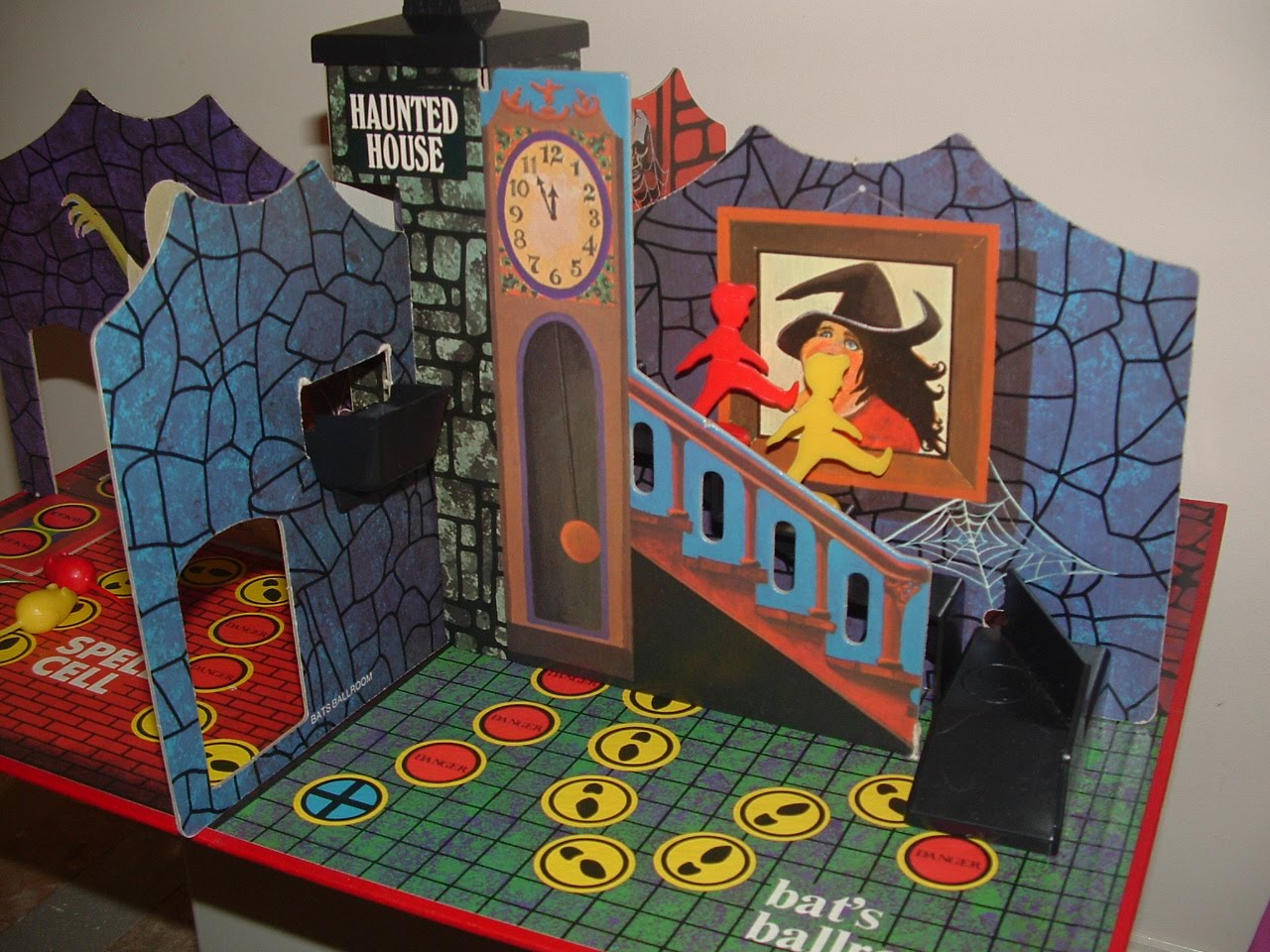
Now the first ace thing about this game was the fact it featured a three dimensional board. Now this was completely brilliant for several reasons. Firstly, it did what it said on the tin as they say in the adverts.  For there has always been games that sounded incredibly cool, often coming in fancy boxes with amazingly exciting cover art with explosions, and dinosaurs/robots/ pirates galore. However when you got them out the box, you discovered this was yet another exercise in rolling dice and moving dull counters around an arbitrary track - an activity that fell WAAAAAAY short of the exploding dino-pirate-bots fun promised on the box. However this long-lived board was different - you actually got to build a haunted house/ghost castle! And thanks to clever designs and great art on the board, it looked even better in real life than it did on the box! Result!

Better still though, it didn't take thirty years to set up. All the pieces slotted together quickly and easily, and in no time at all you were all set to race your chums round the spooky edifice. Yes, there was none of that taking about half an hour to set the game up for roughly two minutes of gaming fun... Yes, KerPlunk, I AM looking at you! Now, this was a game with exciting moving bits that did all kinds of thrilling things during game play, and unlike similar board games, in this one they all bloody well worked properly too! Yes, you may well hang your head in shame Mouse Trap!

the original Which Witch/Haunted House

So what about the actual game itself? Well at first glance, the game mechanics appear to be very simple - players race each other round the board to get to the end first. Indeed if we are looking for an ancestor for this game, its grandfather is surely that enduring classic Snakes and Ladders. For like that well-loved game of climbing and sliding, Which Witch/Haunted House/Ghost Castle made the race fun by including horrible hindrances and fiendish obstacles. And here is where the magic comes in...

Now the board is divided into four spaces, indeed in the older versions of the game, four rooms in the spooky old house. These were in the vintage incarnation labeled as the Broom Room, the Witchin' Kitchen, the Spell Cell and the Bat's Ballroom. From the 1975  onwards with the revamp New Haunted House, the game would ditch the first room and replace it with an outdoor scene where you had to make your way up to the ghostly castle/haunted house. And while the decors and some of the traps in the rooms would change over the years, in all versions in the final room is a staircase... a staircase to victory! Well, the Charmed Circle to end the witches' spells in the early versions, and the Coffin to close to end the hauntings in later ones at any rate. 

New look! New Haunted House (1975)! 

Of course to get to the end before your competitors was never simply a matter of rolling more on your turn. For as well as moving, you had to draw a card (in the earlier versions) or spin the Spider spinner (Ghost Castle onwards). Now the original deck of cards gave you three possibilities. The card Wanda the Witch Casts a Spell meant your player was transformed into a mouse and could not move, While drawing Glenda the Good Breaks the Spell meant that you were de-mouseyfied and could move again. Later versions, which ditched witches, had a tweak to this - instead of becoming mice, players were scared stiff - signified by a spooky frighted face that slotted over your player piece. 

But most ominously of all was Ghoulish Gertie Drops It Down the Chimney (a phrase that never failed to raise hilarity in our house). This meant you got to the Whammy Ball (in reality a large steel ball bearing) - or a later versions a glowing plastic skull - down the chimney. This ominous object would then rattle down through the core of the spooky edifice and drop out into one of the rooms to trigger a trap or simple to send your piece flying! If you were hit, you had to go back to the start of that particular room. Now as I said, the beauty of this game was that all the cunning traps actually worked rather well, and what's more you could never predict where the deadly missile was going actually to pop out. Hence there was always a chance you might scupper your own progress if your piece was on one of the danger spots in the track through the house.

The classic edition of Ghost Castle! 

Of course all of these elements added up to an extra bonus feature by accident. And that was if you didn't want to play the game, the game board doubled up as a rather fun haunted house playset for any action figures or toy soldiers you fancied pitting against ghosts or witches! Certainly several battalions of Airfix's finest fightin' folk met horrible deaths investigating a certain haunted house in my bedroom...

So then if you are a games designer looking to create something that will still be on the shelves in five decades time, bear in mind the following features. Make your game fun and quick to set up - this guarantees it will be played with frequently. Secondly make the rules simple and quick to learn - there's nothing worse that a cool looking game that requires a Masters degree in Law to interpret the rules. And finally, make it dynamic and as exciting as it sounds! In addition to these first two factors, which are very important in themselves, the crucial thing that this classic board demonstrates, and probably the main reason for its continuing longevity, is that it delivers what the box promises! Something we shall find severely lacking in some of the other toys and games lurking in the 'Orrible 'Ouse of Terrible Old Tat...

The current version from Goliath Games


Wednesday, 22 February 2017

The 'Orrible 'Ouse of Terrible Old Tat #06 - Which Which Witch?


Welcome once again dear friends to the 'Orrible 'Ouse of Terrible Old Tat! Do come in, just be careful you don't trip over all those dropped 'h's though. Anyhow this week we are looking at a particular item, or rather a family of items, that I really should have opened this blog series with, as it appeared in the logo illustration for the introductory despatch from the 'Orrible 'Ouse. Look I meant to, honest! But as you can see this place is permanently in a bit of state, and I couldn't get to the boxes for a load of old Doctor Who dolls ok! 

Anywho, this week I've dredged up an old board game that I'm guessing made many an appearance on Christmas lists and birthday requests. It certainly was the star item on one of my childhood missives to Santa, and the Bearded Gent did indeed come through on this one. Now that much anticipated item was a board game called Haunted House, and unlike many other much hankered for toys, this one did not disappoint! And looking back, I think it was my favourite childhood board game, and was played with for many many years on a regular basis.


And my experiences with Haunted House is clearly not in any way unusual, for this is a game whose mere mention triggers a wave of nostalgia in several generations. For this is a board game that has never been long off the shelves, and indeed, it's still available in toy shops to this very day. In fact it's now only a few years shy of being 50 years old! I reckon it's only the fact that this board game has gone through several rebrandings that has prevented it from being recognised as a true classic.  So then, let's have a quick wander through its long history... 

The spooky treat first appeared in 1970 in the US, a creation of pioneering board game makers, Milton Bradley (later known as MB Games), under the name Which Witch. It initially came in a huge square box the size of the board itself, but was reissued a year later in a more familiar, slimmer rectangular box that was way easier to get in the toy cupboard, thanks to it now having a more convenient folding board. Now the same year as the folding board made its debut, 1971, it made its first transatlantic appearance, released in the UK by Denys Fisher. And while the game pieces, rules and box art were identical, it was now called Haunted House. European versions began to appear soon after too - in Spain it became Embrujada (Haunted), in France it was Le Manoir Hanté (The Haunted Manor), in German it was Spukschloss (Haunted Castle), and in Italy it was Castello Incanto (Castle of Spells) and also Brivido (Shiver). 

In all its incarnations, Which Witch/Haunted House sold steadily for many years. In 1975, there was the first evolution of the game, with Denys Fisher releasing a rejigged version entitled New Haunted House. Reflecting the new moniker, there was new box art, and the titular witches disappeared from the game, being replaced with ghosts, and one of the game's gadgets, a broom trap becoming a falling knight. In the mid '80s the game evolved again, with a few more tweaks to the mechanics and pieces, and it actually became in two distinct versions.


The more short-lived one, which appeared in toy stores in 1986, saw the now venerable game re-skinned to be a tie-in to the Real Ghostbusters cartoon series, and was called, unsurprisingly, The Real Ghostbuster Game. Needless to say this spin-off edition did not last long. However its other '80s incarnation, released the year before in 1985, proved to be far more tenacious! Ghost Castle from MB Games, brought some more tweaks to the game, several of witch, sorry, which had been first seen in some of those European versions. The main changes were the tower on the board becoming a more durable plastic, a deck of cards becoming a spinner, and a ball being replaced with a skull! A plastic one, not a real one I should point out...  Anyway, since then the game has more or less stuck to its new name of Ghost Castle, and indeed the game is still available to this very day, with the current version being issued by Goliath Games. 

So why has this game been so popular over the years? Well, we'll be bringing out the board and setting up the haunted house in all its glory next week to take a proper look at the gameplay. And along the way we'll note some of the changes and evolutions it has undergone in nearly five decades of providing spooky thrills!