Showing posts with label Merlin. Show all posts

Wednesday, 31 January 2018

THE 'ORRIBLE 'OUSE OF TERRIBLE OLD TAT - The Magic of Merlin


After a somewhat longer than intended Christmas break, welcome dear fiends once again to the crumbling edifice packed with shite that is the 'Orrible 'Ouse of Terrible of Tat! Now then we were last rummaging through this curious collection of pop culture empherea, we had been looking into the ancestry of modern video gaming, specifically the assorted handheld devices that called themselves "electronic games". Now these weren't pocket-sized versions of popular arcade classics - for those would come a little late - but rather in the late '70s there were gadgets using circuits and microchips to make games that could play themselves with you. 

The first superstar of this genre, so popular that it's still around today, was Simon, whose history we charted last time. However Simon wasn't the only kid on the newly built electronic block, for venerable game makers Parker Brothers also had seen the toy potential at the dawning of silicon age. And so in the run-up to Christmas 1978, Simon was locking horns with another bunch of microchips and flashing lights in a plastic case - Merlin! 

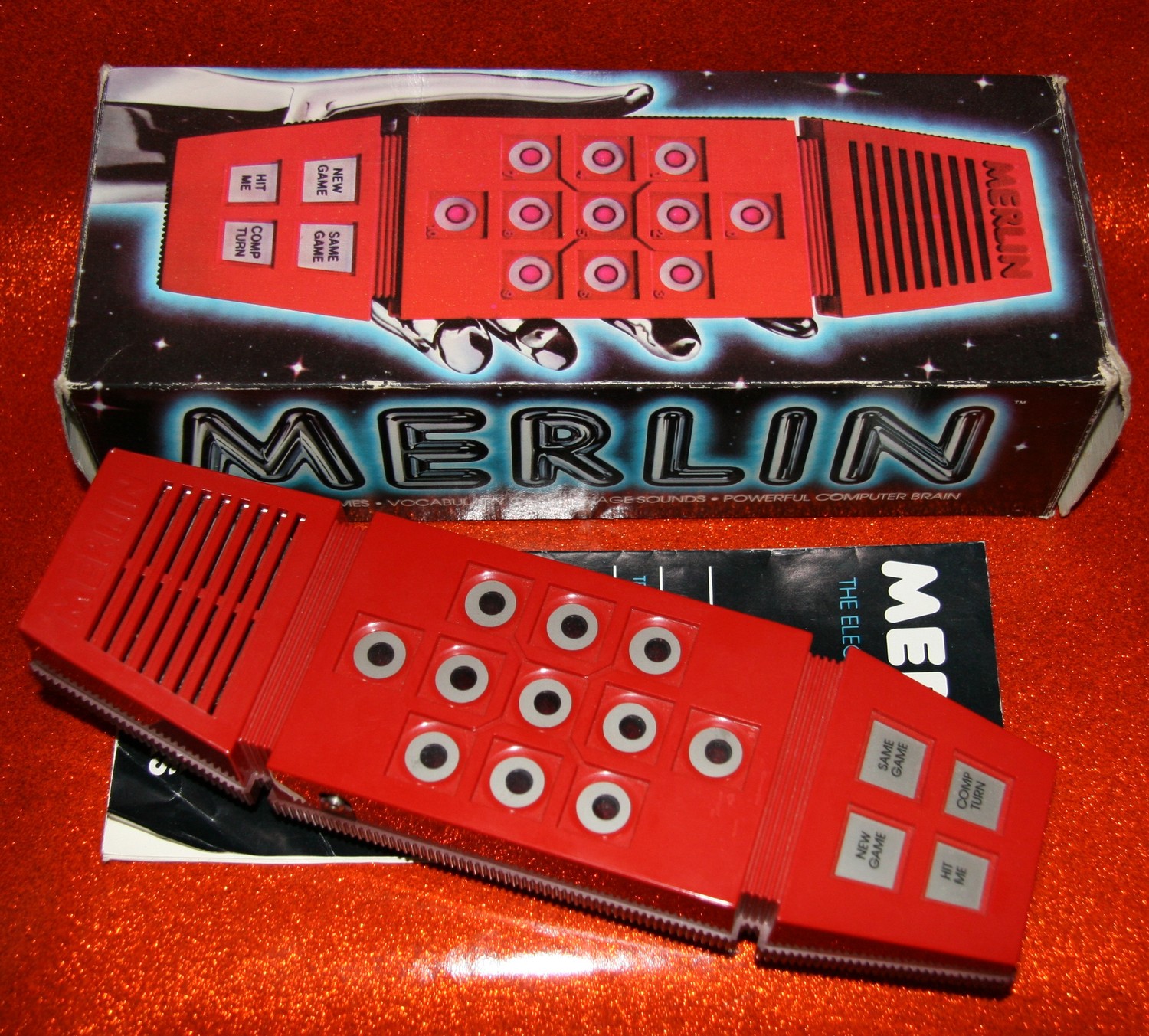
Now despite its name Merlin was not born of the Round Table or cooked up in Camelot, but rather was the brainchild of Bob Doyle, a former NASA engineer, which gives this space-age toy a truly space-age pedigree. Assisted by his wife Holly and his brother-in-law Wendl Thomas, Doyle came up with a device that looked like an over-sized red phone handset studded with eleven buttons that lit up when pressed thanks to inset LEDs. However despite not looking quite as colorful as Simon, Merlin had more than a few tricks up his electronic sleeve, and could in all fairness, quite rightly claim to be a magical marvel of microchippery. Milton Bradley's circular smart-arse might have been heavily marketed as an electronic brain that could think for itself and play against you, but despite looking like a relative of R2D2 who had been flattened in the Trash Compactor, Simon was pretty much a one trick pony. Oh yes, he might have been a clever little bastard, but when you came down to it, he only knew one game.

But Merlin could offer kids not one, not two, not even three, but a whopping SIX different games. And they really were six different games, and not just variant modes of a basic either. Indeed Merlin could convincingly claim to be a whole toybox in electronic form. And the full line-up of electronic delights conjured up by Merlin goes like this... 

1) Tic-Tac-Toe - or Noughts and Crosses as we in this septic isle more commonly call it. Yes, it is as old as the hills, but it is still a classic, and now you could play it against a computer! OK, that doesn't sound terribly thrilling now, but back at the end of the '70s playing a game against a machine was something previously only seen in the realms of SF.

2) Music Machine - Now technically speaking with wasn't a game as such, but more an activity. In this function, Merlin became a primitive synthesizer, with each key on its pad playing a different note. You could program a tune of up to 48 notes and rests - not huge scope there admittedly, but all the same pretty impressive for a toy back then. Certainly there was memory space enough for Merlin to be used as an early sequencer!  The instruction manual also came with some well-known tunes, including tunes as diverse as Beethoven's 9th and Auld Lang Syne, transcribed into ready to program number sequences.


3) Echo - Basically Merlin plays a tune that you had to replicate on the keypad. Yes, very like Simon, but accounting for the development timelines of both toys, I suspect that Doyle and co. had also seen  Atari's Touch Me and, like Simon's creators thought, they could do better.

4) Blackjack 13 - fairly self-explanatory, Merlin plays the dealer for an electronic version of  the famous card game. No gambling involved of course!

5) Magic Square - In this Merlin devised a pattern that the player must deduce from which lights come on or go off when certain keys are pressed.

6) Mindbender - In this game, Merlin ask you to decide deduce a random number - essentially it is an electronic version of the old game Cows & Bulls which earlier had inspired the creation of another best-selling 1970s game we've chatted about before, Mastermind (see here for more details). However the neat thing here, is that you had the option of setting the size of the number, choosing between 2 and 9 digits.

And for more details on all of these games, you can read the original manual online here.

Unsurprisingly "the Electronic Wizard" (as the marketing dubbed him) more than held his own against Simon and would go on to become the best selling toy in America in 1980, notching up sales of over 2 million Merlins in that year alone. Like his rotund rival, Merlin remained popular throughout the '80s, and saw  re-releases periodically over the years. Also like his electronic chum, there were some spin-off versions too, in the shape of Split Second in 1980, Master Merlin in 1981, and Merlin the 10th Quest in 1996.

Now Merlin is just a piece of gaming history, but being a very robust bit of kit, there are still plenty of working units out there. Of course, these days you can play all these games, and hundreds more, on your phone. But considering the unique and eye-catching telephonic design of Merlin, this computerised gadget wasn't just a pioneer of the computerised play, but in a weird way he was a prophecy of the future of gaming! Truly an Electronic Wizard! 


Saturday, 25 October 2008

Merlin - the Mid-Season Report


So we've got the halfway mark, and I thought it was high time for an update on how I feel the show is doing so far...

And the short answer is very well indeed. I've been througly enjoying these Saturday tea-time jaunts to Camelot. The show is delivering just the right mix of magic, adventure and humour to keep this viewer happy, and seems to be confidently stepping over any worries I had.

I've quite acclimatised to the modernist stylings of the dialogue. Of course on principle, I'd prefer a little more of the typical cod-period thee and thouing but I'm finding in Merlin the colloquial approach is working out well. Mainly this is due to the dialogue being sufficently witty and dramatic to carry it off. And I quite like the way that they actually do venture in the verily for soothe realms for the scenes of court formality.

Performances have been top notch and guest roles have been well cast. The regulars are gelling nicely, giving the show a strong ensemble piece feeling. I also like the way different episodes shift the focus; for example it was great to see Richard Wilson's Gaius take centre stage in tonight's episode.

Plot-wise, I'm enjoying the direction the story lines are developing. I'm guessing that like another very well-known series about a boy wizard, the writers are planning on this show to run and run - with the characters aging and presumably reach the point where they can tell the classic Arthurian stories.

On the effects front, I have to say I'm still not a fan of the Great Dragon design - it has failed to grow on me, and still reminds me of Churchill the nodding dog. Other than that though, the cgi has been up scratch, and generally not over used. And I delighted that in "The Mark of Nimueh", the Afanc appeared to be a good old fashioned, physically made creature model.

If I have one niggle though, it's the Great Dragon scenes. Design aside, he is getting a Mystic Meg in his cryptic pronoucements, to point you begin to wonder why they bother consulting him at all. But thankfully, we have had a few episodes where a trip to his cave wasn't obligatory.

On the whole though, I'm finding this is perfect TV fare for winter weekends and I'm looking forward to see where the rest of the series goes. And that's another thing Merlin is doing well - the great 'The adventure continues...' teasers. Can't wait to see what the scary drippy-faced blue demon king thing in next week's episode is all about!


Friday, 26 September 2008

Merlin


So this year, in place of Robin Hood the BBC are offering us a new series Merlin. Now while I applaud Auntie Beeb for going the whole hog and making further adventure series for what's now being refered to as the Doctor Who slot, I never really got into their Robin Hood series.

Overall I found the modernist dialogue jarring and it's grip on its historical setting a bit shaky. I felt that it was trying so hard to be hip and relevant, it was undermining the whole flavour of the Robin Hood mythos. Though in fairness, I should point out that I'd recent rewatched all the 1980's Robin of Sherwood - a series which to my mind is the pinnacle of Hood on screen. So with that series fresh in the memory, naturally the new BBC series was always going to seem a very poor cousin in comparison.

So when I sat down last Saturday to check out Merlin, my main concern wsa that it would fall into the same modernist pitfalls as its predecessor in this slot. However although it shares much of the same hip polish of Robin Hood, I felt it worked a good deal better. Perhap this is due to the fact that unlike the tales of Robin Hood, the Arthurian mythos is not so rooted actual history and consequently I'm apt to be alot more forgiving of anachronisms.

Also another key difference is that Merlin is telling new stories set in the Arthurian universe; in setting up a saga about Merlin's early years and breaking new story telling ground, this series is steering clear of unfavourable comparisons. For example, if the show was going to be a retelling of the classic Camlot legends, then inevitably we'd be measuring it up against John Boorman's Excalibur.

The first episode of the series introduces us to a fresh perspective of the mythos, setting out to tell the untold tales of Merlin's youth. It's Camelot via Smallville if you will. And it's an interesting approach, opening the door to a good rich vein of potential plots playing with the viewers' knowledge of what the characters eventually will grow up to be. The series opener chucks out two great curve balls - firstly that Arthur and Merlin don't actually like each other, and secondly the romantic frisson between Merlin and Guinevere.

In addition to this, we are also given a similar twist on the setting. Merlin is set during the reign of Uther Pendragon who has brought peace to the land after very dark troubled times. And part of maintaining that peace, is that the practice of magic has been outlawed. All in all, these elements open the way for a very interesting spin on Arthurian mythology and great scope for the series in terms of story arcs and character development.

The cast is also very strong - a rea lboon if they plan on taking the character's down the type of epic emotional arcs that Smallville and Buffy The Vampire Slayer did. Tony Head and Richard Wilson are as every bit as good as you'd imagine them to be, and Bradley James and Angel Coulby play great versions of the young Arthur and Guinvere. James in particular hits the right balance of arrogance and nobility for the teenage king-to-be. However the real stand out is Colin Morgan's Merlin who is an instantly likeable character - Morgan's performance is naturalistic and with subtle depths and proves he can more than carry this series.

Another piece of great casting is John Hurt as the voice of the Great Dragon. However here we hit the one down point - I really didn't like the CGI dragon. It wasn't that it was badly animated, it was more that I didn't like the creature design. To me the dragon's head appeared slightly too large for its body at some points, reminding me of one of the nodding dogs that haunt the back window ledges of cars.

However this is a minor quibble in an otherwise excellent opening episode. The series shows great promise and potential. Whether it will live up to this remains to be seen. It will be interesting to see what elements of the existing stories they work into the mix. However for now, I'll round off by saying that I've looking forward all week to see what tomorrow's episode brings ... A good result for any series opener.