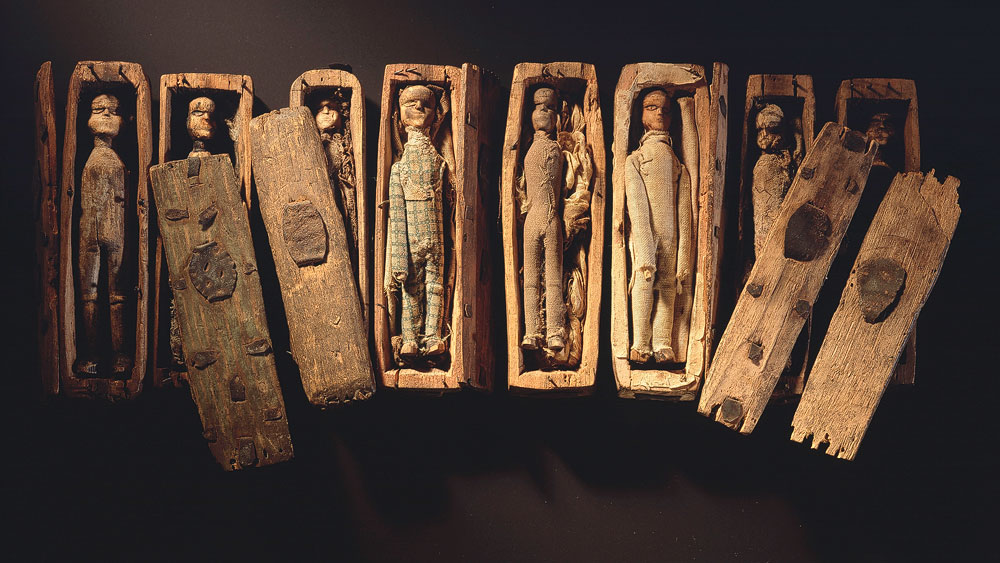
Last week we scrambled down the slopes of history and unearthed a curious find in Victorian Edinburgh. Known as the Fairy Coffins, these little figures in caskets have provided students of the strange a lasting challenge, an enduring mystery that remains unsolved, with no convincing explanation for their purpose or origin ever so far being established. However since they were first discovered in 1836, there have been plenty of theories on the true nature of these enigmatic little folk.
When the story of their discovery first broke, they were very soon dubbed the Fairy Coffins, however over the years no one has actually proposed that these are the relics of faery funeral rites and evidence of the existence of the Little People. But it is true that the first theories mooted for their existence owed something to the supernatural world. For the prevailing opinion in 1836 was that they were something to do with witchcraft. Arthur's Seat has long been said to be a favourite haunt of witches, with one area of the mighty hill being named Haggis Knowe thanks to local belief that witches gathered here. Its long association with witchcraft is further demonstrated by the fact that a natural spring on Arthur's Seat is featured in one of the earliest Scottish witch trials that we still have detailed records of. Apparently in 1572, one Jonet Boyman of Canongate, Edinburgh was brought to court charged with witchcraft and "diabolic incantation". It was alleged that -
At an 'elrich well' on the south side of Arthur's Seat, Jonet uttered incantations and invocations of the 'evill spreits whome she callit upon for to come to show and declair' what would happen to a sick man named Allan Anderson, her patient. She allegedly first conjured 'ane grit blast' like a whirlwind, and thereafter appeared the shape of a man who stood on the other side of the well, an interesting hint of liminality. She charged this conjured presence, in the name of the father, the son, King Arthur and Queen Elspeth, to cure Anderson.
from
Scottish Fairy Belief by Lizanne Henderson and Edward J. Cowan (2001)
Of course other than local folklore and history, there was another reason that witchcraft was dominant in the first theories on the Fairy Coffins, and that is the famous magical device popularly known as the Voodoo doll. Now despite this pop culture term implying Caribbean or African sorcery, the use of dolls by witches to place curses on victims had been very well known throughout Europe for centuries. Indeed it appears in cultures all over the globe, and this seemingly universal curse operates by the witch fashioning an effigy of their intended target and whatever dire fate they subject the doll to would be magically transferred to their victim. Therefore it was suggested in the pages of The Scotsman newspaper on Saturday 16th July 1836 that -
Are still some of the weird sisters hovering about Mushat's Cairn or the Windy Gowl, who retain the ancient power to work their spells of death by entombing the likenesses of those they wish to destroy. Should this really be the case, we congratulate the public, but more especially our superstitious friends, on the discovery and destruction of this satanic spell-manufactory, the last, we should hope, which the 'infernal hags' will ever be permitted to erect in Scotland!
Given that
odd artifacts discovered often do relate to witchcraft, it does seem reasonable to conclude that these curious caskets were some species of ritual object. However more benign rites have been suggested for the origin of the Fairy Coffins. And this school of thought has yielded several variants; the first is that the dolls were placed by nautical men as a charm to prevent death on their voyages. Whereas a second maritime based theory holds that they are a mimic burial, with these dolls buried as proxies for men who have lost their lives at sea. More generally, it has also been suggested that perhaps they are a memorial for deaths in a family - the interment of a child's beloved toys, or another symbolic funeral for deceased children. But the strangest theory of all also revolves around the time the Fairy Coffins were supposedly created.
As discussed
last week, scientific analysis of the dolls and their caskets has placed the the date of their interment to be (probably) some point after 1830. And scholars of the strange and the macabre have noted that that 1829 is an important date in Edinburgh's history, for that was the year of the trial and execution of the infamous Burke and Hare. While this pair are somewhat synonymous with grave-robbing in the popular imagination thanks to their numerous appearances in horror fiction, in truth Burke and Hare took the easier and more brutal route of murdering folks to illegally supply cadavers for dissection and anatomical study. And in the course of their callous career they sold the bodies of over a dozen unfortunates to Dr Robert Knox, chief of a school of anatomy on Surgeon's Square. And it has been claimed that as there were seventeen victims and seventeen Fairy Coffins made around the same time, this interesting and macabre coincidence suggests that the mysterious find on Arthur's Seat in 1836 was a strange memorial to the victims of Burke and Hare.

However sadly we must rule out the ghoulish connection to Burke and Hare. Firstly the fact that all the eight surviving figures are male does rather sink this pleasingly gothic theory - for only five of the corpses obtained by the infamous pair were actually male. Secondly we should remember that we cannot be certain that all the figures were buried after 1830: for while some of the eight surviving figures include three ply thread only available after 1830, other figures could be older, and as nine caskets are lost we have no clue to the date of their manufacture. Finally, and perhaps most damaging for this theory, is the inconvenient fact that Burke and Hare only actually committed sixteen murders - the touted seventeen victims tally comes from including the first body they illegally sold, that of a pensioner named Donald, whom they simply found dead in the room he rented from Hare. So while delightfully macabre and adding a touch of gothic horror to the legend of the Fairy Coffins, the historical evidence kills the Burke and Hare hypothesis stone dead, and it should now be laid to rest and decently buried.
So then what of the sailor theories? Well, while that fine city has raised many folks who went to sea over the years, we should note that Edinburgh is not on the coast. Therefore it makes no sense that the Fairy Coffins are some sort of charm against misfortune at sea, as usually superstitions and charms that set out to effect a sailor's safe return home are placed somewhere at the port their sea voyage will return too. Similarly the idea that the Fairy Coffins are "mimic burials" for mariners lost at sea also makes no folkloric sense either. Firstly there appears to be no other instances of such a practice existing in Scotland, or it seems elsewhere for that matter*, and so the Fairy Coffins remain a unique find. Secondly if they were some form of proxy funeral ,why were they interred on Arthur's Seat and not on holy ground in a churchyard or in a cemetery? Indeed this is an objection we can level at all the variants of the theory that the Fairy Coffins are some sort of funerary memorial. Indeed the fact that the figures aren't dressed in what would have been traditional funeral dress or shrouds further undermines the idea that they were proxy burials of some kind.
However there are two possible plausible workarounds here, with the first being an eccentric variation of a tradition we are familiar with today. It is common to leave flowers and tributes at the site of a tragic death, and we can imagine without too much difficulty that these little dolls in caskets were placed as such a memorial, albeit a rather unusual and weird one. But the problem here is that despite scouring historical records, so far no one has been able to find an event or accident featuring seventeen people occurring at Arthur's Seat or in the Edinburgh area in that time period. Even allowing for the possibility there was more coffins to be added to bring the number of victims higher, no matching tragedy has been discovered.
But the place of death memorial theory could still be possible, if we go with the idea that the Fairy Coffins were a tribute for just one person. For a single tragic death on Arthur's Seat could easily go undetected by historians. Furthermore the idea that this mysterious burial is commemorating a single death does rather suggest that the loss was that of a child, for indeed even today, alongside the flowers and wreathes, toys, dolls and teddy bears are left at the site of a child's untimely death. Now considering the high infant mortality rates of the 1800s, unless it was a violent murder it is unlikely a child's death would be widely reported, if at all. A death by misadventure, say of tumbling down the rocky slopes where the Coffins were discovered, most probably would not have made the papers, and the place of death is unlikely to be recorded in parish records.
Our second workaround is unfortunately even more undetectable in the records and assorted historical documents, due to its highly personal nature. This theory holds that the location of the Fairy Coffins was a significant place to the deceased; with their strange burial being the weird equivalent of having your ashes scattered at your favourite beauty spot or on your team's home grounds. Once again it is hard to not draw the conclusion that this would be marking the death of a child. And to don a Holmesian deerstalker for a moment, we can make some deductions from the figures themselves that appear to support this. Firstly as detailed last week it is likely that the figures were toys. And secondly, judging from the way the dolls have been given new clothes, this would suggest that they have been passed down in the family from older siblings or relatives; old battered soldiers getting new togs to make dolls for a girl, or perhaps just to smarten them up for a new owner.

However if we consider the Fairy Coffins as buried toys, another possible explanation presents itself. Rather than being a memorial to a dead child, is it not possible that they are toys which were buried as part of a game? Firstly we should note that from the end of the 18th century there was a huge interest in all things Egyptian - a craze that would find full flower in Victorian society. Hence it is not inconceivable that some children decided to make their own version of a pharaoh's tomb, making decorated coffins for their old toys. More generally, kids do love spooky stuff, and building a toy mausoleum is probably not as unusual as it first sounds. Furthermore as children start to grow out of toy soldiers and dolls, their childhood companions are often subjected to strange and terrible fates in their final playtimes - Action Men and GI Joes are shot with air pistols or blown up with firecrackers, and once favoured dolls are subjected to cosmetic experiments that would appal Frankenstein himself!
However while this idea seems quite plausible, when one considers the time spent making and decorating the coffins, it begins to seem rather too elaborate for a child's game. And this suspicion is strengthened when we consider the clothes. The figures' garments are individually tailored, with even the limbless figures being stitched into their armless outfits. Again this would suggest a too great investment of time for a youngsters' game. However on the other hand, their clothing isn't highly elaborate, with signs that in some cases spots of glue have been used to fasten the garments in place. Possibly this is just the crude re-wardrobing of old toys, but it does raise the question of whether the clothes were made specially to bury the figures in.
It is unfortunate we do not have more of the seventeen to examine, for ascertaining if the clothes were specifically made for the burial would throw a different light on the affair. For if they were, we could reasonably rule out the game idea as it becomes implausibly elaborate, but also the theory it was a child's memorial could be discard too, for it would be odd to so drastically change beloved toys rather than inter them as their young owner knew them.
However the possibility that the clothes were added deliberately for their burial could tie into the oldest theory of all. A common objection to the witchcraft theory is that all the figures are pretty much all alike, whereas we tend to think of voodoo dolls as being modelled to resemble their targets. However largely this is a conception born of 20th century horror fiction - in truth a witch creating an effigy in this way only needed to create a magical link to their victim and generally this was done in a way other than fashioning a doll-size doppelganger. Common methods used included burying the doll for a time where the victim walked, baptizing it with their full name, or incorporating hair, nail clippings or blood from the victim into the doll itself. And another oft-used method was giving or attaching to the doll something stolen from the target, such as an item of clothing; even a scrap of fabric would do...
...Perhaps like the scraps of fabric used to clothe the little figures? Certainly as their dress does not seem to correspond to any contemporary fashion, it is tempting to assume that their garments were not intended to be decorative, and furthermore the cloth itself might be of some ritual importance. Of course, without any record of how the missing nine figures were clad, we cannot be sure that all the figures sported different outfits. Again this is another instance of any solution to the mystery being hampered by having an incomplete collection of the caskets. Additionally even if they did all sport clothes of different fabrics, this still could be simply be a case of their maker using whatever pieces of old cloth that were to hand.
However the original notion that the Fairy Coffins as the product of witchcraft is still the best fit. As we have seen other theories are lacking in both supporting evidence or logic. Whereas the idea that these figures represented seventeen folks who had angered a person or persons unknown enough to warrant a hexing still seems very possible. Firstly we have a long-held association of Arthur's Seat with witchcraft, and secondly it ties into a well-established and widespread folk belief - after all, the doll curse is the witch's spell nearly everybody knows. So then while we cannot entirely rule out that they were some unusual memorial, or even that they simply were the product of some poor soul suffering from mental health troubles, witchcraft is still best fit for the case, with supernatural revenge being sought by burying magical effigies of their perceived enemies in the ancient soil of Arthur's Seat...
* Indeed if you google 'mimic burials' you end up back at pages about the Fairy Coffins