Showing posts with label russell t davies. Show all posts

Thursday, 15 September 2011

TORCHWOOD: MIRACLE DAY Episode 10 - The Blood Line


456 Classification - Thank the Lord! It's over!

Well, we got here at last! And I must say that writing these weekly reviews has turned into something of a war of attrition, where every seven days I've had to struggle to find new and amusing ways of saying 'this storyline's broken!". And so for that reason alone, I minded to be kindly about this final episode...

...Of course I bloody well won't! But it has to be said that The Blood Line IS an improvement on The Gathering - well as far as it is possible to make any improvement in the grand finale of a story that hinges around a massive rude looking gash in Mother Earth.

But there are some positives all the same. Firstly this closing chapter manages to have Jack and Gwen both on top form and doing what they do best, and at the same time unlike many of the previous instalments where we've have had one but not the other doing anything interesting. Secondly there is a rather neat extended confrontation with the Families' agents. I must admit I didn't see the blood switch trick Rex pulled coming and we had some real proper tension building in this stand-off over over two continents.

And thirdly, and possibly the most welcome, was the fact that considering this was a Russell T Davies finale, it was played out in a rather simple and restrained fashion rather than hurling everything the FX wizards can muster at the screen in a swirling maelstrom of logic defying plot holes.

But of course that's not to say that this episode wasn't thoroughly riddled with nonsense. Oh come on, don't look surprised! This is still an RTD script after all! Because if  you were you looking for an explanation for the Blessing, forget it!  Now, I'm not adverse to story tellers leaving a gap filled with mystery sometimes, and arguably the giant stone labia could qualify. However the scant details we do get about it, notably that it's two ends act as some species of morphic poles, only serves to increase the idiocy of the concept.

Now I could have bought the polar thing if they hadn't shown us a computer model that clearly shows that the colossal crack is off centre - tracing a point from Buenos Aires to Shanghai gives you a line that doesn't pass through the core of the earth . So while this may help some viewers reconcile its existence with small barriers to belief such as the entire field of geophysics, having a pole that doesn't pass through the centre of the earth - i.e .it's not a pole - only replaces the first foolishness with an equally massive hurdle to credibility.

Similarly the reveal that the Families plan to wreck the world with immortality in order to rebuilt it in their own image is similarly half-baked. As we're told they are effectively the secret puppet masters of the world anyway, did they really need this elaborate plot in the first place? Yes, they get immortality but honestly the Miracle isn't really worth having - eternal life coming with eternal pain and aging. But most damningly, we discover at the very end that this whole charade was just 'a trial run'... So effectively the whole Miracle was pretty much a colossal waste of everyone's time. Including yours.

Similarly the end of Dane's plot thread also proves how useless he was a character. Now don't get me wrong, I've really enjoyed Bill Pullman's performances, but in the end the character has been fraught with problems and ultimately serves no real purpose. And indeed how this finale plays out only serves to highlight how irrelevant the majority of what has gone before has been.

Seeing at last how the Miracle Day storyline concludes, I am inclined to suspect that is was originally planned as a five part affair and them clumsily expanded. And that would certainly explain a great deal about the many and varied dead ends and blind alleys the narrative has took us down. But I believe I have harped on about the poor story structure more than enough in previous reviews, so then let's skip to the end.

I doubt many are going to happy with the fact that Davies chooses to kill off Esther, who appeared to strike a chord with most viewers, instead of Rex, who everyone has decried as having all the depth of a cardboard cut-out. And then to add insult to injury, he makes 'the assholey one' of the team immortal. Yes, having Jack's blood as somehow infected Rex with the Captain's same indestructible nature. Insert your own stream of tired, bitter abuse here...

...And the stage is also conveniently left wide open for another series. Or to be rather less charitable, there's a whole mess of plot threads left flapping for another season. And I have to say that the prospect of another ten episodes like this fills me with more tension and dread than the entirety of Miracle Day managed in its frustrating two and half month lifespan.

Now I don't hate Torchwood, and even the messy disappointment this series turned out to be doesn't make me want to see the show vanish forever. Indeed I used to enjoy the series and I still believe the format has potential (and if you want to hear how I'd fix it check out HYPNOBOBS 46 - Torchopsy). However at the same time, I rather suspect that this debacle may well have cooked the Torchwood goose, and what's so galling is that it is the show's own creator who has served up the sauce. And with Starz seemingly not rushing to stump up for another series, the ultimate irony of Miracle Day is that while the world became immortal, the show may have expired...


Reviews of previous episodes can be found here
Also don't miss HYPNOBOBS 46 - Torchopsy! for more Torchwood talk! 


Saturday, 22 January 2011

DOCTOR YULE – Christmases in the TARDIS


Spoilers ahoy!

The tinsel is boxed away, the decorations are back in the loft and I’m avoiding the bathroom scales, so then with the world returning back to the usual routine, it’s high time we had a look at this year’s Doctor Who Christmas special and indeed took a trip back in time, courtesy of the Ghost of Christmas Past, to see where else the TARDIS has fetched up in the festive season.

Back in the early part of the 21st century, few could have predicted that the massive success that the rebooted Doctor Who would attain. Even dyed-in-the-woolly-scarf fans didn’t predict that half a decade later our beloved old programme would become a flagship show for BBC1 – the most we hoped for was that the episodes produced would be half decent somehow. And many suspected that the Russell T Davies version probably wouldn’t last long. Yes RTD himself was one of us but we really weren’t expecting that the rest of the nation would embrace the Doctor’s return with such enthusiasm and passion.

But aside from the joys of seeing toy stores full of Who toys and hearing children across the land impersonating Daleks once again, perhaps the real measure of the show’s success is that the Christmas specials are now a traditional part of the Christmas Day schedule. Incredibly it seems now that the festive episode of Doctor Who has the same cache as the Christmas specials produced by telly titans of the past like Morecambe & Wise and Only Fools & Horses, and has become a similarly hugely anticipated highlight of Yuletide TV.

However despite going down well with the general public, with this year’s offering beating even old enemy Coronation Street in the Christmas rating war, it’s fair to say that the specials have been something of a mixed bag. And this isn’t a reflection on Doctor Who as a whole, more the tendency for the festive specials of any TV show to be an excuse to muck in a light-hearted fashion about rather than deliver a storming episode.

Now those who prefer their sci-fi all serious and po-faced, may well say that the inclination to light-hearted tomfoolery is an inherent weakness in new Who. However humour has always had a place in the show, but more importantly the modern incarnation has been carefully tailored to it’s time slot. An essential part of Doctor Who is, for want of a better term, its ‘Saturdayness’ and if you consult my series of articles on the history of the Doctors, you can discover for yourself how the show began to hit the skids with general viewers when it was moved from its traditional early Saturday evening slot.

Now while good old Russell T Davies, may have leant to far in the direction of comedy on occasions, he understood from the get-go that if the show was to be a success he needed a Saturday night slot. And more importantly he understood that with the mechanics of modern telly viewing, the show itself must deliver what a weekend audience wants – fun, excitement and nothing too heavy. Now that’s not say that Doctor Who can’t explore deep issues or complex ideas but more that he was very clear that this should be a show that appealed to all ages and, more importantly, would find favour outside the usual genre audience.

So although some fans may have wanted the new Who to be a serious and weighty programme; mooting something similar to the radical reboot Battlestar Galactica would receive a couple of years later. But had the TARDIS ventured into such hard sci-fi areas, it’s highly unlikely the show would have won the legions of new fans it currently is enjoying, and the Davies template for the show managed to pull off the trick of updating the format while still retaining the flavours of the original in its heyday, Saturdayness and all.

Now as Christmas Day is effectively a childhood Saturday to the power of ten, a day packed with sweets, toys, games and loafing in front of the idiot lantern as a family, a good Christmas episode should reflect this in the same proportions. And true to form the previous Christmas Day outings for the Doctor have been geared up for an audience enjoying that festive sense of delightful freefall once all the stresses of cooking the Christmas dinner and sorting out presents are out of the way and want nothing more than something big, flashy and a bit funny to goggle at while happily demolishing chocolates and emptying the drinks cabinet.

But as well as aiming for a concoction of super-Saturdayness, RTD was also firmly of the opinion that if you are doing a Christmas special then it should be, well, Christmassy. And his successor in the producer’s chair, Steven Moffat is very much of the same mind, promising us that this year’s Yule offering would be the most “Christmassy Christmas special ever” and furthermore it would be “all your favourite Christmas movies at once, with the Doctor and monsters”. But before we put these claims to the test, let’s have explore the previous entries into this sub-genre of festive Who


Now technically the very first Christmas special was actually in 1965 – in the First Doctor’s third series, the longest ever single Doctor Who story was broadcast, the twelve part The Daleks’ Masterplan. This epic saga began in mid-November and concluded at the end of January 1966 which meant that Episode 7 was shown on Christmas Day and as this was the first time in which a Saturday happened to a Christmas Day, this episode entitled ‘The Feast of Steven’ took the form of a knockabout interlude in which the Doctor and his companions blunder into a film set and cause havoc and concludes with the TARDIS Crew having Christmas dinner with William Hartnell breaking the fourth wall in order to wish all the viewers at home a Merry Christmas.

However presumably the audience of the day, like fans who revisit this story today, didn’t take kindly to the on-going narrative of the story effectively being put on hold for a week in this episode, and so the experiment was never repeated (although some fans might claim that the 10th anniversary team-up tale The Three Doctors is essentially a pantomime).

But moving swiftly on, the modern tradition of a slice of Doctor Who to go your mince pies begins with 2005’s The Christmas Invasion. Forming the bridge between seasons, The Christmas Invasion really plays more like an extra ‘proper’ adventure than a Christmas special while still celebrating the season. In fact the only real downside, is that the new Doctor spends most of the story in a post regenerative kip. And apart from begin David Tennant’s first foray as the Eleventh Doctor, this episode formed the template for what would follow – set a Christmas time, sporting suitable festive elements - snow, robo Santas and a killer Christmas Tree and all wrapped up in a suitably big and eye-catching threat to the world.


And indeed, The Runaway Bride (2006) follows pretty much the same formula, even down to the climax featuring reference to what would be the coming season’s big story arc. Now for me, this outing suffered from adhering a tad too closely to the previous year’s special, with the roboform Santas reappearing and a snow dusted finale. However it did establish a new element which would continue for all the other Christmas adventures until this year – that the Doctor would be companionless – though this would seem to be more an accident born of changing cast rosters than design.

Although perfectly serviceably, this outing seemed a lot more conscious of being a Christmas special – a lot more overt comedy and big set pieces to provide undemanding fun for a turkey sated audience. The casting of Catherine Tate was very divisive, and though personally I thought she was better than expected I can understand why some viewers wanted no truck with Donna Noble; Tate’s comedy isn’t to every one’s taste and has a high irritation factor and for older fans the casting of the comedienne looked a little too much like the stunt casting JNT used to indulge in (see The Regeneration Game series for more details). But over all, The Runaway Bride was fun enough viewing for a Christmas Day night and although nowhere near the best Doctor Who stories, in the context of a festive special it was ok.

However this adventure does contain a major continuity bugbear for fans of the show familiar with the mythology of the show – basically the expanded universe created in the Virgin and BBC novels takes extrapolates from the 3rd Doctor Story Inferno (which centres on a scheme to drill to the Earth’s core) and 4th Doctor adventure State of Decay to give us an entirely different creation story for the planet we call home.

Now here isn’t the time or place to go into unravelling the lore surrounding what lies at the centre of the Earth (if you really want to know all the messy details, some one fire up a question along those lines via Formspring), and generally continuity issues between different stories in different eras of Doctor Who can be easily trumped by playing the Time War card. And The Runaway Bride is no exception… but it still nags at me as the chunk of mythology that is being overwritten has massive potential for future storylines and the changes aren’t exactly key to this episode’s plot either. But enough fanboy carping!


But that said, we now come to The Voyage of the Dammed (2007), which it’s fair to say is one of the least well regarded Christmas specials. Now really this should have been a cracking episode, as on paper it has something for every one – art deco gold robots, a starship modelled on the Titanic, and Kylie Minogue in a maid’s outfit. Unfortunately though, it turned out to be less than the sum of its parts, not exactly bad, but somehow unimpressive and very forgettable. Although the Host, the afore mentioned gilded service droids, looked fantastic, the big villain Max Capricorn was less than inspiring – again on paper he looks an intriguing choice of foe but what we got on screen just didn’t properly gel.

The real problem with Voyage of the Damned is that while it’s geared up to hit the entertaining froth for Christmas Day mark, it really doesn’t contain enough of the old festive spirit or atmosphere to justify not telling its tale in a straighter, more serious fashion. Nor does it have enough fun with its core concept – setting the Doctor down in an old school disaster movie.

Furthermore several elements were looking rather shop soiled – turning the crashing space Titanic into a threat to all life on earth felt a bit tacked just to keep up the newly minted ‘tradition’ that the Christmas Special should feature a BIG MENACE to planet Earth, and Astrid’s ultimate fate was almost insulting in that it was so blatantly stolen lock, stock and barrel from the Moffat two parter, Silence in the Library/Forest of the Dead, in the preceding season. So all in all, it’s not surprising that while most TV viewers are savvy enough to allow a show a certain amount of leeway for a Christmas special, Voyage of the Damned received a host of ‘must do better’ remarks red inked in its margins.


However some lessons it seemed had been learned as the following year’s Yuletide adventuring, The Next Doctor (2008), was a definite step forward. To begin with we have a setting that is properly fermented in the Christmas season, and racked up extra festive points by being set in Dickensian times. And the Christmas spirit was further bolstered by spinning out a story full of heart, not to mention a lovely present for old school fans with a cunningly worked in montage of all the old pre-reboot Doctors appearing. But best of all we have a wonderful performance from David Morrissey as the titular ‘Next Doctor’.

We have Christmas atmosphere galore and a solid story line that could cut the mustard as ‘proper’ Who and the two entwine to together to finish on a properly heart warming finale. And all in all, The Next Doctor is looking in good position to confidently bag the title of Bestest Doctor Who Crimbo Outing…

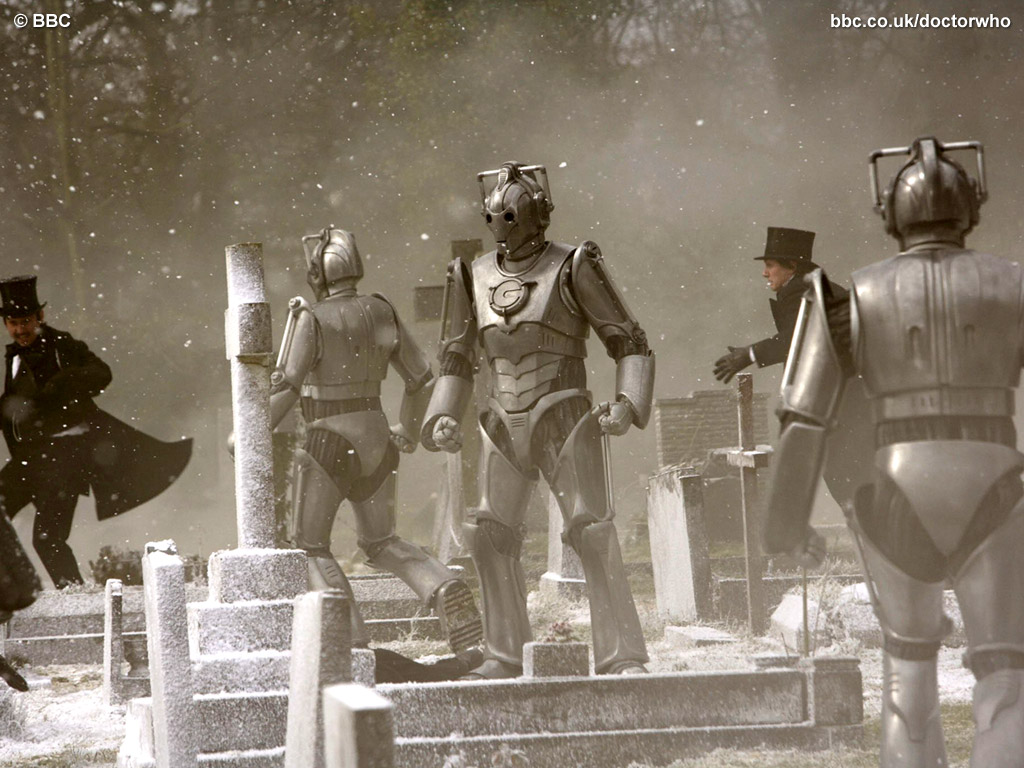
But while it was great to see a Christmas special featuring one of the biggest names in the Doctor Who League of Famous Monsters, and furthermore it not be the somewhat over used Daleks, the Cybermen sadly were somewhat underused in this story, relegated to playing second fiddle to the ruthless Miss Hartigan (Dervla Kirwan). Now this doesn’t necessarily make for a poor outing for the metal monsters – much the same occurred in the classic Second Doctor adventure The Invasion, and in their past they have shown themselves more than willing to ally with local forces to carry out their schemes. But what sinks this venture is the Cyber King itself.

If you are at all familiar with Cyber-History, you’ll know that Cyber-plans aren’t always exactly the logically executed schemes, often being highly convoluted for no good reason. For example, fans have often wondered what the tin men were playing at with their covert to the point of lunacy machinations in The Wheel In Space. Looking at their varied attempts for dominating the universe, one can’t help but notice that the Cybermen don’t really go in for all out massive invasions or full frontal assaults in the same way the Daleks or Sontarans do; rather they usually cook up a tactical and stealthy plan to bring their targets to their knees and then swarm in en masse.

Hence their gigantic dreadnaught doesn’t really seem to fit their style. And even for viewers aren’t au fait with all their previous appearances, stylistically the concept of the Cyber King just didn’t seem to fit them, looking a tad more Transformers than Doctor Who.

The overall effect was not unlike happily stuffing your face with a most delicious Christmas pud only to nearly choke on a silver sixpence. Many, myself included, felt that perhaps a new alien race menace would have suited the giant steampunk colossus better or that the episode would have been better served with the Cybermen unveiling some form of gigantic war tank to crush to crush London.

But that said, we are still under the holly wreathed conventions of a Christmas Day special, and if we only have to play the festive card once to let the Cyber King’s appearance passed then The Next Doctor is still snowbound streets ahead of the competition. But at the same time, the inclusion of the Iron Cyber-Giant does mean this outing is merely very good, rather than the enduring classic it could have been with a minor tweak.


2009 brought us not one but two specials over the festive period, The End of Time, the Tenth Doctor’s swansong which screened on Christmas Day and New Year’s Day. Now as the Tennant Doctor made his debut upon a Christmas night, it looked a fine plan to rest the series for a year.

Now as this two parter is providing the epic conclusion to the Tenth Doctor’s life, the usual festive flavours very much took a back seat. And for all those frustrated with the seasonal fripperies of years past, it looked like this time around they’d get what they had wanted from the beginning a bumper helping of ‘proper’ Doctor Who unfettered by the need for snow, Christmas trees and other Yule related gubbins.

However this year the series has been ‘rested’ and instead of producing the usual season the plan had been to do four specials placed throughout 2009, culminating in the big regeneration at Christmas.

And so before weighing up these particular festive episodes, we must examine the lead up to this two parter…

The first of the quartet, Planet of the Dead, aired at Easter and was a lot of fun. Yes, it had the air of a seasonal special in that it was flashy and entertaining but it was for my money a solid enough adventure albeit one at the ‘romp’ end of the dramatic spectrum. It‘s real downside though wasn’t the playful tone but that bar a touch of foreshadowing at the finale, it was really just business as usual for the Tenth Doctor. Like many fans, I was hoping for the beginning of the end to kick off with this story but I did accept RTD’s pronouncements that this was meant to be a last bit of fun before the final darkness.

Much later in the year, we got Waters of Mars. Now this was much more like it, the holiday special cloves were off and the episode closed on a highly ominous note. As you’ll see if you look back at the review I published not long after it aired, it looked like that the Doctor’s decision to change a fixed point in history was going to have serious consequences and the stage was well and truly set up for a climatic conclusion to the Doctor’s tenth incarnation.

Unfortunately, what we actually got rather squandered this superb set up. And I wasn’t alone in being rather disappointed that ‘the End of Time’ in the story turned out to, well, exactly nothing to do with the Doctor breaking the laws of history in Waters of Mars. The consequences of messing about with a fixed point in time provided the ideal plot device to return the Master and the Time Lords, and I’m amazed no one at the BBC didn’t tell Davies that he was missing a great story opportunity.

Instead we got the usual merry-go-round from RTD – moments of brilliance sunk in a poorly paced narrative, smothered with indulgent silliness and big set pieces to paper over gaping plot holes. It is somewhat ironic that his final Who script reflected not only all the strengths of the new series but also all its weaknesses. For a long time my opinion of Davies scripted episodes has been that he tends to throw too much into his plots in an attempt to please all tastes but often this results in stories that don’t fully satisfy anyone, particularly as the tone of different scenes often ends up jarring and there are annoying gaps in the narrative’s logic.

And The End of Time is a shining example of this approach. Again I wouldn’t denounce The End of Time as total tosh or a crime against this venerable show, but equally it is a mixed bag. Some of you will love it, others hate it and many more, like myself, will peg it as not bad, but could have been so much more *.

Now often the festive specials can compare poorly to the series proper, particularly when they are view outside their Christmas slots and their license to indulge in fun and frolics is less easily forgiven. And although The End of Time waives its festive rights to tell a ‘real’ Doctor Who story, it still ends up looking a little too panto for its own good. The trouble is with hindsight it’s clear that the four specials should have been far more closely linked together. Planet of the Dead should have sown the seeds for the final two, Waters of Mars in all fairness could probably stay as it is, and The End of Time should have had a massive temporal crisis freeing first the Master and second the Time Lords.

However even if a rogue TARDIS landed in BBC Cardiff to allow RTD to go back in time and properly structure this mini-season of four specials, the biggest problem would still remain. And that is quite simply that Big Russell had already written a brilliant swansong for the Tenth Doctor that would have tied up all the threads and themes of his and Tennant’s tenure on the show together into a satisfying climax. Yes, I’m firmly of the opinion that the Tenth Doctor should have regenerated at the finale of Series Four – we had the return of Davros and nicely integrated crossovers with Torchwood and The Sarah Jane Adventures and guest appearances from previous companions. And with all the old gang together, and a plot that contained many nods to the events of the last four years, The Stolen Earth/Journey’s End would have made the perfect finale.


So then, at long last we come to this year’s offering. As we’ve seen there was definitely room for improvement on the Davies era, and more to the point, crafting a tale that is properly festive and top quality Doctor Who at the same time isn’t an easy recipe to get right. Could Moffat find the right balance of ingredients and deliver a real Christmas cracker of an episode?

Well, from the outset and considering Moffat’s statements this year’s special, I was all prepared for something that would successfully deliver the Saturdayness squared Christmas but not necessarily a truly great episode of Doctor Who. However when December rolled around and we discovered the episode was to be entitled A Christmas Carol and a teaser trailer had the Doctor proclaiming “I’m the Ghost of Christmas Past”, I must admit my heart sank a little.

Now on one hand, as the Dickens classic is largely a tale of time travel, I was surprised that no one before had thought of basing Doctor Who adventure upon it, as our favourite Time Lord has the perfect compassionate nature to fulfil the roles of the Ghosts and means to visit Christmases past, present and future thanks to the TARDIS. However on the other hand, riffing on the tale of Scrooge is probably the oldest cliché in the book for a TV Christmas special.

And indeed, when the episode kicked off, it looked like this was exactly what we were going to get. But to borrow Zaphod Beeblebrox for a moment, on the third hand, if anyone could do this tired concept justice and do it well to boot, it would be Stephen Moffat. So then the first twenty minutes or so brought us a suitably Dickensian alien world and Kazran Sardick (Michael Gambon), an embittered covetous old sinner who would get on famously with the pre-haunted Scrooge. Therefore when the Doctor suddenly appears turns up in Sardick’s childhood video diaries, many, myself included, were expecting the usually three acts of A Christmas Carol to play out...

But this being a Moffat script, very soon there were twists brought into play that steered this Christmas Carol well out of Dickens’ much trodden turf and into interesting, fresh territory. Yes, there were still visionary visits to the past, present and future but this wasn’t to be just a retelling of Dickens’ tale, this time around transplanted to a fogbound planet where fish fly.

As a scriptwriter, Moffat loves to subvert expectations and craftily misdirect the viewer at every turn, and this story is no exception. And this tricksy mindset, makes him the prefect writer to play about with the possibilities and puzzles time travel. First he blindsides us with the Doctor blithely rewriting Kazran’s past but then hits us with the marvellous twist that his actions leave us in a present where the old Sardick is still embittered but for different reasons.

However some have said that the plot has a fatal flaw in that the Doctor doesn’t notice the whacking great LED counter on Abigail’s cryogenic chamber which ticks down ominously every Christmas Eve. And certainly given that we all know the Doctor, in any incarnation, just can’t keep his mitts off any technological gubbins he comes across, it does seem strange he overlooked this chunky read out. However, first off one thing Moffat has established with the Eleventh Doctor is that he is fallible and gone are the days of the “Ain’t I brilliant! I can do EVERYTHING!” Tenth Doctor. And indeed the Doctor does, if you pardon the pun, clock it but is distracted.

More importantly though, we have to remember that the counter is highly prominent for our benefit – it’s featured heavily in the scenes to clue us in that this is something the Doctor hasn’t spotted. So then the fact that our Time Lord hero overlooks it until it’s too late isn’t exactly a plot weakness, and if there is an error here, it’s more of a set design fluff in making the counter so eye catching than an oversight in plotting.

But let’s face it, whether can one chooses to forgive it or not, either as a plot misstep or a design issue, the counter consternation is a minor nitpick compared potential deal breakers like the Cyber King or some of the Doctor ex machine nonsense plugging plot crevasses we’ve had to endure in previous years through out the rebooted series in general. And that troublesome readout aside, Moffat has delivered an episode that entertains and surprises and is thoroughly Christmassy but also Doctor Who through and through.

And although Amy and Rory were somewhat sidelined, I’d have to say that I’d prefer Gillan and Darvill to have less screen time and stay relevant to the story than to have more scenes that are distracting from the flow of the narrative. Certainly looking at the Ghosts of Doctor Who Past, many otherwise decent stories in both classic and new Who have been brought low by the inclusions of scenes where the story line flaps about looking for something for the supporting cast to do.


But on the flipside, we got two marvellous turns from the guest cast. Michael Gambon was superbly nasty and snide as the mean spirited Kazran, no doubt relishing a chance to show the younger audience more familiar with him as the avuncular Dumbledore a different darker performance. And Katherine Jenkins, gave a wonderfully natural performance as Abigail Pettigrew, a turn that is all the more remarkable as this was her first proper acting role. And the sight and sound of her singing to a dying flying shark must go down as one of the most remarkable scenes I saw all last year, truly surreal and strangely beautiful.

All in this was a solid outing and, to my mind at least, the best festive special so far. I’m less sure it quite lives up to the hyperbolic quote from Mr Moffat given at the opening of this article – after all it does rather depend on which are your favourite Christmas movies. But equally it’s worth noting that a committed humbugger of my acquaintance, a man who has no truck with Christmas, has hailed it as one of the best episodes of new Who so far, and for an episode to be so Christmassy and elicit this reaction is a truly telling testament to the quality of this tale, and higher praise would be hard to find.

However, it’s also true that this year’s festive episode does still fall foul of the dread Curse of the Christmas Specials - in that I can’t see it playing well once the decorations are back in the loft. However, unlike its predecessors, this isn’t because we must allow the story some special festive license to be a bit silly and generally forgive it being a bit knockabout in its execution. No, this time the reason is that A Christmas Carol is so properly Christmassy, it should only be viewed during the festive season. And that’s a subtle but important distinction to make. Indeed if you have delivered a proper Christmas episode, telling a good tale rich in the festive spirit, then really it shouldn’t work at any other time of the year. And certainly I’ll be dusting off this episode in the run-up to next Christmas with all my other festive favourites.

And finally, there’s one last thing to be said on the subject of the Christmas specials; a factor that tends to somewhat diminish them all, even the wonderful A Christmas Carol. And that is the fact that after the credits roll, we get a teaser trailer for the forthcoming series – a handful of moments packed with fleeting glimpses of what is come, leaving us focusing on what the future holds rather than reflecting on what we have just seen.

However whereas in previous years, the festive edition has been overshadowed and indeed, in some cases quickly forgotten, A Christmas Carol will linger in the memory and knowing how far ahead Moffat starts laying out his story structures, I wouldn’t at all be surprised if some of the events we witnessed this Christmas Day won’t take on new meaning and significance in the coming adventures...


* The funniest and indeed most succinct summing up of The End of Time comes at the opening of A Disappointment Episode 5 – find it here!

Saturday, 3 April 2010

WHO'S NEXT - A STATE OF THE TARDIS ADDRESS


As any dyed-in-the-woolly scarf Doctor Who fan will tell you, the faithful mark the long running sci-fi show’s different eras are measured, not by which actor is in the eponymous role, but by who is sat in the producer’s chair and who is script editing. And so, on the eve of the 11th Doctor’s debut, it seems only fitting to have a look back at the Russell T Davies helmed first era of the regenerated Doctor Who and indulge in some tentative speculation on what the Steven Moffat incarnation is going to bring.

It’s difficult to remember now, in these days when our favourite Time Lord’s latest outing regular gives the top rated reality shows and soaps a run for their money in the ratings and the shops are brimming with Whovian ephemera, that it was a huge risk bringing this show back. And not least for show runner Davies who stood to see all his hard earned industry kudos go up in flames if the show flopped. However as we all now know, the show quickly achieved a level of success that nobody ever dreamed it could.

And we are not just talking about the ratings here either. Although the sight of children playing daleks in the street again is a wonderful and heart-warming sight for fans of the original incarnation of the show, the real triumph of Doctor Who is that it has had a massive impact on television itself. According to those arch-enemies of the viewing public, demo-bloody-graphics experts claimed that a show that could appeal right across the board wasn’t possible in the brave new world of niche market television they had helped to spawn. The gospel delivered by these chumps with their graphs was that family TV watching was over, and in their book any telefantasy show was to be labelled ‘cult’ and immediately relegated to a scheduling ghetto.

However the amazing reception to the revamped Doctor Who and its continuing success over the next half decade has proved that this gospel according to St Demograph to be the work of a false prophet - the old adage that “there are lies, damned lies and then there are statistics” springs to mind. Thanks to the Davies version of Doctor Who the stations are once again producing a plethora of entertaining adventures for all the family. And not only that, but since the continuing tales of a bloke zipping about all time and space have proved so popular, it looks like the attitude that sci-fi is purely for the geek market is finally dissolving.

For example, witness the development arc of Who spin off Torchwood. After the successful return of its parent show, Auntie Beeb green lit Torchwood which incidentally was a format devised by Big Russell some time before the High Council of the Broadcasting House sanctioned the resurrection of the Doctor. It was a bold but wary move; brave because the new Who was still in its infancy and could yet prove to be a passing fad, and yet the BBC cardinals were somewhat cautious, limiting the budget and production time and airing the series on one of their more niche channels, BBC 3.

But despite a certain unevenness in the first series, Torchwood garnered healthy ratings, and quickly secured repeats on the more prestigious BBC2. And when Captain Jack and co. returned for series 2, the show had better funds in the coffers and a longer production time. And there was a marked improvement in the quality of the show and this time it aired directly to BBC2. Again the series performed well with the viewers, and so last year when the third batch of Torchwood arrived this time it was as a five part mini series but going out on BBC 1 at prime time, heavily promoted and shown over the course of a week as event television.

And lo, it not only did it clean up in the ratings game but Torchwood: Children of Earth actually turned out to be the best televisual science fiction we’d seen in a long time. In fact, considering the weight and depth of the story, Children of Earth was simply the best TV drama is quite a while too. It wove a story full of aliens in an intelligent manner, was jam-packed with social and political commentary, and managed to grip the nation - Nigel Kneale would have been proud.

Undoubtedly the remarkable blossoming of Torchwood is partly due to the production team actually listening to the criticisms of the first two series, but its trajectory from a small digital channel to the big gun of BBC 1 is also a reflection of the developments ushered in by Doctor Who itself. No matter how well written the script was Children of Earth would have not have received the slot, budget or backing without the shift in cultural perception that you can enjoy a drama featuring monsters and spaceships and have an Aspergers level knowledge of a pretend universe and have to live perpetually in fancy dress. Indeed without Doctor Who returning from the wilds of space-time to exorcise the demographics demons, it’s doubtful that even a script as good as Children of Earth would have ever even gotten the green light.

So then regardless of what you think of the new Who, lovers of genre fiction and good television should be raising a glass to old RTD for all the changes to the medium he has wrought. However what of the changes to the show itself? Because there is obviously a large ‘but’ lurking here like a Cyberman in a shadowy corridor.

Now I’m not indulging in the lazy critical ploy of bait and switch here, building him up only to systematically dismantle him until all his achievements spectacularly collapse. No, there will be no such Jenga sarcasm here – for a start I’ve already remarked on his weaknesses in my review of The Waters of Mars, and I’m not holding the fact that The End of Time didn’t join up with his Martian excursion to form a tight trilogy as I’d hoped it would against him either.

Nor am I not one of those somewhat bitter old school fans who for years fantasised about how good the show could be if they brought it back thanks to the wonders of CGI and advances in the quality of television productions, only to hypocritically dismiss the new stories as being too flashy and full of special effects. Because I do think that overall the new Who is rather good. Yes, there have been some missteps here and there but largely RTD and co. have done a great job in returning the show to our screens and hit a pleasing balance on new and old. However although it is very good television – and cue the Cyberman and screaming Dudley Simpson synths – there is room for improvement.

As stated as the beginning of this piece, the different geological strata of the show in the pop cultural bedrock are delineated by the production team rather than the title role’s incumbent. For example, Tom Baker’s reign covers three eras and each time a new producer takes the stage the show shifts in tone and style. If you become a fan of the original series, you will soon find that different combinations of producer and script editor, and particular writers and directors are more to your taste than others.

So to nail my colours to the mast, personally I favour the dark and gothic Phillip Hinchcliffe era (the first few Tom Baker series) and the 70s action psychedelia of Barry Letts (Jon Pertwee) to the frothier fun in space of Graham Williams/Douglas Adams team (late Tom Baker) or the hard sci-fi approach implemented by Christopher Bidmead under the John Nathan Turner flag (last series Baker and early Davison).

Now for me, the RTD era most closely resembles the Williams/Adams period – there is the same focus on space fantasy and the humour is more pronounced. But also there’s more than a touch of JNT about RTD too – Big Russell played the press and generated plenty of interest in the Who in much the same way JNT used to and he shares with his predecessor a tendency to stunt casting – casting well known name actors and assorted other familiar faces from the goggle box in roles.

Obviously neither of these fit my favourite mode of Who but I do enjoy stories from all eras of the show, indeed there are many stories that I hold in high regard that aren’t from the Hinchcliffe/Letts stables. So I don’t take issue with the tonal and stylist directions RTD has taken the show in just because they do not mesh with the preferred rubrics in my head. At the end of the day, as important as the producer’s influence is, individual stories live or die on their own strengths.

And the RTD era has had a good strike rate in this regard; generally it has produced episodes that land in the ‘good’ folder. Admittedly some episodes like The Long Game or The Unicorn and the Wasp are standard lightweight run-arounds, perhaps a little too rompy for their own good, but the quality is still there and the stories are fun and entertaining even though they may not be breaking any new imaginative ground. Even Love and Monsters which is a strong contender for the least favoured episode of new Who, still has enough positive points to be a total write-off.

But even the kooky tale of the monster from Klom has its fans. And this is perhaps the most interesting aspect of RTD Who and particular the episodes penned by Big Russell himself. While we can all agree on some negative points like the fact that this era has seen too much of the sonic screwdriver as a magic wand, there is a wild divergence in opinion over what works and what does not. The conker headed aliens in The End of Time are a case in point - some loved them for their portrayal as jobbing technicians rather than extraterrestrial villains, others enjoyed the colour and comic relief they brought, and some just didn’t like them, seeing them as irrelevant at best and cheesy annoyances at worst.

And this sort of polarisation is true for the wider aspects of the show. For every viewer that finds the moments of broader humour too much, there’s another who loves the show for it. And similarly people are equally divided over whether the higher emotional content of new Who is a hit or a fumble. Now there are no right or wrong answers here, it is a matter of personal taste pure and simple but the key point is that Davies nearly always manages to include enough of the aspects you like as well as elements that irritate. So regardless of whatever pros and cons make up the personal scorecard for any particular viewer, he does manage to please most of the people most of the time as the ratings bear out.

However this attempt to cover all the bases for everybody is also why many episodes, although hitting the ‘good’ mark fall short of being brilliant. And perhaps this commitment to the broadest possible appeal is also the real root of many of the weaknesses in the show. The overuse of humour, the too insistent tugging at the hearts strings, Murray Gold and his orchestra going crazy ape bonkers every five minutes and the papering over of plot holes with big special effects dues ex machine all stem from the urge to make the show as accessible and appealing to the widest possible audience.

But this populist approach is the right route to go down – in its previous incarnation Doctor Who began to flounder when began to wrap itself up in its own continuity and shifted from being a TV show all the family could watch to being purely for the benefit of the fans. In the Colin Baker years, we had Attack of the Cybermen which was a sequel to the Patrick Troughton adventure Tomb of the Cybermen and an even earlier Hartnell story The Tenth Planet. And obviously such continuity obsessed hi-jinks meant little to the average viewer who couldn’t remember the details of episodes aired over EIGHTEEN years ago and were lost forever at the time (Tomb has since been found). And the crowning irony was that even the die hard fans didn’t like this particular outing much either!

And the scars of Attack of the Cybermen run deep, and as life-long fan of the show RTD is all too well aware. Hence we have had a preponderance of stories that are full of easy to relate to humans, plenty of laughs and an avoidance of technobabble and info at all costs. However this has come at the expense of the scripts – it is my guess that the infamous under exploration and resolutions of his plots stems directly from this fear of alienating the causal viewer and tipping show back into the dreaded cult category. Ironically, it would appear that the shadows of those freshly exorcised fiendish demographics are still haunting the corners of the production office.

However as Children of Earth has proved, the public has a far greater tolerance and appetite for harder science fiction that expected these days. People are not going to turn off in droves if they develop the more fantastic elements of the show or explore the mythology a little deeper. And looking back over the past five years, it seems clear to me that Doctor Who can still scale new heights provided they stop playing it quite so safe.

Now, new producer Steven Moffat has been widely heralded as being the man who could accomplish this. His episodes in the Davies era have been some of the best, brimming with intelligence and imagination as well as being some of the most spooky stories. And consequently everyone is hoping Moffat will usher in an edgier Who, replacing RTD’s Williams style froth with some Hinchcliffian darkness.

It is true that new producers often rebooted and reimagined the format during the show’s classic run, and with a new Doctor, a new Tardis and a new logo it would appear we are in for a big change. However looking at the handovers in the past, I don’t think we are going to get anything quite so radically different just yet – there is always a transition period where the old bleeds into the new.

For example, in 1970 when Barry Letts took the reins and was substantially altering the format – the then new Doctor John Pertwee was to be exiled on earth – the first story Spearhead From Space wisely didn’t shock the viewers by plunging into all the tropes he would later establish. Indeed it wasn’t really until his second season that he really began to ring the changes and the show mutated to reflect the popular ITC action serials of the day.

And I can see Moffat doing the same, with the first couple of stories acting as a bridge between the two modes. However despite penning some of the most frightening stories in modern Who, I think it is a mistake to expect dark and creepy to be the order of the day for every single outing. To begin with his new Doctor, Matt Smith is following on the heels of one of the most popular Doctors ever and the new boy need a level playing field to win the audience’s affections. Hence to start shifting the stylistics of the show too much now is not a smart move, the viewers boat will be rocking enough acclimatising to the new face in the Tardis.

Now blatantly, although I’d lap up a darker Who like a big fat Ogron Eater, what I’m really hoping for from Mr Moffat isn’t a tougher, grittier show. Actually I’d be more than happy with more of the same but with tighter plotting and more imaginative scripting. And I believe that in this emerging new climate where fantasy and scifi are becoming part of the mainstream again, that taking a few more risks will see audience figures will increase rather than decline…

Wednesday, 18 November 2009

DOCTOR WHO - THE WATERS OF MARS


And so we’re finally here – into the last leg of the Tenth Doctor’s voyages. A companionless doctor lands on Mars in 2059 and encounters the first Martian pioneers. However something ancient is stirring and the Doctor knows that history does not record a happily ever after for this team of explorers…

The Waters of Mars is the second of the four specials that will end David Tennant’s reign as everyone’s favourite Time Lord. The first of this mini-season specials, Planet of the Dead, met with somewhat mixed reactions - as often do the stories where the writers have their fun heads on.

Now Doctor Who is, and always has been, an anthology show effectively. The format of a character and his companions who can travel to any point in space of time has allowed the show to tell a wide range of different types and styles of stories over the years, ranging far wider tonally than the usual long running series. So as well as the accepted TV detours like dream episodes and Christmas specials, Doctor Who has explored many different favours of science fiction, frequently delved in horror and fantasy and ventured into the realms of outright comedy more than once. And naturally, not every excursion into different genres comes off, but also not every style is to all tastes. Roughly speaking the thrilling and frothy stories often catch a bit of flak particularly from those who like their scifi to be serious and pompous.

Myself, I thought Planet of the Dead was a highly entertaining romp and while it delivered nothing very new, it did it with sufficient style to feel like a rather traditional adventure rather than a by-the –numbers/ going-through-the–motions affairs. And it worked well as the last moments of humour and simple excitement before the storms surrounding his coming regeneration. And from the trailers and publicity materials it seemed that The Waters of Mars would be an equally traditional tale – a base-under-siege adventure, complete with darker tones and a guest cast picked off one by one by the menacing villain.

Considering that these special not only see the end of the Tennant incarnation but series resurrecter and producer Russell T Davies stepping down also, I wasn’t really that surprised that he want a crack at penning a properly frightening episode in the traditional mould before he handed over the reins to new broom Steven Moffat. The base-under-siege is one of the better known tropes of the show; a staple format through Doctor Who’s many incarnations and also most closely associated with the scarier period of the show’s history such as the Troughton series and the first few years of the Tom Baker era. And I had the sneaking suspicion that old RTD was going to be taking a shot for the most frightening episode of new Who crown – currently held by his replacement’s episode Blink.

And indeed, all the things you expect as here – isolated setting, a creeping threat, a high body count, monsters that will probably have the smaller varieties of ankle-biters behind the sofa, and of course, lots and lots of running down corridors. And jolly well done it is done too. However The Waters of Mars has a fair bit more stuffed into its overcoat pockets…

Now before we delve any deeper, I have a confession to make – I am a long time Doctor Who fan. This show was a highly formative influence upon me – indeed one of my earliest memories is seeing the Sea Devils rise from the depths back when Jon Pertwee held the Tardis keys and I could spell ‘dalek’ before I could spell ‘school’. Over the years, my interest in the show has waxed and waned but never dropped off the radar. And despite, wasting more time than is probably healthy pondering minutia such as what’s the chronological order of the dalek stories and when the Doctor got his second heart, I am one of those fans who accepts that not every story is 24 carat flidor gold and if anything I tend to be more critical of the show than the casual viewer.

But like many fans of the series, I tend to assess the show in terms of who is in the producer’s seat combined with who’s inhabiting the script editor’s office rather than which actor’s operating the hexagonal console. And RTD’s tenure has seen a widening of the producer’s role – past producers have penned the occasional script whereas Davies has also taken the mantle of chief writer, not only turning out scripts for the majority of episodes but also polishing the other stories to fit the house style.

And naturally, having scripted over half of all the new Doctor Who, it’s Davies’ stories had have come in for the most flak. When asked for advice for novice writers, RTD often say “Just finish it!”, and while this is sage instruction, it does also reflect his biggest weakness as a creator – namely a reliance on deus ex machine to resolve his stories and a tendency to chuck in action set pieces or emotional meltdowns to zip the viewer over the plot holes. In fairness, this doesn’t affect every RTD offering but unfortunately a good number to conjure up as “as if by magic” solution to resolve the stories and you can’t help wishing he spent a little more time plotting than just speeding ahead to finish the script.

However, as Planet of the Dead and Torchwood – Children of Earth proved, when he collaborates with other writers we do get stronger stories with better narrative structures and conclusions. And The Waters of Mars continues this trend, with Phil Ford on hand to balance his excesses. Hence, although there is a little of the sonic screwdriver as magic wand but crucially this story doesn’t rely on some convenient and hitherto unseen power of said handy device to save to the day.

As mentioned earlier, The Waters of Mars is a typical base-under-siege story and as such it really benefits from the tighter sscripting. To begin with it neatly sidesteps the cliché one by one wandering off alone and get taken over motif. And as soon as three crew members are infected by the alien threat, the remaining team members do the sensible thing and make moves to get the hell out for change. Equally refreshing, is the fact that for once the Doctor doesn’t know a thing about the nature of the threat on Mars – too often these days, the Doctor’s encyclopaedic knowledge is over-used as a plot mechanism.

And indeed, it is in the portrayal of the Doctor that The Waters of Mars really shines. Here instead of the Doctor’s expansive intellect and Time Lord familiarity with all history being a device for lazy writing to escape from a tricky plot corner, it forms the focus of a classic Whovian moral dilemma. The base-under-siege is a story format that has been done many, many times in the past, but The Waters of Mars presents something very new – what happens when the Doctor appears somewhere and knows that the events about to unfold can’t be changed.

Although The Fires of Pompeii in the new series and The Aztecs in the classic run both touched on this concept; that some events cannot be changed due to their importance in the web of time, never before has the issue been so centre stage. And here the moral dilemmas facing the Doctor are the crux of this story, with the typical base-under siege shenanigans gaining a far deeper emphasis and significance than the usual run-around under steel skies.

And aside for providing a fresh and dynamic spin on an old story format, the decisions the Doctor must make have real weight, and without going into the spoiler vortex these choices are literally life changing for our Time Lord hero. I was reminded very strongly of Utopia in Series 3, which although was billed as a stand alone story, actually turned out to be the first part of a trilogy of episodes, and The Waters of Mars is effectively the beginning of the Tenth Doctor’s swan song. It might be not a true first instalment delivered by stealth – and we’ll find out if it is come Christmas - but the events of this adventure are certainly integral to Tennant’s finale and serves as a prologue or prequel to the final story The End of Time.

It delivers a solid story backed up with splendid performances and some of the best special effects to come out of the Mill so far. However I did a few niggles with it, and they are the same irritants that have characterised the Davies era. First up and most petty was the robot. Now this automaton has received a bit of stick from other reviewers for its design but in all fairness, GADGET does like exactly like a real world robot i.e. built by scientists rather a special effects guys’ idea of a cool droid. My problem however was its tendency to chirrup ‘Gadget! Gadget!” which brought back unpleasant memories of the Old Republic droids’ “Roger” Roger!”. It’s a small point but it did highlight the fact that like prequel era George Lucas, RTD does tend to insert material into his script that are too self consciously kid friendly, and speaking frankly, unnecessary – you’ll have most children’s interest as soon as you show a spaceship.

More seriously, The Waters of Mars features yet more “oh humanity you’re brilliant” speeches from the Doctor. Now while in this story, the admiration the Doctor has for the human race’s character and achievements fit perfectly well and mesh beautifully with the plot’s ethical considerations, the trouble is we’ve been hearing such sentiments spouted for the last five years in the series on a regular basis and often with far less script justification. And as such, this does undercut the drama slightly, as when Tennant starts gushing about the Martian pioneers you tend to think ‘oh here we go again’.

And another related problem is Murray Gold’s score. Now in this episode, and in the series as a whole, generally Mr Gold provides suitable stirring music, but tends to go all overblown and intrusive when scoring the dramatic scenes. Now admittedly in new Who there is a tendency to being a tad too much sentimental and particularly in Davies penned episodes. Sometimes it seems that the scripts are striving for genuine drama or operatic emotional set pieces, but end up melodramatic and slushy. And undoubtedly often the root cause is weakness in the writing, but in a lot of cases and this is particularly true in the Waters of Mars, I am unsure whether the problem is with the script of with the way it’s been scored. On balance, generally the script and music hit the right tones but there were a couple of moments when I felt the music was over selling and over stating – less would have been more.

But all that said, these gripes are minor and reflect more general issues I’ve had about the style of RTD Doctor Who. They are niggles that come fitted as standard with the revived series but it has to be said that in The Waters of Mars they are at their most minimal. And really, perhaps the biggest problem with this episode is not from these issues about general styling of the series – the trouble is that it functions so well as a lead in to the big regeneration story, you end up more excited about what is to come than what you have just watched… it looks like The End of Time is on target to deliver a suitable epic conclusion to the Tenth Doctor’s travels. Roll on Christmas!