The green and pleasant lands of Britain are full of delightful flora and fauna. However if our folk tales are to be believed, this ancient land was once haunted by creatures far more fearsome than the usual well-loved woodland favourites. For according to legend, many counties in England harboured larger wildlife than just badgers, bunnies, foxes and squirrels, with old tales telling of great worms that roamed the countryside preying upon all and sundry. And no, not the kind you get in the garden! In European folklore, a worm is monstrous serpent or dragon, a term derived from the Old English:
wyrm, the Old High German:
wurm, and the Old Norse:
ormr, all which mean snake or serpent. And the North-East of England seems to have been something of a favoured habitat for these monsters, home to famous legends such as the Lambton Worm, and the Laidley Worm of Bamburgh. However one lesser known beast has had a curious literary legacy, spawning a monster more famous than the worms of Lambton or Bamburgh.
If you venture to the southern reaches of County Durham, you find the mighty River Tees. And not far from the little town of Croft, this North Eastern river takes something of a wandering path, almost going into a complete loop, and forming a patch of land known as the Sockburn peninsular. A few miles from here is the market town of Darlington, and on the heraldic arms of the borough one can see a shield, supported on one side by a lion and on the other by a wyvern with a falchion - a type of medieval sword - embedded in its neck. Now this is no mere heraldic symbol or decoration, for this scaly beast is the legendary Sockburn Worm which terrorized the area back in the Middle Ages.
Borough of Darlington coat of arms
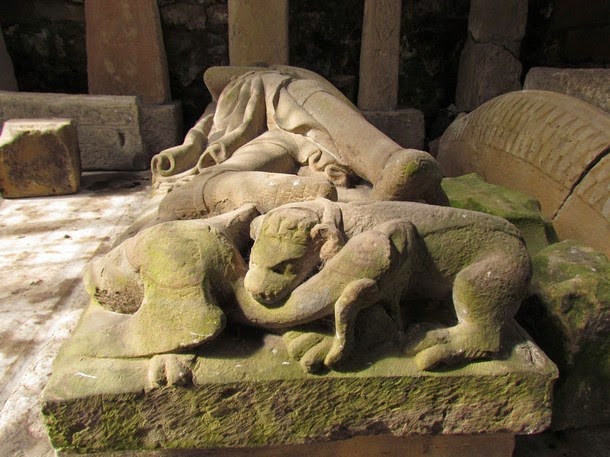
The Sockburn area is the seat of Conyers family, and according to old manuscripts this noble house was founded by one Sir John Conyers, who lies buried at Sockburn church. And while most of the church is now in ruins, a portion known as the Conyers Chapel is still standing and the tomb of Sir John, complete with his effigy in full armour, can still be seen there. And a further relic can be seen at the Treasury of Durham Cathedral - Sir John's own falchion. Originally housed at Sockburn Hall, until the late 18th century the falchion was used in a ceremony when a new Bishop of Durham entered the bishopric for the first time. The Lord of Sockburn would present and hand over the falchion to the newly appointed bishop on the bridge at Croft. This little ritual symbolised the noble family recognizing the authority of the incoming Prince-Bishop, and while there are many similar historic customs where a token is passed to show fealty to a ruling authority, in this case the falchion was more than a symbolic prop. For this ancient weapon was the foundation on which the nobility of the Conyers family was built upon.
Historians believe that the Conyers originally came over to England during or just after the Norman conquest of 1066. However the family were not ennobled and granted lands until several centuries later, at some point between 12th or 14th centuries. However according to tradition, it was Sir John who won these honours. For back in those dark days, a monstrous worm was ravaging the lands of Sockburn, devouring both livestock and people. The Sockburn Worm was not only highly ferocious and but it was also very toxic, for like many European dragons, rather than breathing fire, its breath and bite were lethally poisonous. Sir John, then just a humble knight, undertook to challenge the beast. What happened is documented in the Bowes Manuscript -
Sr John Conyers, Knt. slew yt monstrous and poysonous vermine or wyverne, who overthrew and devoured many people in fight, for that ye sent of yt poison was so strong yt no person might abyde it. And by ye providence of Almighty God this John Connyers, Kt, overthrew ye saide monster, and slew it. But before he made this enterprise, having but one sonne, he went to the Church of Sockburne in compleate armour, and offered up yt his onely sonne to ye Holy Ghost. yt place where this great serpent laye was called Graystane; and as it is written in ye same manuscript, this John lieth buried in Sockburne Church in compleat armour before the Conquest.
So then the Conyers gained their lands and title from Sir John slaying the Worm of Sockburn, and indeed it is the brave knight's falchion that we see on the coat of arms of the Borough of Darlington. And while the Conyers family is long gone, the custom of handing of Sir John's falchion to the new Bishop of Durham was revived in 1984, with the Mayor of Darlington handing over the ancient blade and intoning the time-honoured words -
My Lord Bishop. I hereby present you with the falchion wherewith the champion Conyers slew the worm, dragon or fiery flying serpent which destroyed man, woman and child; in memory of which the king then reigning gave him the manor of Sockburn, to hold by this tenure, that upon the first entrance of every bishop into the county the falchion should be presented.
The Conyers Falchion
However was there ever really a Sockburn Worm, and if so what exactly was it? Some historians have suggested that the beast was a symbol for Viking invaders, and that Sir John actually slew a ferocious marauding Norseman. The theory goes that the worm legend was inspired by the carved dragon heads that adorned Viking long ships. However as the Northern counties abound with first hand accounts and handed down tales of such raids, it seems unlikely that in this case Viking pillagers should be transmogrified into a reptilian monster. And then there is also the additional problem that Sockburn, Croft and Darlington are a fair way from the seas, around twenty-five miles away in fact.
Furthermore we should not jump to the conclusion that the Worm was a dragon. Now the account quoted above uses the term 'wyvern' which refers to a specific type of dragon - namely one with wings and two legs. And indeed this is how the Sockburn Worm is often depicted, for example it is seen on the Darlington coat of arms. However this classification comes from 17th century heraldry rather than folklore. And while the manuscript account quoted above is thought to have been written in 1600s, the tale is prefixed by the author stating that "In an ould Manuscript wh I have sene of ye descent of Connyers, there is writ as followeth..." Therefore "wyverne" is very likely to have been used in an older sense of the word, one derived from Middle English, in which it meant simply "viper".
And considering the serpentine forms of other Northern Eastern monsters, and indeed many British dragons, it would seem likely that the original tale is speaking of a monstrous serpent rather than a winged and clawed traditional dragon. Indeed when one considers the accounts of these monstrous worms found all across Northern Europe, which are all are oddly consistent with each other, it is tempting to wonder if there is perhaps some truth behind the old tales... However that is a subject for another day.
Whatever the true nature of the Worm of Sockburn, the beast has sired some notable spawn. Firstly after the Conyers line died out, the Sockburn estate came to the hands of the Hutchinson family. And in 1799, Thomas Hutchinson and his family had some famous visitors come to stay, the poets William Wordsworth and Thomas Coleridge. It would prove to be a memorable stay for all concerned - Wordsworth fell in love with Mary Hutchinson, who he would married in 1802, and Coleridge found romance with her sister Sara. In his ardour for Sara, Coleridge wrote the poem
Love and both drew inspiration from, and made allusions to, the local legend and the effigy of Sir John in the chapel.
However this isn't the only literary progeny of the Sockburn Worm, for about forty years later another literary luminary was in residence in the district. In 1843 a new clergyman and his family took up residence in the rectory at Croft-on-Tees, and the eldest son, then eleven years old, was one Charles Lutwidge Dodgson - a boy who would grow up to follow in his father's footsteps as an Anglican deacon, but also become a noted mathematician, a logician, a photographer and ultimately become better known to the world as Lewis Carroll, author of the
Alice in Wonderland books.
Dodgson remained very fond of Croft and the North East, and often came back to stay for long periods throughout his entire life. And it was on one such trip back to Croft in 1855 that he penned a short poem that he entitled
Stanza of Anglo-Saxon Poetry. It went like this...
Twas bryllyg, and ye slythy toves
Did gyre and gymble in ye wabe:
All mimsy were ye borogoves;
And ye mome raths outgrabe
...And I'm sure that most of you will recognise those lines. For a little later Dodgson was to expand this verse, one that would eventually appear in Alice's second round of adventures -
Through the Looking-Glass (1871), as the classic poem
Jabberwocky.
The Jabberwock by Sir John Tenniel
Now over the years it has often been thought that given Dodgson's love of the North East,
Jabberwocky, must have been inspired by the tale of the Lambton Worm. However it is now generally agreed that the legend of the Sockburn Worm is most likely the sire of the dreaded Jabberwock. Firstly while the beast itself, now one of the famous monsters of literature, is clearly a draconic horror, and may appear to be different from the Sockburn Worm, it is consistent with the later wyvern depiction that Dodgson would have been familiar with.
Furthermore however this celebrated piece of nonsense poetry has the hero slaying the Jabberwock with a special sword, a vorpal blade. This clearly parallels Sir John and his falchion, whereas the Lambton Worm required a more arcane means of disposal. Finally of course, given Dodgson's close association with the church and Croft, he would have certainly known the Sockburn legend. Indeed when the Dodgson's' took up residence at the rectory, the last falchion ceremony would have still been within living memory. Interestingly Carroll scholars have suggested that 'vorpal' is an amalgam of 'verbal' and 'gospel' - an allusion perhaps to Sir John's prayers and pact with the Lord to gain victory over the beast?
The final clue to the Sockburn link is perhaps the most obscure, but is also possibly the most interesting, for it sheds a new light on the literary nature of Jabberwocky itself. This hint lies in the title of the seed version of the poem - Stanza of Anglo-Saxon Poetry. For while most writing on the Sockburn legend these days dates the tale to around the 14th century, based upon the real Sir John Conyers dying in the early 1400s, accounts in books from Dodgson's era mention that it was then believed that the events of the tale occurred far earlier. For example, Bulmer's History and Directory of North Yorkshire published 1890 has this to say on the dating of the Sockburn Worm story -
This story, as handed down by tradition, is very much out of harmony with the recorded facts of chronology. The ancestors of the Conyers came to England in the train of William I., at the time of the Conquest, and an effigy, said to be that of Sir John Conyers, the hero of the Worm story, now in Sockburn Hall, whither it was removed at the demolition of the old church, represents a crosslegged knight of the 13th century, clad in chain armour, with his feet resting on a lion engaged in a deadly conflict with a winged worm or griffin. But the exploit, according to the tradition, occurred before the Conquest.
And so, suddenly the title of the original short poem suddenly makes a lot more sense. Whereas we think of the Sockburn Worm as a medieval story, folks of Dodgson's time considered it a legend from the Dark Ages. And in this light we can clearly see the nonsense language of Jabberwocky, rather than being just linguistic tomfoolery, is also a deliberate echo of the archaic spellings, phrases and cadences of pre-modern English, not dissimilar the kind of language found in the original account, recorded in the Bowes Manuscript. Many of Carroll's poems are deliberate parodies of other poems, and so considering the Sockburn inspiration for Jabberwocky, it is possible that the nonsense wordplay of this famous poem is in fact a humorous approximation of the tongue of the Dark Ages, a form of speech halfway between Middle and Modern English.
All in all then, whilst it remains one of the lesser known British dragon stories, the old Sockburn Worm has proved to be a most remarkable monster, inspiring literary greats such as Coleridge and Carroll and fathering one of the great legendary beasts of literature. Long may it continue to burble in the tulgey wood and seize our imaginations with its claws that catch!
Effigy of Sir John Conyers at Sockburn Church, with a dragon at his feet
A reading of Jabberwocky by Mr Jim Moon